This site uses cookies to offer you a better browsing experience.
Find out more on how we use cookies in our privacy policy.

 
Support The New Mithraeum The New Mithraeum is an independent, non-profit project dedicated to Mithraic studies, ancient religions and classical culture. Developed and maintained independently since 2007, the site exists without advertising, paywalls or institutional funding. If you have found value in its articles, interviews, photographs or database, please consider supporting the project with a contribution. Every contribution helps keep The New Mithraeum open, free and alive. Thank you.
Support us →
Monumentum

Rock Mithraeum at Kreta

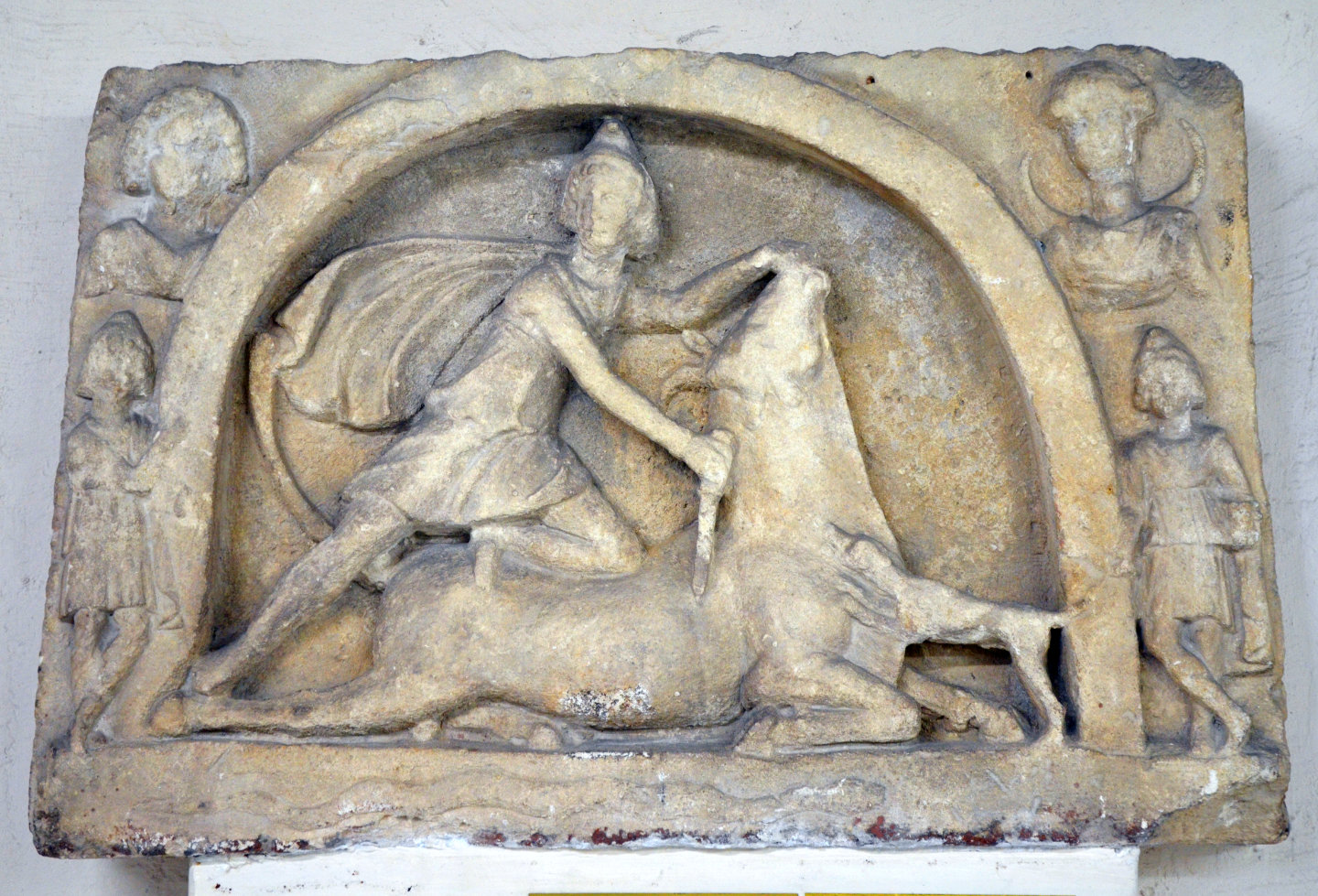
Mithraic sanctuary excavated in a quarry at Kreta near Nikopol, Moesia Inferior, carved into the rock and including a small niche with a sandstone tauroctony relief, a base, and several altars.
 
The New Mithraeum
27 May 2026

TNMM 2016 ↔ CIMRM 2256

Near the village of Kreta (distr. Nikopol), 12 kmtrs south of the Danube and on the r. bank of the Vit (Utus) there are stone-quarries which were already used in Antiquity. In the quarry of Veliko Iwanow, situated at a distance of 2 kmtrs. west of the village, a Mithraeum was excavated in 1933. The finds are in Sofia, National Museum.

Welkow in La Bulgarie IX, 1935 col. 3055, 30; BIAB VIII, 1934, 82ff; Kazarow in Germania 1935, 25 No. 2.

The Mithraeum has been hewn out in the rock (H. 1.80–2.00 L. 7.00 Br. 6.00) and its floor is 2 mtrs. above ground-level so that there may have been steps. The southern part is now destroyed; on the north side the sanctuary is enlarged by a construction of stoneblocks. A large niche (H. 1.75 Br. 3.00 D. 0.50) is made in the east side of the grotto and in it a smaller niche (H. 1.30 D. 0.15) with the cult-relief. In the border of the niche letters are discernible but only an A is legible.

Before the niche is a space with a large step and before the relief is a stone water basin (H. 0.30 Br. 0.36 D. 0.25). A stone arm-chair (H. 0.15 Br. 0.30) is placed against the west wall. Only from this side could the light penetrate, but stone rings attached to the vault point to an illumination by means of oil-lamps.

References

Back to Top