This site uses cookies to offer you a better browsing experience.
Find out more on how we use cookies in our privacy policy.

 
Monumentum

Mitreo de Lugo

The exploration of an old pazo, a manor house, near the Roman wall, in Lugo, led to the discovery of a Roman domus, which existed continuously from the beginnings of the Christian Era until the Late Empire.
1 / 3
 
The New Mithraeum
20 May 2007
Updated on Jan 2025

TNMM 27

The exploration of an old pazo, a manor house, near the Roman wall, in Lugo, led to the discovery of a Roman domus, which existed continuously from the beginnings of the Christian Era until the Late Empire. Part of this domus was remodelled to create a room identified as a Mithraeum dated to the early 3rd century A.D. Around 260 A.D. the domus was almost completely destroyed in the course of re-building the city wall. Nevertheless the Mithraeum remained in use for a further 60 years or more. The shrine seems therefore to have been constructed at the beginning of the 3rd century and have continued in use as a religious centre for its community until the mid 4th century.

The structure is rectangular, some 15.7 m long x 7 m wide, with a central corridor bordered on each side by five equidistant pillars of uncertain height. It is plausible to suppose that they supported the lateral podia which served as triclinia for the members of the community.

Between the fourth and fifth pillars from the South wall (where it can be assumed that the entrance was, facing the now lost cult-niche), two parallel walls narrow the central aisle. Other evidence, to be described later, makes it clear that the main ara was located on this platform. Behind it was probably located the cult-niche with a statue or relief of Mithras killing the bull, but there are no archaeological traces of it because of the intrusion of modern building work. The main door was probably located in the façade opposite the niche, as usual, but no remains of it could be located, just some structures identified as a sort of a narthex or ante-room. The superficial area of the cella is around 110 sq. m, but some of the adjoining rooms may have belonged to the same complex for ritual purposes or service needs.

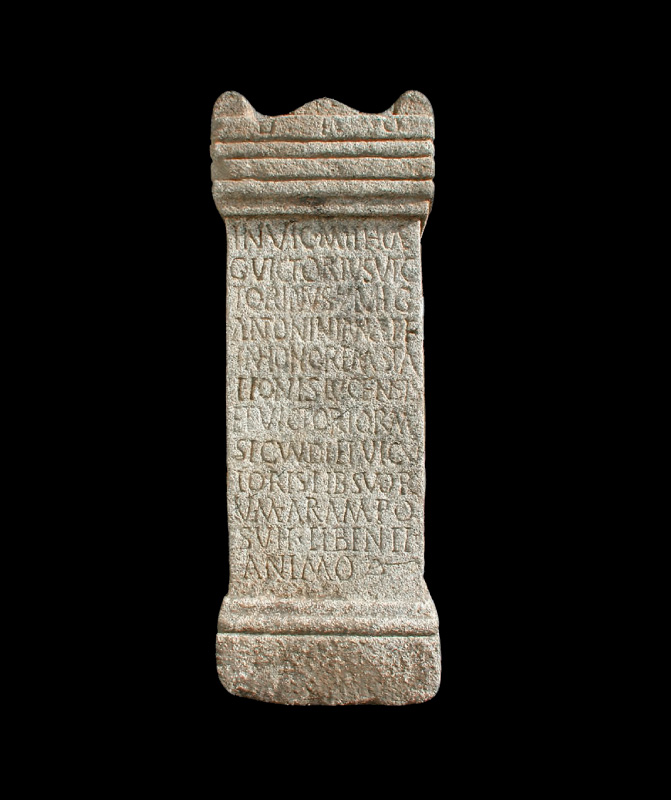
Inside the shrine two inscriptions were found.

Related monuments

Ara of the Mithraeum of Lugo

Victorius Victorious, centurion of the Legio VII, erected the altar in honour of the Lugo garrison and of the Victorius Secundus and Victor, his freedmen.

 
Back to Top