Tauroctony from Santo Stefano Rotondo
TNMM 365
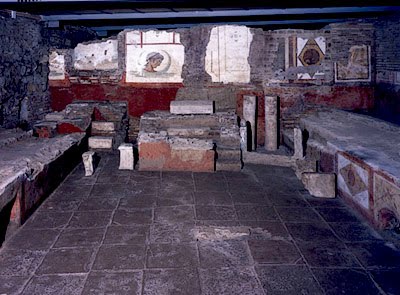
At the altar and in the space between the altar and the west podium were found the pieces of a remarkable polychrome of the tauroctony (n.inv. 205837). 0.905 m high, 1.48 m wide, the frame often 6 cm wide. Between the head of Mithras and the head of the moon is the mark of a strong blow with a blunt instrument, presumably at the time of the destruction of the Mithraeum. Part of a leg of the quadriga of Sol, and part of Sol’s face, is missing. The relief falls within the type 1 representation of Campbell.
At the top left is the quadriga driven by Sol, wearing the corona radiata. He is wearing a short cloak that covers his chest and swells out behind him. He has the globe in his left hand, and holds the reins with his right.
At the top right is the chariot of the moon, drawn by two oxen. Luna, wearing a sleeved chiton, has the crescent moon behind her. She holds the reins with both hands. In front of her, above the chariot, hovers Hesperos, dressed in a cloak that covers the chest and swells behind, hands raised, and face towards Luna.
At the lower left is Cautes, in a tunica manicata (sleeved tunic), his cloak held on the right shoulder by a circular fibula. The cloak falls behind him. The rooster is at his feet.
At the lower right is Cautopates, similarly dressed, facing away from Mithras. At his feet is a bird, which should be interpreted as an owl.
Mithras plunges the knife into the bull, holding it by the left nostrils. Also wearing a sleeved tunic, anaxyrides and cloak fastened with a circular brooch on the right shoulder. Perched on Mithras’ cloak, just in front of the heads of Sol’s horses, is the raven. Below the bull, as usual, are the scorpion, snake and dog.
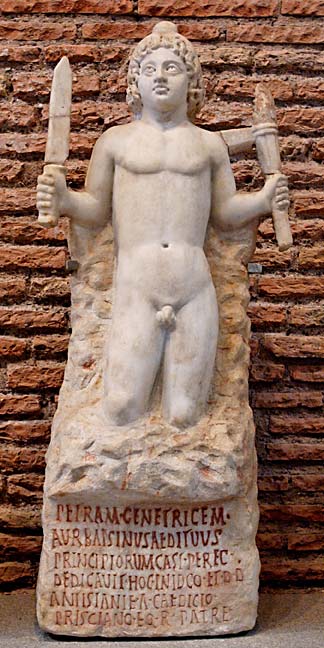
There are two unusual features to the relief; the presence of Hesperus hovering in front of the moon, and of the owl at the feet of Cautopates. Hesperus also appears in a relief in the Louvre, originally from Rome, depicted as a child with two torches in his hands, rushing headlong before the moon; and also in the Osterburken relief in the Badisches Landesmuseum at Karlsruhe. But the depiction of Hesperus flying before the moon is quite common on sarcophagi, such as that with the Capitoline divinites in the Ducal palace in Mantua.
The presence of the rooster at the feet of Cautes has been noticed elsewhere, but the presence of the owl at the feet of Cautopates is a first. However the Cautopates at Rusicade probably also has an owl at his feet, and an owl appears in the mosaic of the animals at Ostia. The owl represented darkness, as the rooster represented light.
The preservation of the colours, more than any other relief known, also makes this an important relief.
The abundant use of the drill in the treatment of hair and fur, and a widespread flattening of the figures allows us to date the relief to the end of the 3rd century A.D.
The relief was probably positioned behind the altar and in front of the cult niche.
References
- Roger Pearse (2014) CIMRM Supplement - Mithraeum. S.Stephano Rotondo / Castra Peregrinorum, Rome.