A Man of the Gods and Mysteries. On Vettius Agorius Praetextatus
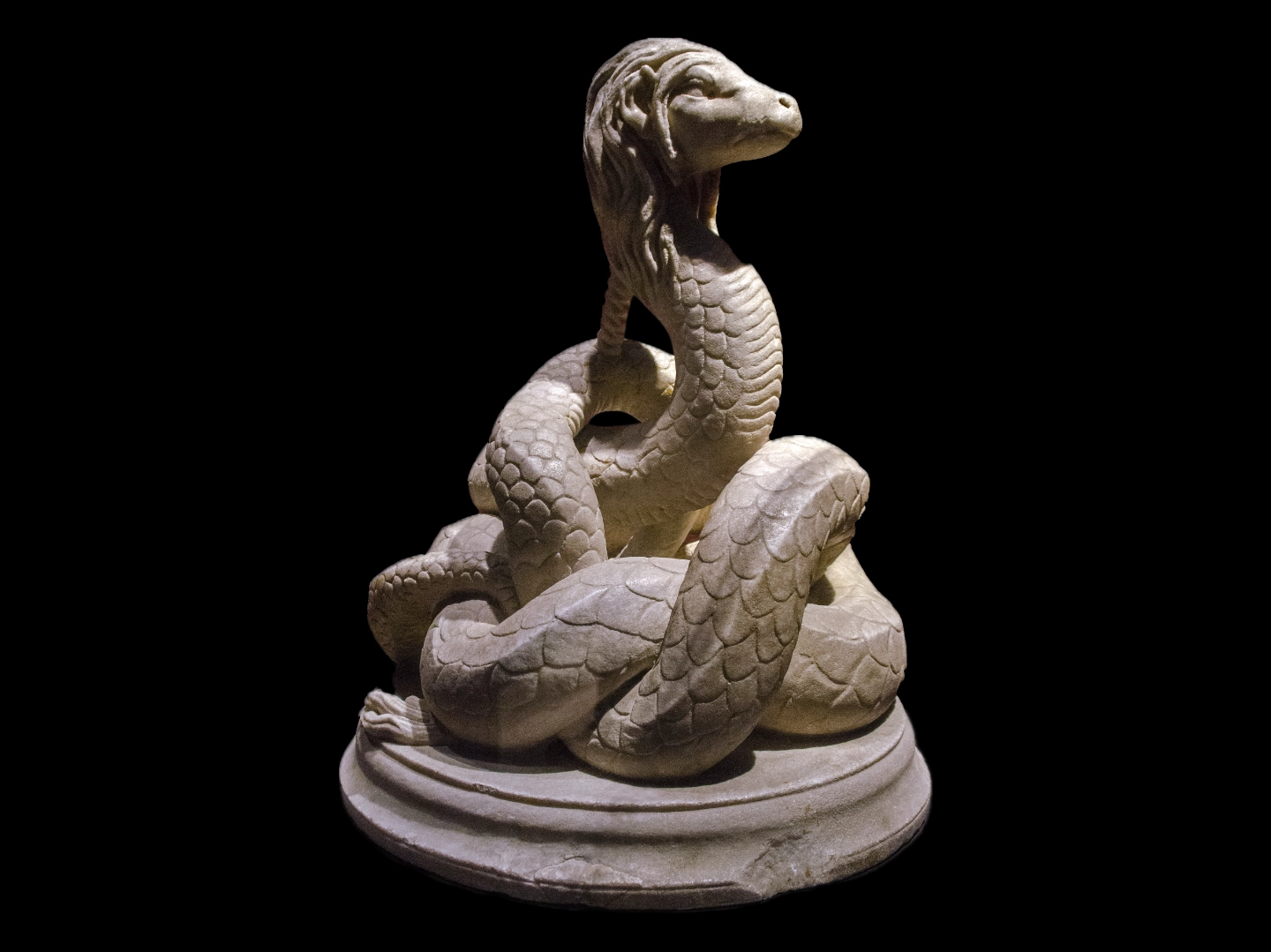
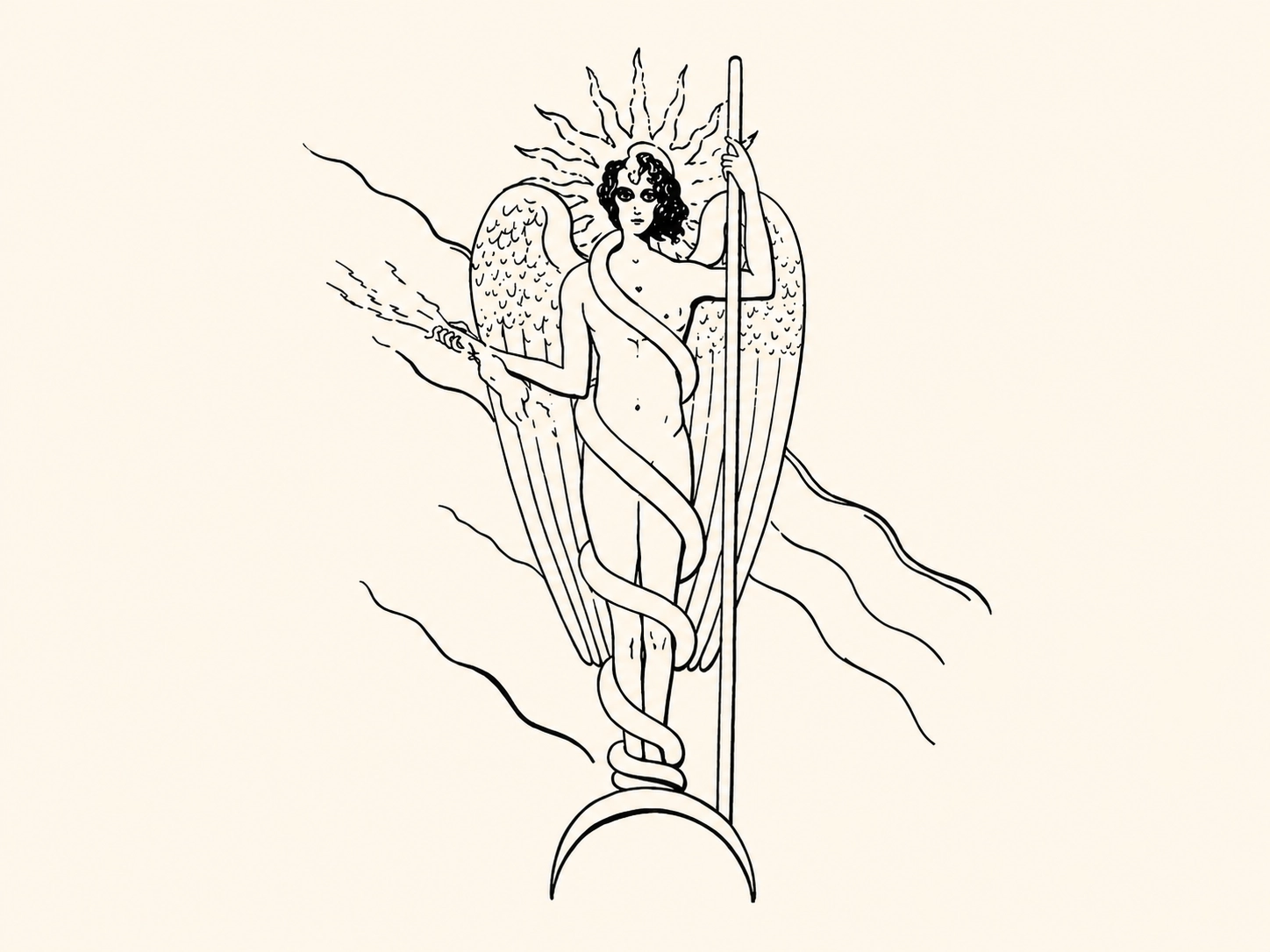
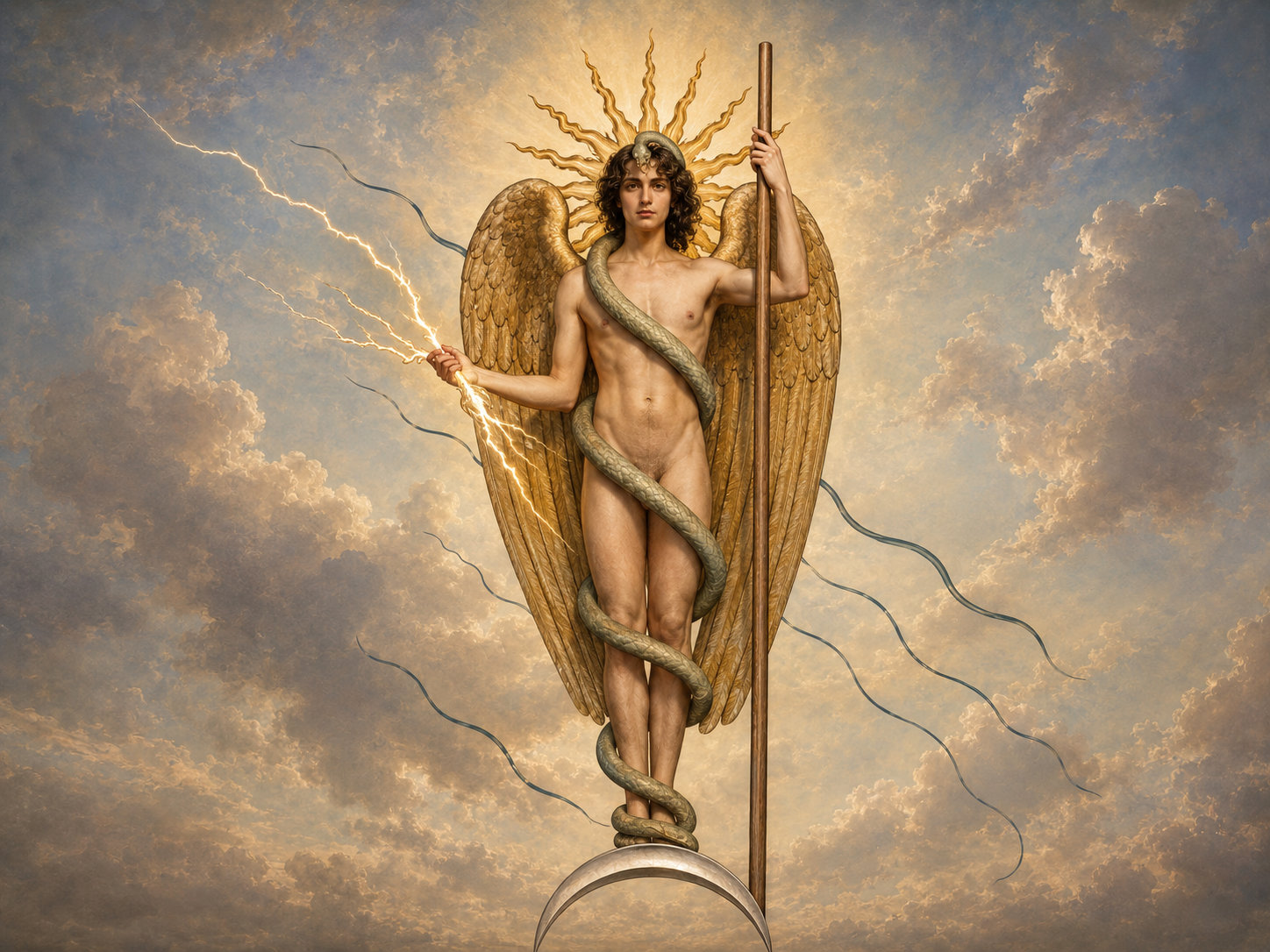
Figure of the snake god Glycon, 2nd century CE.
Ángel M. Felicísimo from Mérida, España / via Flickr, CC BY 2.0
As an entry point and invitation, I would like to invite you to consider this definition of the virtue of humanitas I value most highly—one from which I believe all other virtues naturally follow:
Humanitas: A perfectly balanced proportion and ratio of elements intrinsic to the human species—its nature, its bestiality, and its idyll—manifested in the highest virtues of civilization, proven great through their enduring effects upon the world of nature, men, and Gods. It is the mature individuation of the human spirit, souls, heart and mind both in solitude—unbent, undefeated by seclusion—and in society, as an active participant forging a bond between mankind, nature, the cosmos, and the divine. This bond is realized in its proper relation, ratio, ethos, and interaction, striving toward the highest reaches of possibility, ability, and merit, according to the talents of both individual and society.
If humanitas is the harmonization of the human spirit within society, nature, and the divine, then the lives of exemplary figures—those who embody civic virtue and sacred knowledge—offer the clearest manifestation of this principle. One such figure is Vettius Agorius Praetextatus, whose intellectual and spiritual leadership in late antique Rome provides a living exemplar of humanitas in practice.
WHO was the leading light and intellectual glory of the pagan aristocracy, the shining star of its testimony at the dawn of an epoch? We know for certain that Praetextatus was older than Symmachus (340–402) and Virius Nicomachus Flavianus (334–394). We may speculate that he was born in Rome around 324 and lived until 384, thus being sixty years old at the time of his death. Another hypothesis suggests a birth date between 310 and 320.
He was married to Paulina for forty years, most likely his only and first wife. Roman senators usually married between the ages of 20 and 25. He belonged to the Vettii family, attested in sources from the late second to the early fourth century, probably originating from Africa Proconsularis, though this is uncertain.
His roots reach back to the noble “agori, superbo qui creatus germine” from Paulina’s funerary poem referring to Praetextatus. Most likely his father was C. Vettius Cossinus Rufinus, since he held the same titles as Praetextatus later did: corrector of Tuscia and Umbria, proconsul of Achaea, pontifex of Sol, and augur. Sons often inherited sacred offices from their fathers.
His wife, Fabia Aconia Paulina (of the Aconii family), daughter of Aco Catullinus Philomathius—urban prefect from 324 to 344 and consul in 349—married Praetextatus around 349. They remained married for forty years until his death. Their daughter Praetextata died early along with her husband, giving St. Jerome the pretext to claim that this was “punishment from the Judeo-Christian god.”
They were a wealthy family, possessing estates on the Esquiline and Aventine hills (once a plebeian district, later a fashionable residential area for pagan and Christian aristocrats), as well as properties in Baiae and Etruria. There is speculation they also owned estates in Crete. We do not know whether Vettius was an extremely wealthy senator owning latifundia—small kingdoms with senatorial residences, hippodromes, forums, shrines, fountains, and baths, miniature cities. Latifundia expanded throughout the imperial period, forming self-sufficient economic units and socially independent domains.
At that time only a few senators resided in Rome; by 356 their number was fixed at only fifty, after which they were permitted to reside wherever they wished. Praetextatus is mentioned by John Lydus as participating in foundation rites, polismos, with Sopater Teletes of Constantinople around 330, acting as hierophant in ceremonies associated with January and the god Janus—traditional rites of city founding. Constantine served as imperial judge, Praetextatus as pontifex (Pontifex Vestae or Pontifex Maior), and Sopater as augur. Praetextatus’ presence as pontifex was essential during foundation rites. The ritual transport of the palladium—the foundational stone or consecrated image of a god or goddess—was crucial. These rites were not explicitly pagan and were still regarded as traditional ceremonies.
Understanding Praetextatus’ civic and religious roles requires examining the formal structures of Roman sacred offices. The pontifical duties he held—ranging from Pontifex Vestae to augur—were not ceremonial alone but integrated him into the divine ordering of the city, demonstrating how human virtue and societal responsibility intersected in tangible ritual practice.
Defining the word “pagan,” an initially pejorative term, Christians first used “pagani” or “gentes” (Ta Ethne in Koine Greek) for non-Christians. The term paganus (villager, rustic peasant) first appeared in legislation in 370 but became widespread only in the fifth century. Pagans themselves called their class “Nobilitas,” meaning “nobility,” just as the Hellenes called themselves “civilized,” in contrast to “barbarus,” the uncivilized. To the Nobilitas, Christians appeared as uncultured barbarians devoid of reason, intellect, and heroic virtues—a mass of zealous destroyers. In the East, “pagans” were simply adherents of the old cults without a dismissive tone; in the West they were regarded as a group outside Christian society.
Now a digression that is valuable and instructive: what is consecration, what are foundation rites? Inauguratio, consecratio, dedicatio. It is a process of integration into the divine domain by the will of the gods or of humans themselves. “Consecrated objects were regarded either as divine property or as standing in a certain relation to a god and thus sharing in its supernatural substance and energy.”
The Greek term corresponding to consecration meant “I make this sacred.” Human will and action achieved consecration through dedication, offering, and entrusting an object to a deity. Every object offered to supernatural forces was an act of consecration. “Telein” meant “to complete a sacred act.” With the spread of magic, incantations, and oriental cults, “Teletike” came to refer to a set of instructions for achieving consecration. In Rome, consecration was more formal than in Greece, though the general approach was similar.
“Consecratio” differed from “dedicatio.” Consecratio meant transferring an object into the domain of a deity as res sacra under the protection of the state (while res religiosa referred to private consecration not belonging to the state). Dedicatio meant surrendering an offered object to a deity in order to obtain divine approval for the act. Dedicatio was performed by a high official or an officially appointed private person. The pontifex presided over consecratio.
These two procedures were combined: a magistrate consecrated by the pontifex and a pontifex consecrating. The pontifex recited the text of consecration, which the official repeated while touching the building being consecrated. Private dedication also required state involvement for purposes of consecration. From a legal standpoint, consecration of land and buildings was possible only in the Ager Italicus, not in Roman provinces, meaning res sacra was not recognized there. Inauguratio was the ritual preceding temple consecration, including divination in selecting the site, defining the boundaries of sacred space, purification rites (exauguratio or evocatio to remove a prior presence from the place), and prayers concerning the sanctuary’s limits.
These rituals illustrate the depth and complexity of pagan religious practice—an intellectual and spiritual system that would later come under critique and transformation by Christian authorities. Understanding these rites clarifies the strategies by which Christian writers such as Jerome and Augustine appropriated, inverted, or dismissed earlier traditions.
Jerome, a Christian writer, held a hostile and malicious attitude toward our subject. He mentioned Vettius in two letters and in the pamphlet Contra Ioannem Hierosolymitanum written to Pammachius. He also criticized Rome as a whole and Bishop John of Jerusalem in 397. Jerome was an aggressive figure with ignoble intentions, attacking only great men he could never equal.
“Praetextatus was too great a figure for Jerome to ignore, and his death caused such sorrow that Jerome could not restrain himself and attacked a figure beloved by the people and the aristocracy.” Jerome slandered Praetextatus, calling him “miserabilis Praetextatus” and “homo sacrilegus et idolorum cultor.”
Aurelius Symmachus, friend, rhetorician, and the most eminent orator of his time, presents Praetextatus as a virtuous man and an outstanding judge of the Res Publica. The historian Ammianus, mentioning him three times in Res Gestae written in the 390s, portrays Praetextatus as “a senator of distinguished character and ancient dignity,” who acted honestly and reliably from early youth, “through numerous acts of integrity and probity for which he became renowned from the first beginnings of adolescence.”
Macrobius, fifty years after Praetextatus’ death, in a work probably written around 430, presents him as almost superhuman in calmness, gentleness, and gravity. He depicts him as the intellectual leader of the Roman senatorial Nobilitas, possessing unquestioned authority in religious matters—“princeps religiosorum, sacrorum omnium praesul”, “the one uniquely conscious of all sacred things.”
Zosimus, in his Istoria nea (fifth century), described Praetextatus as a supporter and defender of Hellenic cults in Greece. A hierophant called Praetextatus is mentioned by John Lydus in De Mensibus. Most likely Praetextatus was a resident hierophant at Eleusis and it is speculated that he was initiated by Emperor Julian into the Eleusinian mysteries—“a man distinguished in all virtues.”
Praetextatus led embassies of Roman senators when Emperor Gratian refused to accept the title Pontifex Maximus and possibly appealed for restoration of the Senate’s Victory statue, also influencing Symmachus’ famous appeal for religious tolerance in his third relatio. He may have introduced Augustine—later a saint—to the “Platonic books,” after which he was attacked in Gentiles antiquarii in Dissertatio Maximini contra Ambrosium as a man of “monstrous vanity” because of his greatness and generosity toward Augustine.
Choice of religious affiliation was a crucial element in the appointment of high offices in the fourth century, despite aristocratic networks of amicitiae. Loyalty to class and senatorial culture often preceded religious identity and it is important to remember than in many civilized cases Galileans coexisted with their traditional pagan friends peacefully.
Fragments of the Theodosian Code refer directly to Praetextatus as Praefectus Urbi and Praefectus Praetorio. Emperor Valentinian addressed several letters to him when the bishops Damascius and Ursinus were embroiled in dispute. Himerius delivered a panegyric to him when he was appointed consul of Achaea by Emperor Julian, though this text has unfortunately been lost.
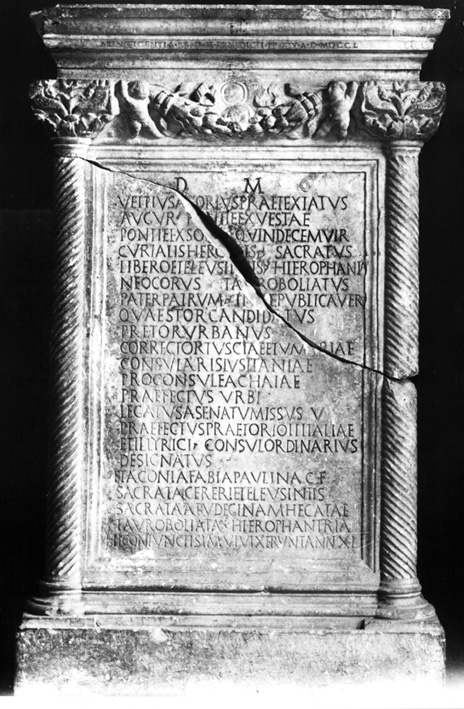
Archivum Corporis Electronicum | CIL search result for “CIL VI 1779” — The web interface of the Corpus Inscriptionum Latinarum (Archivum Corporis Electronicum) at the Berlin-Brandenburgische Akademie der Wissenschaften allows searching for CIL inscriptions by number; a query for CIL VI 1779 returns the relevant entry in the online database.
To the Spirits of the Dead (Dis Manibus)
Vettius Agorius Praetextatus, augur, Pontifex Vestae, Pontifex Solis, member of the quindecimviri sacris faciundis, curialis sacred to Hercules, hierophant of Liber and the Eleusinian mysteries, neocorus and tauroboliatus, father of fathers in the res publica, quaestor candidatus, urban praetor, corrector of Tuscia and Umbria, consularis of Lusitania, proconsul of Achaea, praefectus urbi, envoy sent by the Senate, praefectus praetorio of Italy and Illyricum, ordinary consul, designated consul, and Aconia Fabia Paulina, most illustrious woman, consecrated to Ceres and the Eleusinian mysteries, consecrated to Hecate at Aegina, tauroboliata and hierophantess—these two joined together lived forty years in union.
Vettius Agorius Praetextatus, husband of Paulina, devoted to his wife Paulina, conscious of truth and chastity, dedicated to the temples and friendly to the divine powers, preferring his wife over Rome, modest, faithful, pure in mind and body, benevolent to all, useful to the household gods, now seated with the celestial powers forever.
Vettius Agorius Praetextatus, husband of Paulina, partner in the affections of our hearts, the spark of modesty and chastity, pure love and faith planted in heaven, the secrets of my mind entrusted to him, entrusted by the gods who join the marital couch with bonds for friends and the chaste, through maternal piety and conjugal grace, through the modesty of sister and daughter, and by the trust with which we join friends, consecrated in the practice of age, united in faithful and simple concord, aiding and honoring the diligent husband.
The splendor of my parents gave me nothing greater than that I was deemed worthy of my husband; yet all light, honor, and the name of my husband, Vettius Agorius, proud from birth, illuminate the fatherland, the Senate, and his wife. By integrity of mind, morals, and studies, he attained the highest peak of virtue. Whatever has been produced in either tongue, whether by learned minds or the songs of experts, or expressed in free speech, he renders better than one could have imagined. Yet these things, small as they are, you, dutifully attending the sacred rites and mysteries, pursue with the secret of your mind and reverence the manifold divine powers, kindly joining your wife in the sacred, conscious and faithful to both gods and men.
What honors or powers can I now recount, what joys sought by human prayers, which you, high priest adorned with fillets, always deem fleeting and small? You, my husband, through the benefit of disciplines, by fate preserving my purity and modesty even in death, lead me into the temples and present me as a servant to the gods; with you as witness, I am imbued in all mysteries. You, Dindymenes and Attes, priest of the rites, honor the taurobolia, faithfully sharing the mysteries of Hecate, revealing her triple secrets, and preparing me worthy in the sacred rites of Greek Ceres.
For your sake, all celebrate me as blessed and pious, for you yourself disseminate goodness. Throughout the world, unknown to all, I am recognized. For, husband, how could I fail to please you? Mothers of Rome seek an example in me, and if they imagine offspring resembling yours, they desire and approve. Now, both men and women honor the distinctions you have bestowed. With these gone, I, grieving wife, languish; I would have been happy if the gods had granted my husband to survive, yet I am happy in that I was yours, and I shall be so even after death.
Pearse, Roger. 2013. “The Monument of Vettius Agorius Praetextatus.” Roger Pearse Weblog, February 19, 2013. The monument of Vettius Agorius Praetextatus.
Kahlos, Maijastina. 1994. “Fabia Aconia Paulina and the Death of Praetextatus: Rhetoric and Ideals in Late Antiquity (CIL VI 1779).” Arctos – Acta Philologica Fennica 28:13–25. https://doi.org/10.71390/arctos.86778.
Posthumous poetry in honor of Vettius Agorius Praetextatus (310/320–384), possibly based on a funeral oration delivered by his wife, Fabia Aconia Paulina, emphasized his virtues, knowledge, philosophy, mysteries, and ethos—the ideal of married life in late antiquity among the aristocracy (pagans). Praetextatus often appears alongside Quintus Aurelius Symmachus and Nicomachus Flavianus as a spiritual leader and unifying force among fourth-century pagan senators. Symmachus, like the Roman people, held him in great respect and affection.
Ammianus Marcellinus, known for his criticism of senatorial morality, wrote that Praetextatus was a man of noble birth and ancient, traditional dignity. Macrobius, in Saturnalia, the last breath of a fading antiquity, places him at the head of the senatorial vanguard. He was a man devoted to literature, philosophy, and the mysteries. In 384 he was appointed consul, but unfortunately died before the new year began.
All Rome mourned his death. He was a pontiff of the Vestals, and after his death Symmachus, as prefect of Rome, opposed the Vestals’ desire to erect a statue to him, since this violated religious protocol. However, the chief Vestal, Coelia Concordia, secured its construction.
This man may be placed in complete superiority over the base attack of St. Jerome, who in one of his lamentable letters responded to Paulina’s eulogy with an abusive epistle, declaring:
Now that he is dead, he has not reached the heavenly palaces, as his wretched widow claimed, but has been cast into foul darkness.
In this way he opposed pagan immortality, attempting to appropriate heaven for the sects of the Galilean—emerging as Christians with a standardized doctrine established by the First Council of Nicea in 325 and approximately 220–318 bishops out of 1000–1800 forged a mint imperial religion among battling over what is a heresy and what is not, what is a divine ‘fact’ and what is not. In a letter to Christian women, Lea and another Paulina, St. Jerome—in a manner typical of Christianity’s trivialization and inversion of meanings—employed a simple device: slander of the opponent (diabole); reversal; distortion; and the elevation of his own group above all others. In such a manner any reasoned elite discourse could be defeated in the eyes of the uneducated, non-elite, and boorish.
The pagan virtues of Paulina and Praetextatus surpassed Christian virtues which already, paraphrasing the words of Emperor Julian in Contra Galileum,
took the worst from Judaism and Hellenism, and proclaimed it a triumphant value,
yet as with every Christian attack, content did not matter—only who authorized it. If goodness was associated with paganism, in the eyes of the Galileans it had to be renamed, profaned, and then imitated, signed under the religion of the Hebrew god—regardless of human cost and harm to the common good in the strategic long run.
Paulina was no “ordinary” woman; she was a priestess initiated into the Eleusinian, Lernaean, Dionysian, and Demeter mysteries, as well as into the cults of Isis (Isiaca), Hecate (Hierophantria), and the Great Mother (Tauraboliata). In all these cults Praetextatus stood as her witness before the deities, instructed her in ritual and theology, and prepared her for a worthy and meaningful initiation. Tertullian’s meaning of “sacrament” would translate to Greek mysteron, therefore not merely a military pledge and a sacred oath, but also an effective transmission into initiation that elevated the soul, mind, and heart of the practitioner in mystagogic soteriology, at least the ones that matched the demands of such a great office of the ethos and annointment to duty equaling the profundity of the initiation.
Hecate is known today chiefly as patroness of witches and magicians (practitioners of goetia, i.e., goes), yet it is often forgotten that in later middle Neoplatonic reinterpretation it was only one of her aspects—namely physis. Physis is understood not only as matter, but also as the chthonic, plutonic, subterranean, shadowed aspect of earthly, planetary, lunar, and cosmic depths of the underworld. Historically this aspect dominated in antiquity, until the evolution of Hecate as a Neoplatonic goddess who in the Chaldean Oracles of Julian the Theurgist appears as a teacher and instructor alongside Apollo, as Anima Mundi, the world soul in the triple form of Epipurgidia (gr. Ἐπιπυργιδία)—the watchtower, the axis of the world, which penetrates not only the material world but also the ethers and the divine, transcendent fire. The latter may be compared to the third teletarchic world—from the Protean Monad, through the second teletarchic universe, to the world beyond the suns, the Aeons, Hyperion, below which lie the phenomena of the created world, of which Helios in our solar system is the visible manifestation. This unveiling is marked and symbolized in Iamblichus’ Theology of Arithmetic.
The mediator between worlds in Neoplatonic theurgy is Hermanubis—a syncretic Hellenic-Egyptian being combining two powerful forces into one concentrated form. Such magical technology of combining, entwining, and aspecting forces was not a novelty, not depriving the separate ontologies of individuated masks of the Numen Multiplex, but instrumentally extracting the deified qualities in the reality-as-a-process in order to increase the conceptual and operational clarity during the teleology of understanding and theurgy. Thus Hecate should be regarded as the world soul, which in the Chaldean Oracles fulfills both a soteriological and cosmogonic, generative role—embodying all souls of the universe.
How does it relate to Mithraism?
Who was the draconic mediator, the liminal power guiding the initiate across the threshold of worlds? How did Hekate as δράκαινα—the dragoness—connect with the esoteric language of Mithraic initiation, and why does her presence resonate in the cosmology of the mysteries? We know that Hekate’s worship persisted in multiple, overlapping strands of the late antique religious landscape, from Arcadia to Asia Minor, from Athens to Rome. She was invoked as the triple goddess, the guardian of crossroads, the mistress of liminal space—and, in many papyri and magical texts, explicitly as the dragon-headed or draconic figure: τὰ δὲ φάσματα αὐτῆς δρακοντοκέφαλοι ἄνθρωποι. This is no mere metaphor; it is an ontological marker of initiation, a symbolic axis bridging the human and the chthonic, the mortal and the divine.
The Mithraic mysteries operated within a similar register. The initiate progressed through the seven grades—each assigned animal or relational designations which encoded spiritual transformation and cosmic orientation. The grade νυμφίος, in particular, signals the neophyte freshly admitted into the esoteric sphere, analogous to the νύμφη δράκαινα of epigraphic sources. Here, the draconic image is not demonic, nor merely decorative; it signifies threshold mastery, the ability to traverse intermediate realms under the guidance of a mediating power, whether the sun-born Apollo, the world-soul Hekate, or the bull-slaying Mithras.
Neoplatonic theurgy and Chaldean Oracles reinforce this paradigm. Hekate as the world soul, as the chthonic axis, occupies the same ontological function as the serpent coiled around the Mithraic Aion: both are mediators of liminality, guides through successive layers of cosmic reality, and guardians of secrets that structure the initiate’s ascent. Hermanubis, in turn, exemplifies the syncretic logic: combining powers into a unified, operational form to increase clarity in ritual work. Just as Hekate is draconic, Hermanubis is hybrid; both embody the principle that the numina may be instrumentally entangled to produce soteriological and cosmological insight.
In Mithraism, initiation is a regulated ascent through cosmological grades; in Hekatean mystery, the drakaina embodies the mediating principle guiding neophytes. The νύμφη δράκαινα is both initiate and operator, simultaneously representing status, spiritual potential, and cosmic function.
A comparative survey of late antique and imperial cultic evidence complicates any monolithic reading of the “dragon” as a purely negative symbol. Within Hellenistic and Roman religious environments the drakōn functioned across a wide semantic field: apotropaic, chthonic, initiatory, and soteriological. The most explicit case is the prophetic and mystery cult of Glykon in Paphlagonia (second century CE), organized around the epiphanic manifestation of a great serpent with anthropomorphic features, accompanied by initiatory rites, temple institutions, and oracular practice. Its ritual dramaturgy—including the staged birth of the serpent—demonstrates how fear-inducing imagery could be ritually transvalued into salvific symbolism.
Analogous serpentine elements appear in Dionysian-Sabazian initiations, in gnostic serpent-venerating groups (e.g. Ophites), and in epigraphic dedications from the Balkans, Rome, and Roman Africa, where draconic figures are invoked in clearly cultic contexts. The recurrence of serpent terminology in Greek technical religious vocabulary—often preserved even within Latin inscriptions—suggests the persistence of an esoteric lingua sacra shared across otherwise distinct initiatory communities.
Epigraphic expressions such as “dracena” or “drakaina,” when attached to personal titles, plausibly denote a cultic role rather than a mythological abstraction—perhaps an initiate, ritual functionary, or member of a serpentine mystery association. The conjunction of marital terminology with such titles recalls initiatory language in several mystery traditions, where nuptial metaphors articulated the transformation of the neophyte.
Hekate may be depicted in Masonic works as three hares chasing one another in a circle—a symbol often placed on churches and cathedrals, mistaken for the Christian Trinity. Such camouflage became necessary from the fifth to sixth centuries, when statues of Hecate were destroyed. Hecate was replaced at crossroads by the Levantine Mary—the mother of Jesus. For Christians it was intolerable that Hecate endured through the centuries—symbolized by the three hares, representing the three most distinct phases of the Moon as well as the tripartite nature of the world soul of Hecate. Souls escaping the world of physis (matter) first reached Selene, which in Greek meant “island of the blessed”; one had to break free from the iron grip of the chthonic dogs and demons of Hecate Physis and the violent tribes of the underworld and sub-lunar airy Hades, while the bow of Artemis symbolized harmony of tensions in opposition—perfectly balanced nature and a soul attuned for the blessed leap, and the arrow represented the soul of a master rising toward the heavenly spheres.
Perhaps, the seven heads of the dragon of Artemis, re-appropriated in this context and purged of negative content, symbolized the alchemical seven planetary crowns of the Chaldean order, and attaining them—aligning oneself with nature as Vir Unus, a solar man or lunar woman complete according to the measure of divine nature and the harmonic order of the astromagical solar system—opened the way to great cycles and stellar aeons. Thus the “beast” is the exalted human, it is the beast of the Solar God, and the “harlot,” paradoxically, is the divine woman, Aerotomis, she who cuts through the celestial spheres and Hades with an arrow through the ether.
Hecate was also identified with Hecate/Rhea—and Rhea was companion of Saturn as Rhea-Ops, that is Earth—the Lady of time, ruler of Olympus, meaning “Time” in the Orphic sense according to the Derveni papyri. In Mithraic belief Mithras symbolized solar energies but also old and new Saturn as the highest Chaldean planet—the ruler of temporal cycles of the solar system—which in the Sun–Saturn conjunction had a peculiar convergence with the cult of Orion–Abraxas–Osiris–Serapis. The soul of Hecate, the world soul, constitutes the foundation of mathematical proportion and cosmic harmony, because it consists of sameness, difference, and being. It is rational, possesses a divine and eternal source of intelligent life, is the crown of generations of co-intelligible worlds—eternal beings possessing reason and harmony—an entity in itself “coiling around itself,” intertwined with the serpent of Kronos—the Erebus of time.
The appropriation and erasure of pagan mysteries: Attis, Cybele, and the rise of Christian ritual authority
The priest of Attis responded to St. Augustine, who had angrily reacted to the accusation that Christianity openly appropriates earlier pagan traditions, by saying,
Et ipse pileatus christianus est.
And he himself, wearing the pileus [the headgear of the priest of Attis], is a Christian.
Jerome perversely transformed the title of the Phrygian Mother of the Gods into “mother of demons,” motivated by his peculiar malice. In antiquity, there existed a Christian practice of inverting the meanings of pagan mysteries, reducing them to the absurdity of Christian doctrine, and assigning them contemptuous names.
In this way, numerous Gnostic sects triumphed, their doctrines either ratified or condemned as heretical at the Council of Nicaea—not due to the superiority of their intellect, but through the trivialization of the higher, sacred mysteries of the pagans. Galileans, wallowing in the mire of their own petty distortions, were never capable of destroying the complex theology of the pagans. They were forced to attack through what could be described today as a form of reductive vulgarization, a kind of proto-Marxist simplification of advanced metaphysical thought, from which modern Christians vigorously distance themselves.
By reducing the entire complexity of ideological superstructures to their own mud and absurdity, they brought in their ineloquent bulldozers, joyfully celebrating the supremacy of their crucified Galilean over the pagan Nobilitas, adding over the centuries fanciful narratives to legitimize his existence as a political-religious symbol, who as an actual person was virtually nobody at the time of his life—Isa, Jesus, son of Miriam, allegedly violated by a Roman archer stationed in Judea, Pantera, illiterate, a failed student of John the Baptist, with no divine provenance or lineage, a fisherman by trade, possibly a brother of Thomas, as reported by sources Talmudic and by Celsus’ On the true doctrine.
In attempting to erase the higher pagan theology from memory and history, through assimilation, they sought to block access to theological constructions that exceeded anything Christians could comprehend in their so-called philosophia perennis—a term coined by Agostino Steuco (1497–1548), librarian of the Vatican—with its universalist pretensions against the pluriversalist panentheist, polytheist world. How could theologia prisca be inferior to Vatican assaults on ancient mystery schools?
The product of this historical distortion was growing sectarianism, a denial of all metaphysics, and a naïve materialism and realism. Thus, the religion of destroyers and fanatics contained the seeds of self-destruction, when viewed through the lens of logical-historical processes later paved by science. Regrettably, in this process what was valuable was eliminated. Even today, Christians believe they have stolen heaven and stars for themselves, colonizing it with their projection of the Divine and proceeding to pollute the idea of the cosmoi in their own minds only, for heaven seems indifferent to Levantine religion and their Galilean. Objective truth, like the scorching Sun, stands honest and triumphant, it belongs to Gods, not approximating doxa-inclined mortals.
In the cult of Attis and Cybele, salvation was enacted through blood in the ritual of the taurobolium, where initiates were sprinkled with the blood of a bull, and the pastoral god Attis became a significant component of the cult in late antiquity. The festival of Attis, Hilaria, fell on 25 March—the very date that Christians later assigned as the death of their Christ. Fasting was part of the cult of Cybele; even Proclus observed a monthly fast in her honor—initially, Christians used fasting as an argument against the cult of Cybele before adopting the practice themselves.
How did Christians explain borrowing these rituals? St. Augustine claimed that pagans imitated Christians under the influence of the devil, unaware that these rituals existed long before the Jewish gnosis from which Christianity derives. Young Attis was said to be miraculously revived three days after his death. Celebrations of the cycle of life and renewal were among the main festivals of the Metroac cult. Thus, Attis represented the promise of life’s rebirth, and depictions of mourning for Attis were a common funerary motif in the ancient world.
It was this figure of Attis that Christianity absorbed, presenting its Christ as the “Good Shepherd.” Furthermore, Cybele herself posed a problem for Christian theological terminology. Cybele was a virgin goddess and threatened the Levantine figure of the Virgin Mary, as did Artemis and Hecate. In the fourth century, the title Theotokos, “Mother of God”, was exclusively applied by Christians to the Jewish Mary; Cybele as Mater Deum was incompatible with this terminology. Frequent renamings and appropriations or replacements of symbols and theology occurred.
One could invoke the motif of the starry heavens—they remain the same, though different cults address them differently—but when one complex theological system is destroyed by fanatics, mixed with mud, and replaced with their own names and words, pretending to have triumphed, we witness a profound historical distortion. There is no single god, at least among humans; even within the monotheism of Abrahamic religions, many versions of God exist. The problem arises when these models are imposed on more inclusive, open cults or religious phenomena.
Another example is the title Pontifex Maximus and pontifices in Rome. The pope, styling himself Pontifex, has no connection with the theology of ancient Rome, for which the title was reserved and which was, moreover, incompatible with Christian theology. The name survives, but its content, structure, and ideological framework no longer exist. The cult of the Metroac was ancient, venerable, and deeply rooted, while Christianity was a novelty. Cybele had an official cult in Rome at least since the Second Punic War, as she was associated with Phrygia and Troy—the legendary cradle of the Romans, Virgil’s Aeneid). Her cult provided both mystical experience and a sense of Roman identity. Emperor Julian’s Hymn to the Mother of the Gods was addressed precisely to Cybele.
Sallustius Philosophicus attempted to integrate the myth of Attis into the Neoplatonic theological corpus. Mature cults often played a significant role in resisting Christianity, while Christians eagerly attacked traditional cults, typically reducing the opponent to vulgarity and striking with zeal—rational, subtle, intellectual discussion was distasteful to Christians, knowing they would lose utterly.
However, the cult of Attis was poorly regarded in Rome; he was a foreign god who had castrated himself and was effeminate. Despite populist attempts—for example, Celsus’ anti-Christian work The True Word (Logos Alēthēs), which compared Christianity to the cult of the Metroac to discredit it—he inadvertently provided later Christians with arguments used against the pagan Cybele.
Decadence in popular consciousness arrived in Rome from the East; the Metroac cult was an oriental cult, facilitating the identification of all eastern cults with subversives in Rome, while simultaneously attempting to replace the values, theology, and superstructure of pagan Rome by persuading the plebs and slaves to a new creation. How exactly the import from Galilee was presented as compatible with Roman interests rather than as another eastern novelty remains debatable—perhaps through populist sentiment, relatively low initial cost, and a simple belief system facilitating a soteriological leap without effort, while simultaneously absorbing and degrading more complex beliefs. The theological entropy of late antiquity was high; it was unnecessary to cut its roots, only to create a primitive vessel called “Christianity,” into which, through negentropic decay among the plebs, the theological crumbs of high culture would fall. This vessel-functioned as a vehicle throughout the medieval period in Europe.
The last taurobolium was recorded in 390 CE, and a year later Emperor Theodosius prohibited paganism.
Even as temples fell and rituals faded, the patterns of excellence embodied by figures like Praetextatus endure. They remind us that true human greatness—rooted in integrity, intellect, and devotion—is not defined by conformity to any dominant ideology, but by fidelity to reason, conscience, and the pursuit of wisdom. The Gods did not abandon their thrones or their cosmic ranks; they wait for humans to call, to embody the Divine, and to align with refinement—the timeless coordinates of deified qualities that resonate with the divine order, revealed through the profound work of great mystery.
Thank you.
Kind Regards,
Mateusz Ksawery Zalewski-G.
References
- Kahlos, M. (1994) Fabia Aconia Paulina and the death of Praetextatus: rhetoric and ideals in late antiquity (CIL VI 1779), Arctos: Acta Philologica Fennica, t. 28, s. 13–25.
- Sarah Iles Johnston (1990) Hekate Soteira: A Study of Hekate’s Roles in the Chaldean Oracles and Related Literature. Atlanta, Ga: Scholars Press
- (2004) Thesaurus Cultus Et Rituum Antiquorum (ThesCRA): And Addendum to Vol. II Consecration. Divination, prayer, veneration, hikesia, asylia, oath, malediction, profanation, magic rituals. Los Angeles: Getty Museum.
- Aronen, Jaakko. Dragon Cults and νύμφη δράκαινα in IGUR 974.” Zeitschrift für Papyrologie und Epigraphik 111 (1996): 125–132.
- Ogden, Daniel. (2013) Drakōn: Dragon Myth and Serpent Cult in the Greek and Roman Worlds. Oxford: Oxford University Press.
- Maijastina Kahlos (2002) Vettius Agorius Praetextatus. A Senatorial Life in Between