Biography
of Melichrisus
- Melichrisus, a slave, is attested as a Leo, with a recorded role as Estate and customs administrator.
- Attested at Novae, Moesia inferior, Moesia in 100 (TNMM 510).
TNMP 140
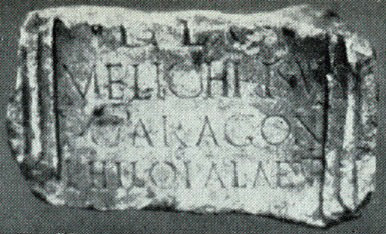
Melichrisus is known from a small square marble monument discovered at Novae (modern Steklen, Bulgaria), a major military and customs centre on the lower Danube. The stone bears an inscription on its front and reliefs of the torchbearers on its sides: Cautes raises his torch while holding a cock upside down by its feet, whereas Cautopates lowers his torch and carries a bird upright. The inscription records a dedication by Melichrisus, a dependant of Publius Caragonius Philopalaestrus, who is known from other evidence as one of the earliest documented conductores of the publicum portorium Illyrici, active around AD 100. The monument therefore belongs to the earliest phase of Mithraic activity currently documented in the Danubian provinces (CIMRM 2268-2269; Beck 1998; Clauss 1992).
A secondary inscription on the monument appears to identify Melichrisus as a Leo, the fourth grade of Mithraic initiation. This detail has attracted considerable attention because the dedicant’s Greek name, Melichrisus (“honey-golden” or “sweet as honey”), seems unusually appropriate for a member of the leonine grade. In De Antro Nympharum, Porphyry states that initiates of the grade of Leo were purified with honey rather than water, and Roger Beck has suggested that the name may preserve an esoteric allusion to this ritual symbolism. The coincidence is striking, since both the title Leo and the name Melichrisus appear on the same monument (Beck 1998).
Such interpretations remain speculative, however. While Cumont and later scholars regarded the name as possible evidence for the ritual importance of honey within Mithraism, more recent studies have noted that Melichrisus was also a perfectly ordinary Greek slave name and need not have carried any religious significance. As Massa and Belayche have argued, the name alone cannot be used to corroborate Porphyry’s much later account of Mithraic ritual.
Melichrisus’s name may be esoteric, alluding to the purification of Mithraic Lions with honey (Porphyry, De antro 15). His master, Philopalaestrus is known from AE 1919 no. 10 line 67 (Histria) to have been one of the earliest (if not the earliest) conductores of the publicum portorium Illyrici in c. 100 AD (de Laet, 1949: 204 n.4)
—Beck, 1998.
Attestations
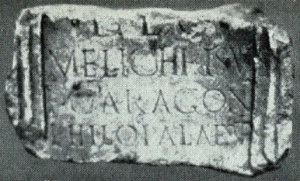
Inscription with Cautes and Cautopates of Steklen
TNMM 510
An unusual feature of this very ancient relief is that Cautopates carries a cockerel upside down, while Cautes carries it right-side up.