
Biography
of Lucanus
- Lucanus, a slave, is attested as a member of a Mithraic community (syndexios).
- Attested at Benifaió, Tarraconensis, Hispania in 2nd half of 2nd century (TNMM 528).
TNMP 157
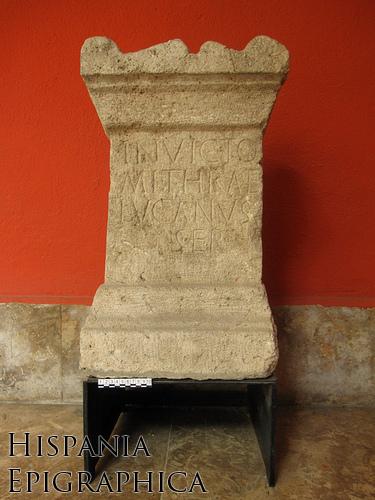
Lucanus was a slave (servus) who dedicated an altar to Mithras at Benifaió, in the territory of Valentia, during the second half of the second century CE. His name survives through a short but unequivocal dedication: Invicto Mithrae / Lucanus / servus, making him one of the very few slaves securely attested among the Mithraic worshippers of Hispania (TNMM 528; Alvar 2018; Chalupa 2023).
The monument was discovered in 1922 near the Font de Mussa spring at Benifaió. Architectural remains and a deposit containing burnt bones were reported nearby, leading some scholars to suggest the existence of a local mithraeum, although no sanctuary has yet been archaeologically identified. More recent excavations have revealed the remains of several Roman villas in the vicinity, strengthening the possibility that Mithraic worship was practised within a rural estate and perhaps even in a villa sanctuary comparable to those known elsewhere in Hispania and Italy (Clauss 1992).
Lucanus belongs to the small group of slaves documented in Hispanic Mithraism, alongside figures such as Hector Corneliorum at Emerita Augusta and the imperial slaves Successus and Elaine at Can Modolell. Although legally unfree, his ability to commission a carefully executed altar suggests access to resources beyond mere subsistence. Jaime Alvar Ezquerra has argued that the dedication was probably made with the approval of the estate owner and may reflect the religious preferences of the household as a whole, illustrating how Mithraic worship could extend into rural environments and involve dependent members of elite domestic communities (Alvar 2018).
References
- Aleš Chalupa (2023) Římský kult boha Mithry. Atlas lokalit a katalog nálezů I.
- Jaime Alvar Ezquerra (2018) El culto de Mitra en Hispania.
- Epigraphic Database Heidelberg. Altar of Benifayó in EDH.
- Alfred Shenington Geden. Altar of Benifayó in EDCS.
- Hispania Epigraphica. Altar of Benifayó in HE.
- Manfred Clauss (1992) Cultores Mithrae. Die Anhängerschaft des Mithras-Kultes..
- Mitra en Hispania. Altar of Benifayó in MEH.
Attestations
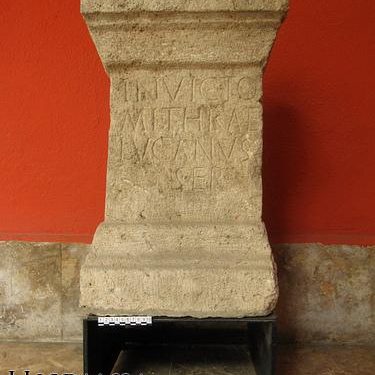
Altar of Benifayó
TNMM 528
This altar found in Benifaió, València, was erected by a slave called Lucanus.
