
Biography
of Pinnes
- Pinnes, a free citizen, is attested as a member of a Mithraic community (syndexios), with a recorded role as Miles immunis, Cohors I Belgarum.
- Attested at Aufustianis, Dalmatia in 161 – 180 (TNMM 754).
TNMP 261
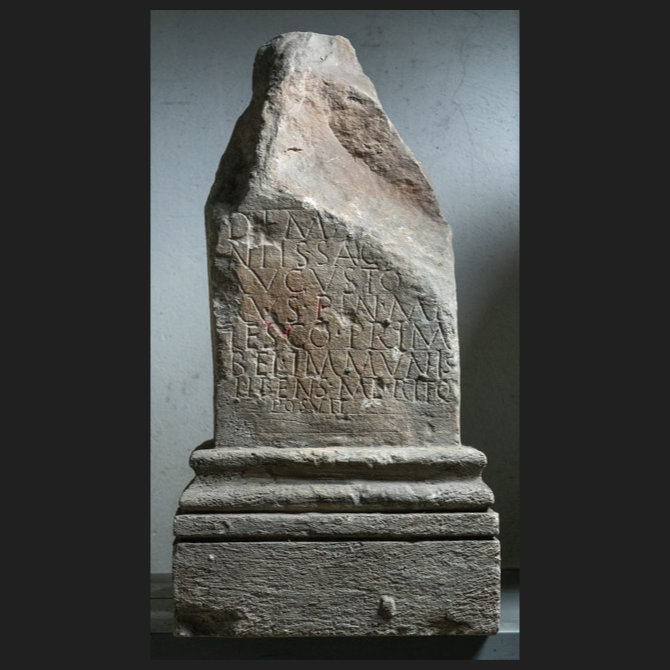
Pinnes is known from a dedicatory altar discovered at Tihaljina, near modern Grude in Bosnia and Herzegovina, and generally dated to the reign of Marcus Aurelius (c. AD 161–180), before the transfer of the Cohors I Belgarum to Germania under Septimius Severus. The inscription records him as an immunis miles, a soldier exempt from certain routine duties, usually because he performed a specialised military function. His altar was dedicated to Deus Invictus Mithras and the Genii sacrorum Augustorum, making it one of the clearest examples of the association between Mithraic devotion and the imperial cult within the Roman army (TNMM 754; CIMRM 1889; Clauss 2000; Vilogorac Brčić 2024).
The cohort was stationed in Dalmatia during the Antonine period and is generally regarded as having recruited predominantly among local peregrini, the non-citizen inhabitants of the province (Wilkes 1969, 146). Since the name Pinnes is characteristic of the indigenous population of south-eastern Dalmatia, modern scholarship considers him to have been probably of Dalmatian origin rather than a recruit transferred from another province (Rendić-Miočević 1948; Alföldy 1965, 86–87; Wilkes 1969, 163–164).
His dedication illustrates the integration of provincial recruits into the religious life of the Roman military. Bugarski argues that Pinnes’ adherence to Mithraism was most likely acquired through his service in the cohort, rather than inherited from a local religious tradition. During the Marcomannic Wars, Dalmatia received officers and soldiers from Pannonian legions, where the cult of Mithras was already firmly established. Although there is no direct evidence linking these troop movements to Pinnes himself, they provide a plausible historical context for the spread of Mithraic worship among auxiliary units in the province (Bugarski-Mesdjian 2004, 655; Wilkes 1969).
The joint invocation of Mithras and the Genii sacrorum Augustorum demonstrates that Mithraic worship could coexist with expressions of loyalty to the emperor and the Roman state. Such dedications illustrate the close relationship between the mysteries of Mithras and the imperial cult within military communities during the High Empire (Vilogorac Brčić 2024).
References
- Anemari Bugarski-Mesdjian (2004) Les cultes orientaux dans Dalmatie romaine..
- Epigraphic Database Heidelberg. Altar of Tihaljina in EDH.
- Alfred Shenington Geden. Altar of Tihaljina in EDCS.
- Ubi Erat Lupa. Altar of Tihaljina in Ubi Erat Lupa.
Attestations
Altar of Tihaljina
TNMM 754
This altar, discovered in Grude, near Tihaljina, Bosnia and Herzegovina, bears an inscription by Pinnes, a soldier of the Cohors Prima Belgica.
