
Biography
of Messius Artemidorus
- Messius Artemidorus, a freedman, is attested as a member of a Mithraic community (syndexios).
- Attested in the mid-2nd century.
- Attested at Pax Iulia, Hispania (TNMM 2129).
TNMP 291
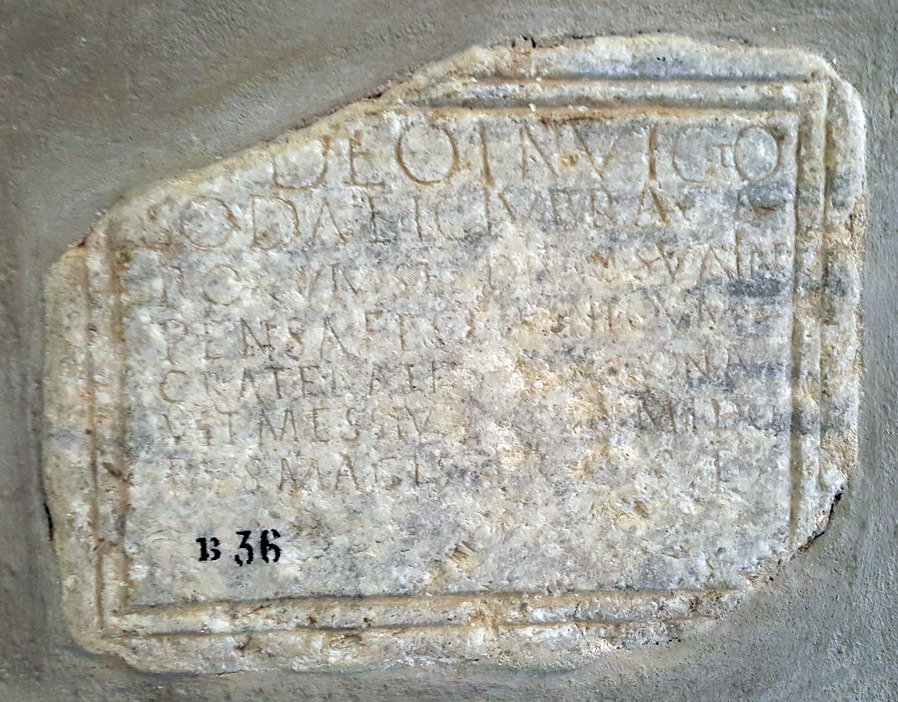
Messius Artemidorus is known from a fragmentary votive inscription discovered at Pax Iulia, modern Beja, Portugal, and generally dated to the mid or later second century AD. The inscription records him as magister of the sodalicium Bracarorum, an association of Bracari, people originating from Bracara Augusta or its surrounding region in north-western Hispania, who were settled in the colony of Pax Iulia.
As magister, Artemidorus appears to have acted as the head or representative of the association. The inscription states that he personally financed the commemorative inscription, while the association itself funded a studium, apparently a meeting hall or assembly room, together with a cratera, a large ritual mixing vessel. The text provides the clearest evidence for his role as a leading figure within the group, although the precise nature of his office remains debated.
Early interpretations regarded the sodalicium Bracarorum as a Mithraic institution. García y Bellido (1967) considered the inscription the only Hispanic testimony explicitly referring to a Mithraic organisation and interpreted Artemidorus as the president of a Bracaran Mithraic association. Later scholars adopted a more cautious position. Dias (1981) argued that the association may have been socio-professional rather than religious in character, while Edmonson (1984) questioned whether the inscription necessarily referred to Mithras at all. D’Encarnação, Farjas, González Herrero and Gutiérrez Alonso (2019) likewise emphasised the socio-economic dimension of the sodalicium, arguing that it may primarily have functioned as an association of Bracari living in Pax Iulia rather than as a specifically Mithraic organisation.
Artemidorus’ Greek cognomen has frequently been cited as evidence for an eastern origin. Edmonson (1984) suggested that he may have arrived in Pax Iulia as a slave and obtained his freedom there, a view later considered plausible by Alvar (2019). The restoration M(arci) l(ibertus) remains uncertain, but several authors have accepted the possibility that he was a freedman of Marcus. His title of magister is likewise open to interpretation and may simply designate the head of the Bracaran association rather than a specific office within the Mithraic hierarchy.
In his most recent treatment of the inscription, Alvar (2019) argued that the association was closely connected with the cult of Mithras and that the mention of the cratera, a vessel of considerable importance in Mithraic iconography and ritual, strongly supports a Mithraic interpretation of the monument. Under this reading, Messius Artemidorus emerges not as the founder of the cult at Pax Iulia, but as the leader and benefactor of a community of Bracari participating in a wider Mithraic network already established in the colony.
References
- Epigraphic Database Heidelberg. Dedication to Mithras from Pax Iulia in EDH.
- Epigraphik-Datenbank Clauss / Slaby. Dedication to Mithras from Pax Iulia in EDCS.
- Mitra en Hispania. Dedication to Mithras from Pax Iulia in MEH.
Attestations
Dedication to Mithras from Pax Iulia
TNMM 2129
Marble inscription recording the construction of a Mithraic meeting place and the donation of a crater by Titus Flavius Artemidorus.
