This site uses cookies to offer you a better browsing experience.
Find out more on how we use cookies in our privacy policy.

 
Region

Mithras in Hispania

Roman Hispania preserves a relatively modest but strongly urban body of Mithraic evidence, centred above all on Mérida.

The Mithraic evidence documented in Roman Hispania reflects a western and comparatively less densely attested expression of the cult than those known from the Rhine-Danube frontier provinces. The material is concentrated primarily in urban environments, with Augusta Emerita standing out as the principal centre of Mithraic activity in the Iberian Peninsula. Additional evidence from Baetica, Tarraconensis and Lusitania illustrates the circulation of religious practices through administrative, commercial and Mediterranean networks linking Hispania to wider currents of the Roman world.
Mithraic monuments of Hispania


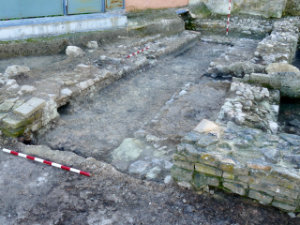
Cerro de San Albín

Although the site at Cerro de San Albín is not a Mithraeum, archaeologists have found several monuments related to the cult of Mithras.

CIMRM 772


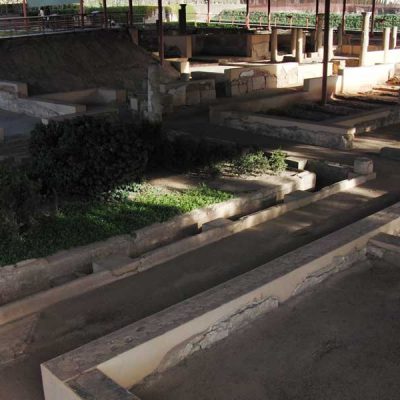
Mitreo de Cabra

The Mithraeum of Cabra is located in the Villa del Mitra, which owes its name to the discovery in 1951 of a Mithras tauroctonus in the remains of the Roman villa.


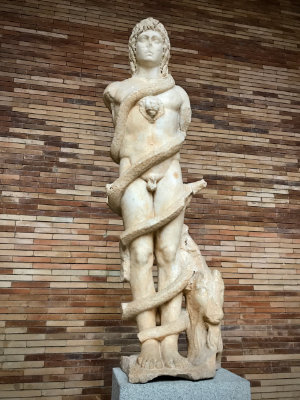
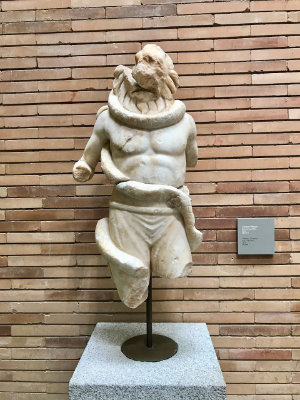
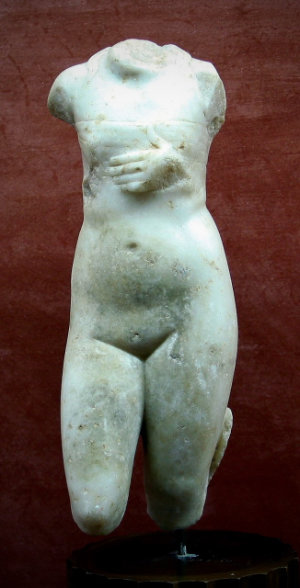
Lion-headed figure of Mérida

The lion-headed figure, Aion, from Mérida, wears oriental knickers fastened at the waist by a cinch strap.

CIMRM 776


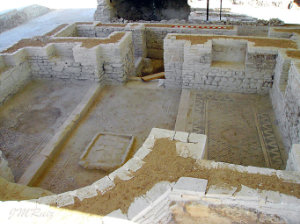
Mitreo dels Munts

The Mithraeum of Els Munts, near Tarragona, is one of the largest known to date.


Mitreo de Lugo

The exploration of an old pazo, a manor house, near the Roman wall, in Lugo, led to the discovery of a Roman domus, which existed continuously from the beginnings of the Christian Era until the Late Empire.


Aion of Mérida

The Aion-Chronos of Mérida was found near the bullring of the current city, once capital of the Roman province Hispania Ulterior.

CIMRM 777


Tauroctony from Santo Domingo de Silos

Mithras slaying the bull appears as the sign of Capricorn in a zodiacal sequence on the Pórtico del Cordero of the Abbey de Santo Domingo de Silos, Burgos, Spain.


Mitreo de la Tumba del Elefante

Set in a Roman necropolis, the so-called Mithraeum of the Elephant takes its name from an elephant statue found in one of the tombs.


Mitra de Cabra

The Mithras of Cabra is the only full preserved Tauroctony sculpture found in Spain yet.

CIMRM 771


Mercury of Mérida

The statue of Mercury in Merida bears a dedication from the Roman Pater of a community in the city in 155.

CIMRM 780


Villa romana de Fuente Álamo

One of the rooms of the villa has been interpreted as a mithraeum, but we do not have enough evidence to confirm this.


Mitreo de Cabrera de Mar

The Roman villa of Can Molodell had a sanctuary that has been related to the cult of Mithras.

See all Mithraicmonuments in Hispania

Places in Hispania


[Santo Domingo de Silos]

Burgos is a city in the autonomous community of Castile and León in Spain.


Asturica Augusta

Astorga is a municipality and city of Spain located in the central area of the province of León, in the autonomous community of Castilla y León, 43 kilometres southwest of the provincial capital.


Baetulo

The area was populated by Iberians, but the origins of Baetulo date back to the 1st century BC, when the Romans founded the city on the Rosés hill. Baetulo was famous for its vineyards, which produced wine for export throughout the Empire.


Barcino

Barcelona is a city on the coast of northeastern Spain. Founded as a Roman city, in the Middle Ages Barcelona became the capital of the County of Barcelona.


Benifaió

The Roman remains of Benifaió, or Benifayó in Spanish, are located on the outskirts of the city. Of particular interest is a rustic villa inhabited between the 1st and 4th centuries according to the numismatic and ceramic remains found.


Caetobriga

Caetobriga, now Setúbal of Proto-Celtic *Caetobrix, became a Turdetani settlement which passed under Roman rule. In the time of Al-Andalus the city was known as Shaṭūbar.


Emerita Augusta

Emerita Augusta was founded in 25 BC by order of the Emperor Augustus to protect a pass and a bridge over the Guadiana River. The city became the capital of the province of Lusitania and one of the most important cities in the Roman Empire.


Igabrum

Cabra is a municipality in Córdoba province, Andalusia, Spain and the site of former bishopric Egabro.


Iluro

Ituro, now Cabrera de Mar, was an important trading town and the capital of the Laietani, an Iberian people, until Roman times.


Italica

Italica was an ancient Roman city in Hispania; its site is close to the town of Santiponce in the province of Seville, Spain.


La Isla

Colunga is a municipality in the Autonomous community of the Principality of Asturias, Spain.


Lucus Augusti

Today Lugo was the capital of the Capori tribe. It was conquered by Paullus Fabius Maximus and named Lucus Augustus in 13 BC after the positioning of a Roman military camp.

See all Mithraic sites in Hispania

Inscriptions from Hispania

Mercury of Mérida

Ann[o] col[oniae] CLXXX / invicto deo Mithrae / sacr[um] / G[aius] Accius Hedychrus / Pater / a[nimo] [libente] plosuit].
In the colony's 180th year. Consecrated to the invincible god Mithras. Gaius Accius Hedychrus, Father, willingly deposited this.

Altar of Merida consecrated by Marcus Valerius Secundus

Ann[o] Col[oniae] CLXXX / aram genesis / Inuicti Mithrae / M[arcus] Val[erius] Secundus / fr[umentarius] Leg[ionis] VII Gem[inae] dono / ponendam merito curauit / G[aio] Accio Hedychro patre.
In the year 180 of the Colony, Marcus Valerius Secundus, frumentarius of the Legion VII Gemina, took care of placing the altar of the birth of the Invictus Mithras, as a due offering, being pater Gaius Accius Hedychrus.

Lápida mitráica de San Juan de la Isla

Ponit Inv/icto Deo / Au[gu]sto. Po/nit lebien/s Fronto / aram Invi/cto Deo Au/[gu]sto. F[ronto] Leveiu/s ponit, pr[a]e/sedente p[a]/[t]rem patr[um] / [c]um leon[ibus]/ M[onumentum] [h[oc]]
Erects it to the Unconquered God Augustus. Erects, willingly, Fronto, the altar to the Unconquered God Augustus. Fronto Leveius, erect this monument which presides over the father of fathers with the lions

Cautopates from Casa del Mitreo of Mérida

Invicto sacrum C. Curius Avitus / Acci[o] Hedychro pa[tre].
Δημήτριος ἐποίει
Dedicated to the invincible. Caius Curius Avitus, Accius Hedychrus being Father.
Demetros made it.

Oceaunus of Mérida

G[aius] Acc[ius] Hedychrus / p[ater] patrum
Gaius Accius Hedychrus pater patrum

Altar by Hector Corneliorum of Mérida

... Invict[o Mithrae] / Hector Cornelior[um] / ex visu.
To the Invictus [Mithrae], Hector of the Cornelians, by a vision.

Ara of the Mithraeum of Lugo

Deo / Inuic[to] Mithrae / G[aius] Victorius Vic/torinus [centurio] L[egionis] VII G[emina] / Antonianiae P[iae] F[elicis] / in honorem sta/tionis lucensis / et Victoriorum / Secundi et Vic/toris lib[ertorum] suor/um aram po/suit libenti animo [hedera]
To the undefeated Mithras, Gaius Victorius Victorinus, centurion of Legio VII Gemina Antoniania Pia Felix in honor of the statio at Lucus Augusti and of the Victorius Secundus and Victor, his freedmen, placed this altar willingly.

Altar of Benifayó

Invicto / Mithrae / Lucanus / Ser[vus].
To the invincible Mithras the slave Lucanus.

Altar of Gaius Iulius from Mérida

Deo / Invicto / pro salute / Cai Iuli / […].
Al Dios Invicto. Por la salud de Gaius Iulius […].

Inscription of Tarragona

[--- Invi]cto Mithra[e]….
To the invincible Mithras.

Altar by Caius Aemilius Superaius of Merida

Deo / Invicto / C[aius] Camilius / Superat[us] / a[nimo] l[ibens] p[osuit].
To the Unconquered God, Caius Camilius Superatus willingly and gladly placed [this].

Plaque of Astorga

Invicto Deo / Serapidi et / Isidi / Cl[audius] Zenobius / Proc[urator] Aug[usti].
To the Unconquered God, to Serapis, and to Isis. Claudius Zenobius, Imperial Procurator.

See all Mithraicinscriptions from Hispania

References

Back to Top