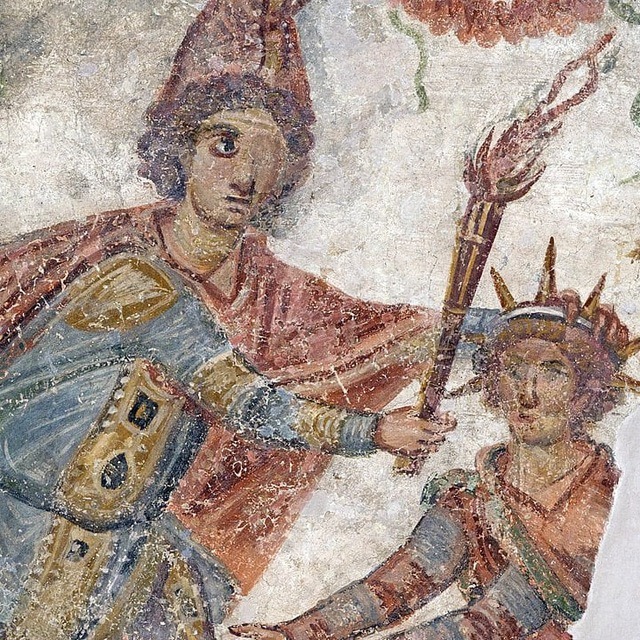
Clay figurine of Mithra (Mihr) from Artashat (Artaxata)
It is interesting to note the following details: the artifact’s resemblance to the specimen from Hoghmik, as well as the presence of a bull behind Mithra.
"...Thus, it can be assumed that not only were the myths of the Great Mother and the dying-and-rising gods built upon a shared conceptual framework, but their iconography was also similar. Attis, Ara, Mihr, and Eros are depicted as extraordinarily beautiful and are associated with vegetation. Like Attis and Adonis, Ara dies from a fatal blow. The cult of Attis and Adonis bears a resemblance to the cult of the Armenian figure Ara the Beautiful. Attis has been depicted in various compositions—merged with other deities, winged, performing a sacred dance, playing the reed pipe, and so forth. The statuettes of Attis discovered in Armenia are winged, indicating a fusion with Eros; he was also identified with Mihr, Men, and other deities. Terracotta figurines from the Hellenistic period, depicting Attis in his characteristic attire and with the wings of Eros, have been discovered in Myrina (Asia Minor) and in regions along the northern Black Sea coast. Literary sources from the Late Antique period attest that reed pipes were also played during the rituals of Cybele and Attis and their associated deities. Attis was also a shepherd; figurines depicting him playing the reed pipe—both with and without a shepherd’s crook—are known to exist." (p.200-201)
"The aforementioned clay figurines discovered in Armenia enrich our understanding of the material and spiritual culture of the ancient period. We hope that future excavations will yield significant new material regarding Armenian pagan mythology—specifically the worship of Anahit and Mihr—and provide an opportunity to reinterpret various issues related to these cults."

![Clay figurine of Mithra (Mihr) from Artashat (Artaxata)
It is interesting to note the following details: the artifact’s resemblance to the specimen from Hoghmik, as well as the presence of a bull behind Mithra.
"...Thus, it can be assumed that not only were the myths of the Great Mother and the dying-and-rising gods built upon a shared conceptual framework, but their iconography was also similar. Attis, Ara, Mihr, and Eros are depicted as extraordinarily beautiful and are associated with vegetation. Like Attis and Adonis, Ara dies from a fatal blow. The cult of Attis and Adonis bears a resemblance to the cult of the Armenian figure Ara the Beautiful. Attis has been depicted in various compositions—merged with other deities, winged, performing a sacred dance, playing the reed pipe, and so forth. The statuettes of Attis discovered in Armenia are winged, indicating a fusion with Eros; he was also identified with Mihr, Men, and other deities. Terracotta figurines from the Hellenistic period, depicting Attis in his characteristic attire and with the wings of Eros, have been discovered in Myrina (Asia Minor) and in regions along the northern Black Sea coast. Literary sources from the Late Antique period attest that reed pipes were also played during the rituals of Cybele and Attis and their associated deities. Attis was also a shepherd; figurines depicting him playing the reed pipe—both with and without a shepherd’s crook—are known to exist." (p.200-201)
"The aforementioned clay figurines discovered in Armenia enrich our understanding of the material and spiritual culture of the ancient period. We hope that future excavations will yield significant new material regarding Armenian pagan mythology—specifically the worship of Anahit and Mihr—and provide an opportunity to reinterpret various issues related to these cults."
Source:
ZHORES KHACHATRYAN - THE ICONOGRAPHY OF CLAY FIGURINES [ref:6aa51835e3f17]](https://www.mithraeum.eu/album/post/8b50b9469dd5f5c0.png)
