Your selection gave 165 results.
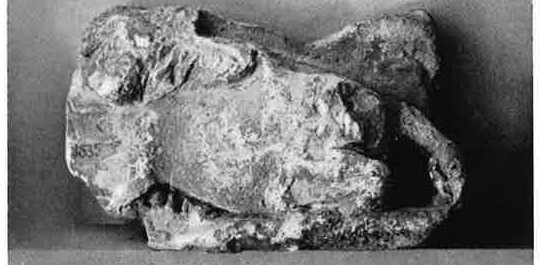
Fragment of a sandstone tauroctony relief from Schwadorf area, ancient Aequinoctium in Pannonia Superior, depicting Mithras killing the bull; the upper part of Mithras's body, the head, and parts of the bull are lost.
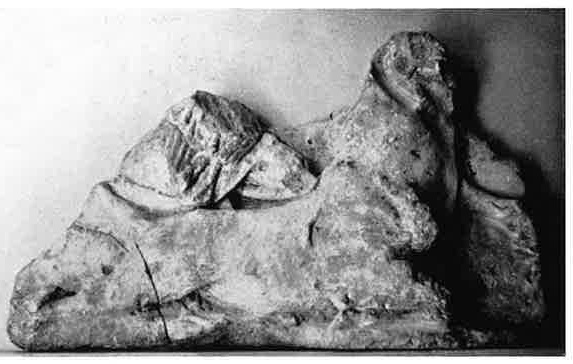
Fragment of a large sandstone tauroctony relief from Schwadorf, ancient Aequinoctium, depicting Mithras killing the bull; the upper part of the god's body, his head, the end of the tail, and the scorpion are lost.

Inscription from Schwadorf, ancient Aequinoctium in Pannonia Superior, dedicated to Petrae genetrici dei — the rock that gives birth to the god — by Aurelius Statorius.
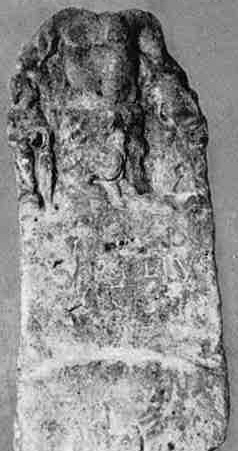
Limestone relief from Schwadorf, ancient Aequinoctium in Pannonia Superior, depicting the naked Mithras being born from the rock with a serpent encircling it, flanked by torchbearers; one of the finest examples of this iconographic type from the Danubian region…
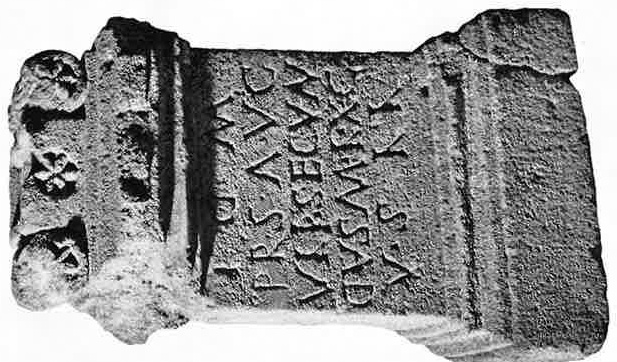
Limestone altar from Vienna, ancient Vindobona in Pannonia Superior, found in 1896 together with two terracotta lamps; the dedicant and full text are not known from the summary description.
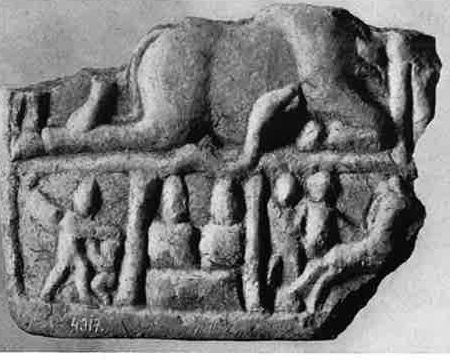
Altar from Eisenstadt, Pannonia Superior, dedicated to Deo invicto Mithrae by Titus Claudius Frontinus, centurion of Legio XIIII Gemina.
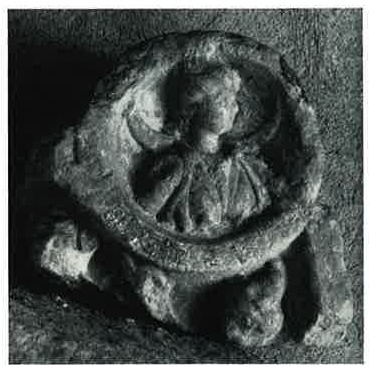
White marble relief fragment from near Klein-Wagna, ancient Flavia Solva in Noricum, preserving part of a tauroctony scene including the bull, Mithras's dagger, and the torchbearers.
Small marble head in Phrygian cap of unknown provenance, associated with the Waggendorf find-group, Noricum; may represent Attis or Mithras.
Crystalline limestone votive altar from Waggendorf near Sörg, Glantal, Noricum, probably third century AD, dedicated to Deo invicto Mithrae.
Natural grotto called the Bichl on the south slope above the Glanegg lake near St. Urban, Noricum, adapted as a Mithraic sanctuary; part of the grotto floor was paved and remnants of water installations survive.
Small altar preserved in the castle of Freudenberg at St. Thomas am Zeiselberg, Noricum, recording a dedication to Hermes invicto Mitrae — an unusual conflation of Hermes and the invincible Mithras.
Small two-fragment altar walled into the church at Schlatten near Rosenbach, Noricum, dedicated to Deo invicto Mithrae by Mocio Aprilis.
Altar from the Drave valley between Teurnia and Virunum, Noricum, now reused as a pedestal for a cross, dedicated to Invicto deo Mithrae for the welfare of Marcus Publius Potens by his freedman Ursulus.
Column found at Sankt Peter in Holz, ancient Teurnia in Noricum, dedicated to Cautes by Lucius Albius Atticus and Caius Albius Avitus — probably father and son — making it a rare joint family dedication to a Mithraic torchbearer.
Marble altar found in flood gravel at Aguntum, Noricum, dedicated to Deo invicto Soli Mithrae collectively by the Aguntenses, making it one of the rare collective dedications to Mithras.
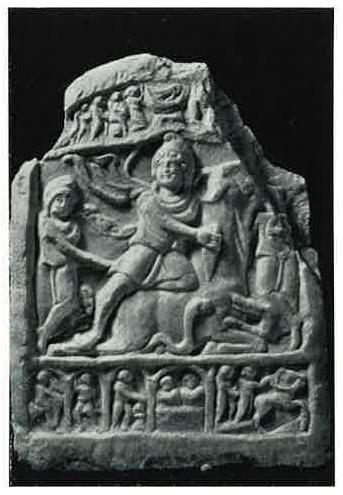
Small limestone tauroctony relief from Enns, ancient Lauriacum in Noricum, found about 100 metres east of the north-east corner of the castra, depicting Mithras killing the bull with dog and serpent and flanking torchbearers.
Carbonised plant remains (4,210 g) from the third room of the Mithraeum at Linz, ancient Lentia, comprising vine, prunes, hedge- and cornelberries, apple pips, walnuts, and millet; interpreted as a ritual food offering to the god.
Several thin silver fragments from the Mithraeum at Linz, ancient Lentia, reconstructed as a votive object surmounted by a crescent or two horns; paralleled in sanctuaries of Jupiter Dolichenus.

Three-fragment terracotta plate from the Mithraeum at Linz, ancient Lentia, with a seven-hole border and a graffito in the centre invoking Iupiter Optimus Maximus; found in the second room of the sanctuary.
Pottery assemblage from the cult room of the Mithraeum at Linz, ancient Lentia, including glazed dishes, three-handled serpent-vases, and related fragments; a vessel type closely associated with Mithraic ritual in the Danubian provinces.
