Your selection gave 488 results.
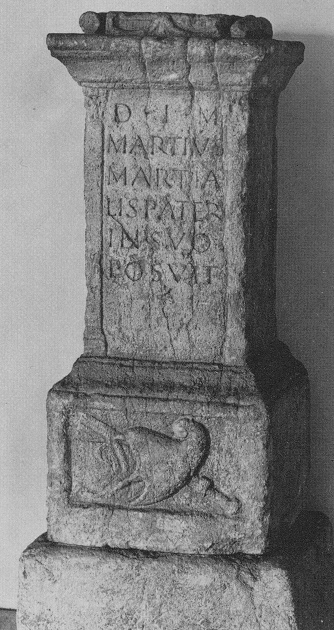
The altar with a Phrygian cap and a dagger from Trier was erected by a Pater called Martius Martialis.

Altar from Höglwörth, ancient Bedaium in Noricum, dedicated to Deo invicto Mithrae for the welfare of Marcus Lollius Priscus by his freedmen Ianuarius and Lupercus.
Votive stone found at Epfach in 1830, ancient Abudiacum in Raetia, dedicated to Soli sacrum by Tiberius Claudius Mace, son of Tiberius Claudius Mace, apparently a dedication by a son continuing his father's cult.
Square altar from Zwiefalten near Ulm, Raetia, found reused in the apse of a church; local tradition places the original sanctuary on a hilltop between Zell and Zwiefalten, or alternatively near Reichenstein.
Fragmentary inscription from Günzburg, ancient Guntia in Raetia, recording a dedication to Deo invicto Mithrae by two dedicants, Tetto and a companion whose name begins Sex-.
Lost stone inscription found reused in a pier of the parish church of St Martin at Günzburg, ancient Guntia in Raetia, dedicated to Deo invicto Mithrae by Publius Oppius Secundus following a vision.
Sandstone plate from Beihingen in the Neckar valley, depicting on one side a youth in Oriental dress with a bow in an arched niche, and on the other a corresponding figure; both may represent torchbearers or Mithraic grades.
Sandstone slab from Kindenheim, Germania Superior, depicting a standing winged Aion with traces of a lion's mane on the breast and objects in both hands; the head and part of the body are damaged.
Sandstone altar found together with the Vocco altar at Rottenburg am Neckar, ancient Solicinium, bearing a fragmentary dedication and decorated with trees on its lateral faces.
Fragmentary inscription from Fellbach, Germania Superior, preserving only the abbreviated name of Mithras.

Large grey sandstone tauroctony relief from Fellbach near Cannstatt, depicting the bull-slaying in a vaulted grotto with torchbearers, Sol, Luna, and subsidiary Mithraic scenes along the border.
Fragmentary graffito from Rheinzabern, ancient Tabernae, preserving only the words vassa decem, a reference to ten cult vessels dedicated to Mithras.
Terra-sigillata fragment from Rheinzabern, ancient Tabernae, bearing a Mithraic graffito; found in 1902.
Inscription from Rheinzabern, ancient Tabernae, in which Tertius, slave of Rusticus, records a dedication of ten cult vessels to Deo invicto Mithrae.
Terra-sigillata vase from Rheinzabern, ancient Tabernae, bearing a Mithraic graffito on its flat border.
Two rectangular sandstone reliefs from Zasenhausen near Cannstatt, ancient Clarenna, each depicting a male bust with astral symbols on the forehead, arranged in opposing directions.
Small sandstone head in Phrygian cap from Cannstatt, ancient Clarenna, probably belonging to a statue of Cautes or Cautopates.
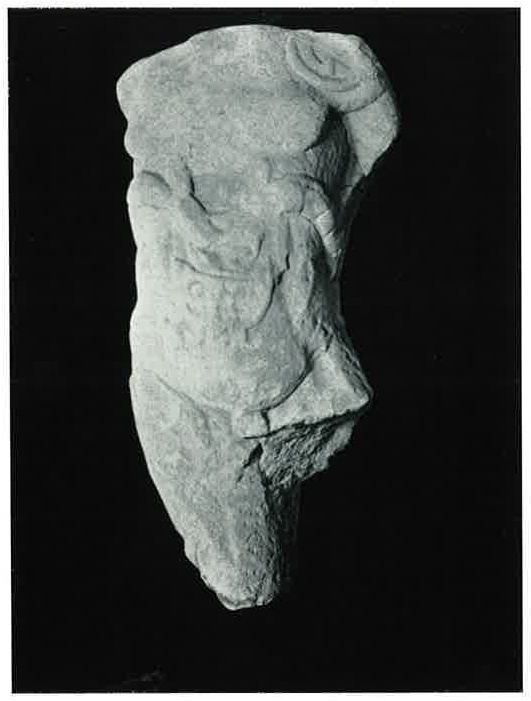
Sandstone statue from Wahlheim, Germania Superior, depicting a naked torso encircled by two serpents holding their heads towards the figure's face — the characteristic iconography of the leontocephaline Aion.
Large votive altar from Murrhardt, dedicated to Soli invicto Mithrae by Sextus Iulius Florus Victorinus, tribune of Cohors XXIV Voluntariorum civium Romanorum, recording the full restoration of a Mithraic temple from its foundations.
Small bronze statuette recovered from the river Saale near Burg Giebichenstein in 1900, depicting Mithras as bull-slayer without a Phrygian cap; the left leg is lost.
