Your selection gave 353 results.

Histria was one of the earliest Greek colonies established on the western shores of the Black Sea.
Drobeta controlled an important crossing point on the Danube and became one of the major centres of Dacia.
Dierna occupied a strategic position along the Danube corridor near the Iron Gates region of southwestern Dacia.
Cioroiu Nou is known for archaeological remains connected with settlement activity in Dacia.
Callatis developed as an important Black Sea port on the western coast of the Pontus Euxinus.
Jiu valley site associated with the defensive system linking Dacia to the southern Danubian regions.
The locality of Botoșești-Paia has yielded material connected with the Danubian provincial landscape.
Axiopolis occupied a strategic position near the Danube crossings of Moesia Inferior.
Aquae was associated with thermal springs and communications routes in the region of modern Călan.
Roman settlement of Dacia superior located in the area of present-day Sibiu in Romania. The site became an important urban and military centre, later developed into the medieval city known as Hermannstadt in German and Nagyszeben in Hungarian.
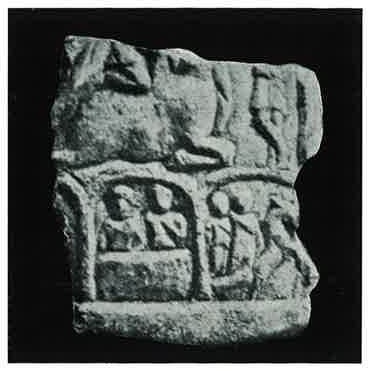
Right lower corner of a marble tauroctony relief from Oltenia, Dacia, preserving the lower portion of Mithras killing the bull.
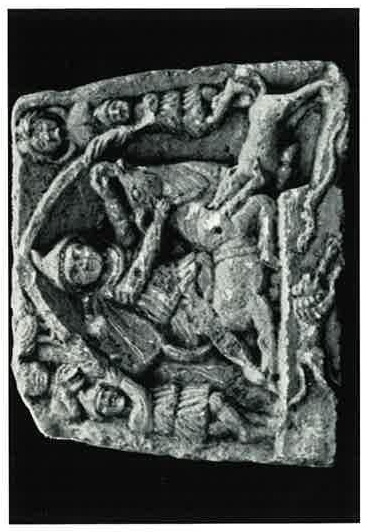
Limestone tauroctony relief from Oltenia, Dacia, of unknown exact provenance, depicting the standard bull-slaying with the full iconographic programme.
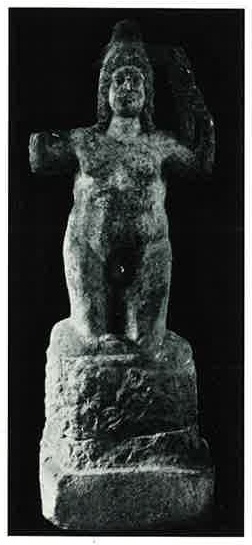
This white marble statue of the rock-birth from Cibinium in Roman Dacia is one of the largest known Mithraic sculptures from the Danubian provinces.
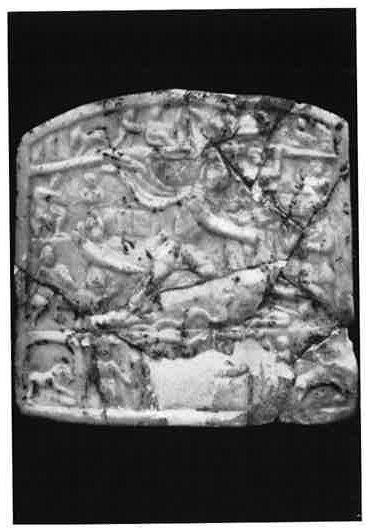
Nine fragments of a white marble tauroctony relief from Scythia Minor, Moesia Inferior, probably from somewhere within the province; the standard bull-slaying scene is preserved in part.

Limestone altar from Tropaeum Traiani, Moesia Inferior, dedicated in honour of the Domus Divina to Soli invicto sacrum by Quintus Lucilius Piscinus, centurion of Legio I Italica.
Altar from Kokardscha near Adam Klissi, ancient Tropaeum Traiani in Moesia Inferior, dedicated to Deo invicto for the welfare of Emperor Marcus Antoninus Verus by Annius Saturninus, centurion of Legio XI Claudia.
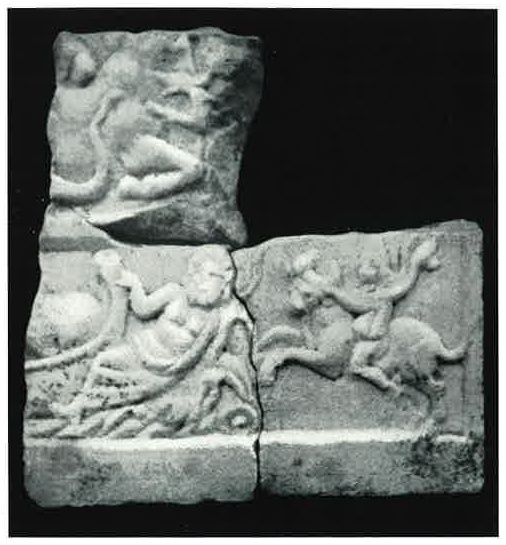
Three white marble tauroctony fragments from Gànt la Mangalia, ancient Callatis in Moesia Inferior, depicting part of the standard bull-slaying scene.
Small sandstone altar with red-painted lettering from the Mithraeum at Tirgușor, Moesia Inferior, dedicated by Horimos to the god Caute; the last letters of the inscription are uncertain.
Small sandstone altar with red-painted lettering from the Mithraeum at Tirgușor, Moesia Inferior, dedicated to the god by Horimos.

Sandstone tauroctony relief with pediment from the Mithraeum at Tirgușor, Moesia Inferior, depicting the bull-slaying with two cross-legged torchbearers both holding their torches upraised and Sol and Luna busts in the upper corners; no dog or scorpion.
