Your search Al-Bahnasa gave 3013 results.

The upper part of a dressed male figure from the Mithraeum at Pons Saravi (modern Saarburg) in Belgica, holding a wreath or broad ring in the right hand and a round object in the other, tentatively identified as Aion but without sufficient evidence.
An altar from Baetulo (modern Badalona) in Hispania Citerior, carved in a rock on a hill facing east opposite the town, recording a dedication to Sol Deus by A. Pompeius Abascantus.
A small four-sided white marble relief of uncertain Mithraic attribution, found at Italica (modern Santiponce, near Seville), depicting a bull walking to the right on the front, a fig-tree on the back, five ears of wheat on the right side, and damaged vine tendrils with grapes on the left…
The inscription on the votive altar No. 756 from Pola (modern Pula), reading Soli above the head of Sol and Milace / Atticus under the head, recording the dedication by a person named Atticus.
A fragmentary inscription found in the foundations of the Theodosian walls at Aquileia, recording a dedication to the Invincible Mithras by ...ntius Manilianus.
An inscription from Aquileia recording a vow fulfilled to Sol Invictus Mithras by C. Calidius Agathopus, a member of the college of the seviri Augustales of Aquileia.

Alfius Severus was a prominent figure associated with the Mithraeum of Marino, probably acting as pater of a small Mithraic community connected with the nearby peperino stone quarries.
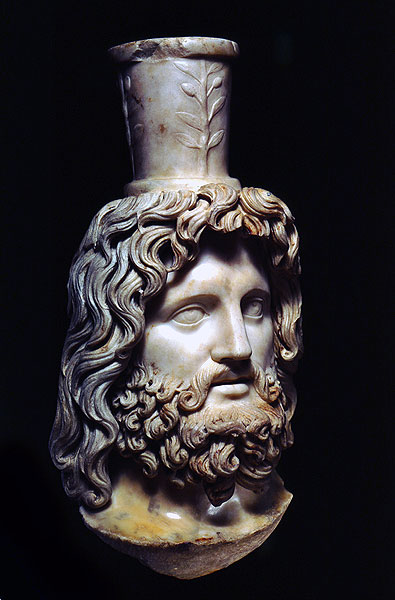
The head of Serapis found at Walbrook, London, is decorated with stylised olive branches.
A marble altar found in 1873 between the Baths of Diocletian and the Via di Porta Pia in Rome, dedicated to Sol Invictus Mithras by Sextus with Titus Flavius Ianuarius as antistes.
Small marble arula found near the church of SS. Apostoli in Rome, bearing a brief Greek dedication to Helios Mithras Invictus.
Greek inscription dedicated to Sol Invictus Mithras by Balbillus, saved from the waters, in the presence of Bassus the priest, belonging to the Mithraic grade of Leo.
Marble relief formerly in the Palazzo Alberoni and then the Palazzo Vaccari on Via del Tritone, showing Mithras slaying the bull with the raven on the god's cloak, the serpent, dog and scorpion, and the busts of Sol and Luna in the upper corners.

Roman building on the Aventine between the eastern side of S. Saba and Via Salvator, probably used as a Mithraeum at the end of the 4th century, with a long corridor bearing three semicircular niches and a large external basin.
Wall-painting of Mithras tauroktonos in fresco, discovered in 1886 in an underground room of the house of the Nummi Albani on the Quirinal (Via Firenze); the god wears a red cap and tunic, the torchbearers wear yellow or orange tunic and cap with green or brown anaxyrides…
Small semi-round base found on the Monte Quirinale in Via Mazzarini, from a small Mithraeum, with a dedication to Mithras by T. Camurenus Philadelfus through Nonius Firmus pater.
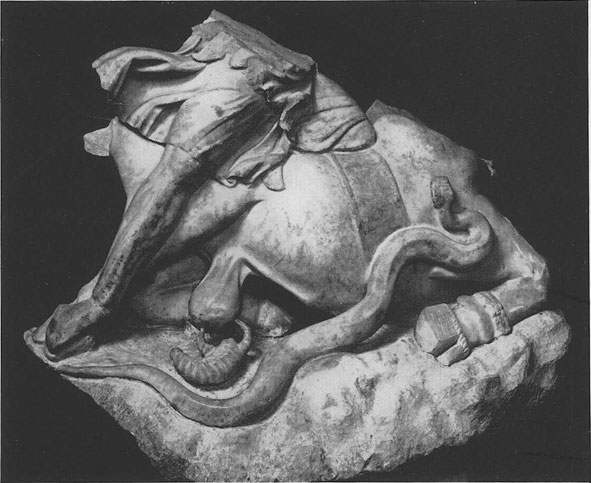
Partial marble statue of Mithras as a bullkiller found near Viale Latino, about 200 meters from Porta San Giovanni.
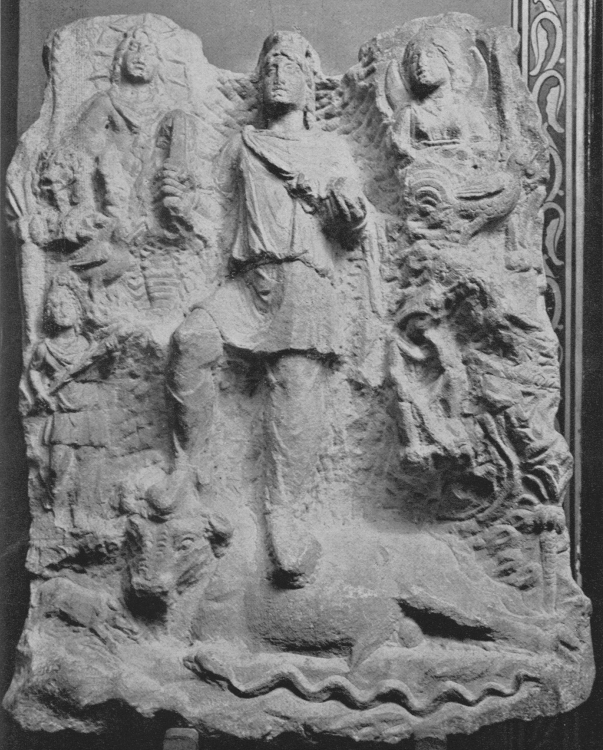
This unusual representation of Mithras standing on a bull was kept in the Casino di Villa Altieri sul Monte Esquilino until the 19th century.
Inscription from Dionysopolis, Moesia Inferior, dedicated to Invicto Mithrae by Quintus Samacius Serenus, architectus salariarius of Legio XI Claudia.
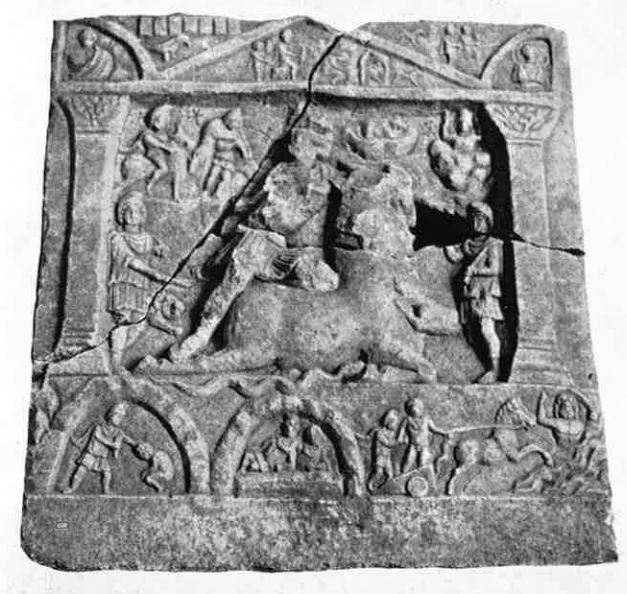
Large marble tauroctony relief from near Tavalicavo, Moesia Superior, with the shape of a temple façade: two columns supporting a pediment, the capital decorated with a head of Medusa, and the tauroctony in the central field.
Marble tauroctony relief from the surroundings of Küstendil, ancient Pautalia in Moesia Superior, depicting the bull-slaying with torchbearers and Sol and Luna busts in the upper corners.
