Your search Al. N. Oikonomides gave 2981 results.

Stone fragment from the Mithraeum at Königshoffen preserving a human thigh against which a hand holds a bunch of grapes; probably part of a larger sculptural group.
Lower-central fragment of the large cult relief from the Mithraeum at Mackwiller, preserving the forefeet of the dog, part of a serpent, and a cult vessel; the base bears a partially legible inscription mentioning an eques Romanus.
Sandstone plate from Beihingen in the Neckar valley, depicting on one side a youth in Oriental dress with a bow in an arched niche, and on the other a corresponding figure; both may represent torchbearers or Mithraic grades.
Sandstone lion from Brumath, ancient Brocomagus, with a votive inscription on its base recording a dedication by Tertius; a common Mithraic cult animal.

Large grey sandstone tauroctony relief from Fellbach near Cannstatt, depicting the bull-slaying in a vaulted grotto with torchbearers, Sol, Luna, and subsidiary Mithraic scenes along the border.
Two rectangular sandstone reliefs from Zasenhausen near Cannstatt, ancient Clarenna, each depicting a male bust with astral symbols on the forehead, arranged in opposing directions.
Small sandstone head in Phrygian cap from Cannstatt, ancient Clarenna, probably belonging to a statue of Cautes or Cautopates.
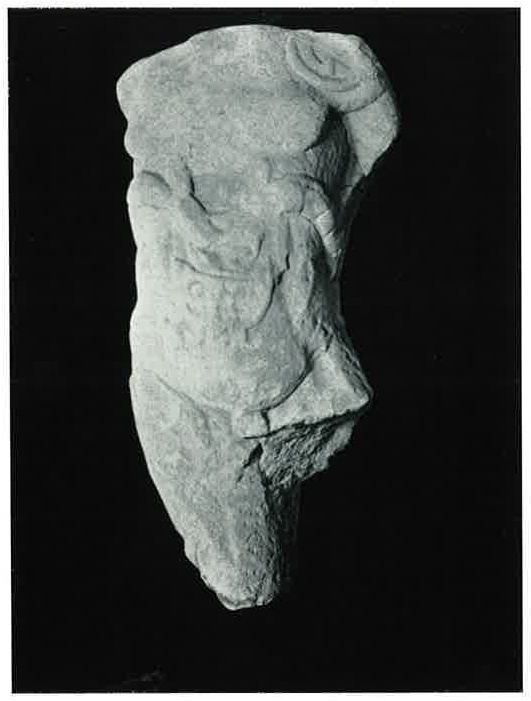
Sandstone statue from Wahlheim, Germania Superior, depicting a naked torso encircled by two serpents holding their heads towards the figure's face — the characteristic iconography of the leontocephaline Aion.
Stone head in a Phrygian cap found near Rothselberg in 1894, preserved in the Historisches Museum der Pfalz at Speyer, looking upwards
Various altar and base fragments, two sandstone balls, and two millstone fragments from the Mithraeum at Dieburg
Small fragmentary inscription from the Mithraeum at Dieburg preserving only the abbreviated dedication D(eo) i(nvicto) M(ithrae)
Small red sandstone fragment from the Mithraeum at Dieburg preserving a head in a Phrygian cap
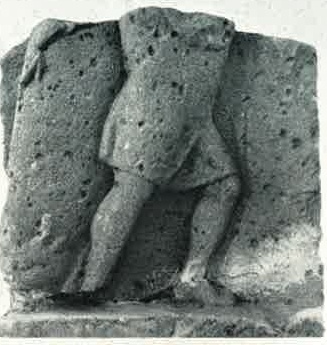
Red sandstone relief from the Mithraeum at Dieburg showing Mithras in Oriental dress carrying the bull on his shoulders
Small finds from the Gross-Krotzenburg Mithraeum including a Phrygian-capped head, a pinecone fragment, coins of Trajan and Hadrian, and column fragments
Basalt fragment preserving the skin and hoof of a bull probably belonging to a tauroctony scene.

Small bronze figure of the torchbearer Cautes fitted with attachment rivets.
Unusual sculptural representation of stylised flames mounted on a pedestal.
Fragmentary limestone statuette of a cross-legged torchbearer originally attached to a tauroctony relief.
Group of monuments from Lepcis Magna published among the principal Mithraic remains of Roman Tripolitania.
White marble plate inscription dedicated to Soli Invicto pro salute, from Caesarea of Mauretania (modern Cherchel).
