Your search Alain Verse gave 32 results.

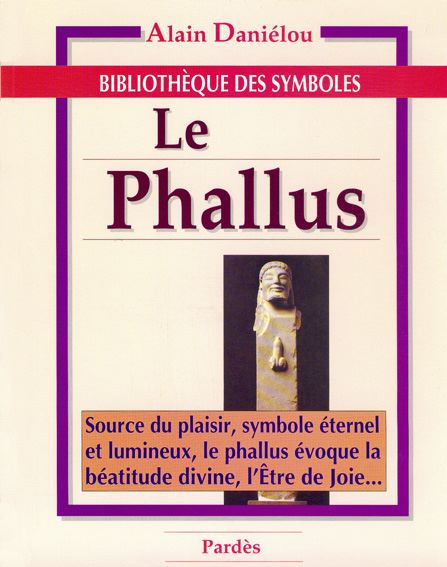
It is only when the penis stands up straight, that it emits semen, the source of life. It is then called the phallus and has been considered, since earliest prehistory the image of the creative principle, a symbol of the process by which the Supreme



Yellow jasper fragment of unknown provenance, formerly in the Museo Borgiano, with a tauroctony on the obverse and a Mithraic figure on the reverse.
A double-sided limestone relief found near Meclo in Val di Non in 1895, now in the Museo Nazionale at Trento, with a raven and altar scene on the obverse and scenes on the reverse showing a figure attacking a kneeling Phrygian-capped person and Mithras as a bull-carrier…
A white marble altar base from the Mithraeum at Angera, decorated with palmettes, eagles carrying a festoon and rosettes on the front, dolphins on the reverse, and on each side mythological scenes of Jupiter and Neptune combatting Giants with snake-feet.
A small limestone head of Cautopates, facing right, with a damaged nose and a stone pin on the reverse indicating it belonged to a relief, found on the slope of a hill near Heiligkreuz at Augusta Treverorum (modern Trier) in Belgica.
A small round bronze slab bearing a Medusa head, with serpents knotted below her chin and serpent heads emerging between two wings attached to the temples, with two hooks on the reverse, from the Mithraic sanctuary at Angleur near Liège in Belgica.
Three small bronze slabs bearing roughly modelled bearded heads of wind-gods, each with a wing on the head, with iron hooks on the reverse for fastening, found at the Mithraic sanctuary at Angleur near Liège in Belgica.
Upper portion of a sandstone altar from the Mithraeum at Königshoffen, later reused as building material, bearing a dedication by Ianussa on both the front and reverse faces.
Altar formerly in the house of the de Vellis family near the Carmelites in Rome and now in the Museo delle Terme, with a dedication to Silvanus on one side and on the reverse a record by M. Aurelius Bassus, priest of Sol, of having made a fountain flow.
Under-layer wall-paintings in the S. Prisca Mithraeum on the Aventine showing a further procession of Mithraic initiates in different colours, with partially legible dipinti including liturgical verses and acclamations.
Gold coin of the Scythian king Hooerkes, reverse showing Mithras (MIIPO) in tunic with lance and sword, north-west India, c. 87–129 A.D.
Gold coin of the Scythian king Hooerkes, reverse showing Mithras (MOPO) standing with wreath and staff, north-west India, c. 87–129 A.D.
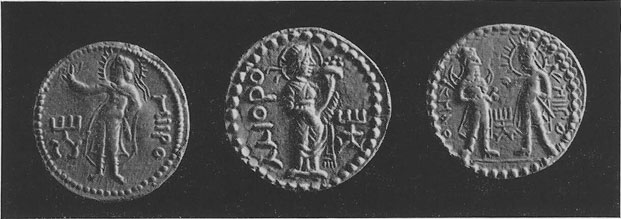
Gold coin of the Scythian king Hooerkes, reverse showing MIOPO (Mithras) as a goddess with cornucopia, north-west India, c. 87–129 A.D.
Lost limestone altar from Apulum, Dacia, decorated on the sides with a rose and serpent, on the reverse with a bull's head; the front bears a Mithraic inscription.


