Your search Arsha wa Qibar gave 1681 results.

Inscription from Schwadorf, ancient Aequinoctium in Pannonia Superior, dedicated to Petrae genetrici dei — the rock that gives birth to the god — by Aurelius Statorius.
Marble statuette of Cautopates from the Mithraeum at Sopron, ancient Scarabantia, in Phrygian cap and Oriental dress, holding the torch downwards; the head is lost.
Lower portion of a marble relief from the Mithraeum at Modrič, Pannonia Superior, preserving the legs and downward torch of a Cautopates.
Small Mithraic sanctuary (9.28 × 4.52 m) found at Modrič near Našice in Slavonia, Pannonia Superior, in 1911; the sanctuary has the standard corridor and bench division with a water-basin in the pronaos, and yielded a rich assemblage of marble reliefs…
Small limestone altar from near Višnja Gora, Pannonia Superior, dedicated to Fonti perenni — the eternal spring — a dedication associated with the Mithraic water cult.
Limestone slab from the Mithraeum at Pohanica, Noricum, elaborately carved on both faces; a metal plate originally attached by pins to its interior was removed, probably by the Mithraists themselves — paralleled at Poetovio.
Sandstone altar with akroteria from the Mithraeum at Pohanica, Noricum, dedicated to Deo invicto Mithrae by Marcianus; the frame bears two outward-pointing darts as a decorative motif.
Marble altar walled into the crypt of the church at Hoče, Noricum, dedicated to Deo Soli invicto Mithrae for the welfare of Marcus Aurelius Felicianus and his son Marcus Aurelius Felicissimus by Helvius Ingenuinus.
Natural grotto called the Bichl on the south slope above the Glanegg lake near St. Urban, Noricum, adapted as a Mithraic sanctuary; part of the grotto floor was paved and remnants of water installations survive.
Small two-fragment altar walled into the church at Schlatten near Rosenbach, Noricum, dedicated to Deo invicto Mithrae by Mocio Aprilis.
Carbonised plant remains (4,210 g) from the third room of the Mithraeum at Linz, ancient Lentia, comprising vine, prunes, hedge- and cornelberries, apple pips, walnuts, and millet; interpreted as a ritual food offering to the god.
Inscription from Oberrohr, Noricum, walled into the right of the north porch of the parish church, recording a dedication to Deo invicto Soli.
Marble epistylium in three fragments from the Mithraeum at Moosham, Noricum, decorated with a central tree, a flying hind pursued by a dog and an Amazon, a walking lion, and a horseman; bearing an identical inscription on both lateral tabulae.
Underground oblong room at Nyon, ancient Colonia Iulia Equestris, situated on the edge of a second Forum dating to the second half of the first century AD, with a series of pillars along the side walls consistent with Mithraic architecture; its interpretation as a Mithraeum remains tentative…
Large limestone relief from Thun-Allmendingen depicting a bull walking to the left; the head is lost. At approximately 2.91 × 2.43 m one of the largest single-animal reliefs from a Mithraic context.
Site excavated by C. F. L. Lohner in 1824–25 at the Renzenbühl near Thun-Allmendingen, Germania Superior, where the outline of five rooms was identified, one or more of which may have served as a Mithraic sanctuary.
Grey sandstone hand holding a globe from the Mithraeum at Königshoffen, with a lead bar indicating attachment to a larger statue; a second globe with a partial hand was found at the same spot.
Stone head in a Phrygian cap found near Rothselberg in 1894, preserved in the Historisches Museum der Pfalz at Speyer, looking upwards
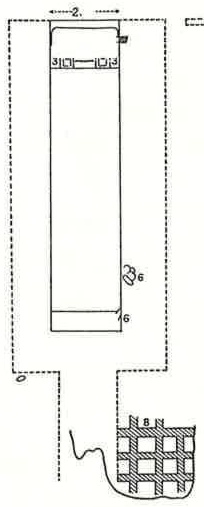
Mithraic sanctuary discovered behind the west part of a Roman cemetery near the camp at Gross-Krotzenburg in 1881, finds destroyed in World War II
Pair of Castor ware vessels interpreted as ritual banquet deposits from the Mithraeum of Procolitia.
