Your search Arsha wa Qibar - Qaybar - Qeibar - Qibare, al-Hawa gave 3149 results.

Large limestone relief from Thun-Allmendingen depicting a bull walking to the left; the head is lost. At approximately 2.91 × 2.43 m one of the largest single-animal reliefs from a Mithraic context.
Site excavated by C. F. L. Lohner in 1824–25 at the Renzenbühl near Thun-Allmendingen, Germania Superior, where the outline of five rooms was identified, one or more of which may have served as a Mithraic sanctuary.
A marble plinth inscription formerly in the Vigna Guidii outside the walls of Rome, recording L. Valerius Megistus as pater and sacerdos of the Invincible Mithras.
Fragment of a small white marble relief showing Mithras slaying the bull with the dog, serpent and scorpion, formerly walled in the inner court of the Palazzo Rondinini (now Palazzo Sanseverino), Corso No. 518.
Graffito on the left wall of the Palazzo Barberini Mithraeum consisting of the single name Macarius.
Square marble slab walled in the right projecting elevation before the cult-niche of the Palazzo Barberini Mithraeum, with a dedication by Yperanthes (a Persian name) to the Invictus, inscribed in a red frame with traces of red and blue colour.
Black and white mosaic floor of the underground room used as a Mithraeum in the house of the Nummi Albani on the Quirinal; the mosaic ends about 1 metre from the side-walls, suggesting side-benches; Nummius Albinus was consul in 345 A.D.
Mithraeum discovered towards the end of the 16th century in a vineyard of Horazio Muti opposite S. Vitale, between the Quirinal and Viminal hills, known from Vacca's report of a sealed room with many terracotta lamp-holders.
Marble lion's head fastened into a wall, its flat square back indicating it was set into masonry, from the Mitreo del Palazzo Imperiale at Ostia.
Two small tuff altars walled into the corners of the benches, each bearing a representation of a jug, from the Mitreo delle Sette Sfere at Ostia.
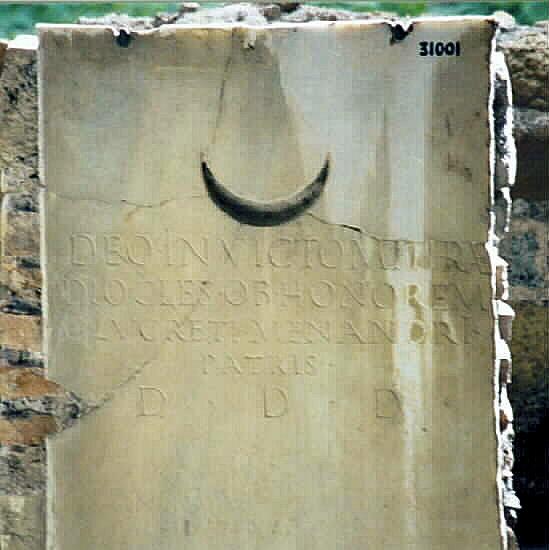
The brick altar of the Mithraeum Menander was covered with marble slabs bearing a crescent and an inscription.
Late Roman funerary inscription from Antium commemorating the senator, governor of Numidia and Mithraic pater Alfenius Ceionius Iulianus Kamenius.
Inscription from a house wall at Apulum, Dacia, dedicated to Cautes by Gaius Herennius Ermes.

This votive silver plaque depicting Mithras was found at the site of Pessinus, Ballıhisar, in Turkey.
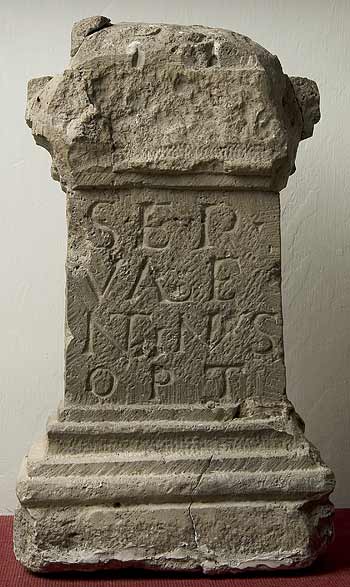
Limestone altar dedicated to Cautes by the Roman optio Septimius Valentinus, discovered in the Mithraeum of Sárkeszi in Pannonia Inferior.
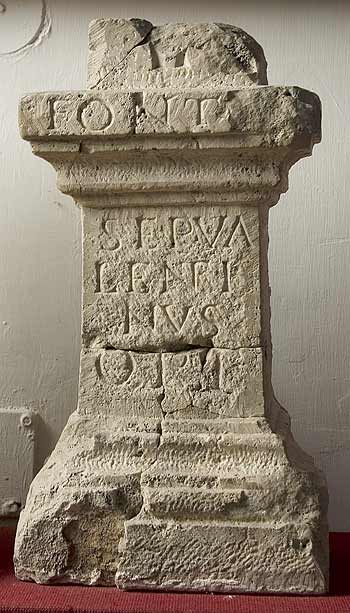
Fragmentary limestone altar dedicated by Septimius Valentinus, an optio, probably discovered in Mithraeum IV at Aquincum.
This supposed Mithraic altar from Soulan in the Pyrenees was later identified as a modern forgery, including both the inscription and the alleged cave context in which it was said to have been discovered.
Marble altar dedicated at the Vatican Phrygianum in Rome by the Mithraic pater Alfenius Ceionius Iulianus Kamenius in 374 CE.
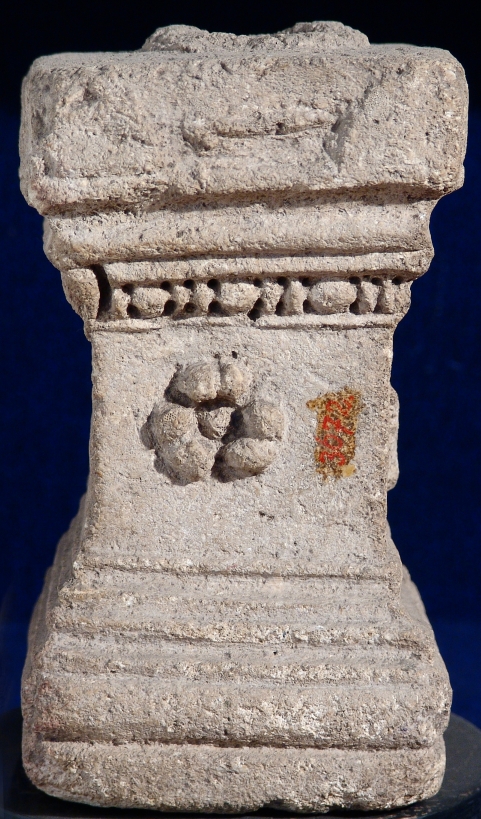
This limestone altar from Roman Dacia preserves a dedication to Mithras by a commander of the Ala II Pannoniorum.
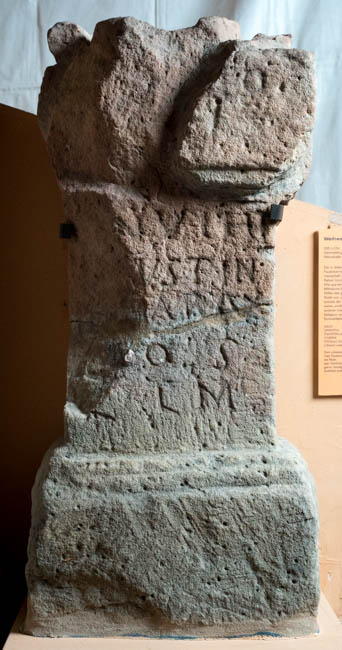
This sandstone altar was dedicated to the god Invictus by a certain Faustinus from Gimmeldingen.
