Your search As Salhiyah gave 2391 results.

Altar from Osijek, ancient Mursa, found when the fortress was demolished in 1922, dedicated to Deo Aeterno — the Eternal God — a title sometimes associated with Mithraic worship.
Fragment of a marble tauroctony relief from Surduk, ancient Rittium in Pannonia Inferior, preserving only Mithras's right foot and leg with the bull below.
Trapezium-shaped limestone tauroctony relief from Nagytétény, ancient Campona in Pannonia Inferior, depicting Mithras killing the bull in an arched niche with scorpion, serpent, and torchbearers.
Fragment of a Mithras relief from Zsámbék near Aquincum, Pannonia Inferior, showing seven altars alternated with trees — a processional or decorative border rather than a main tauroctony scene.
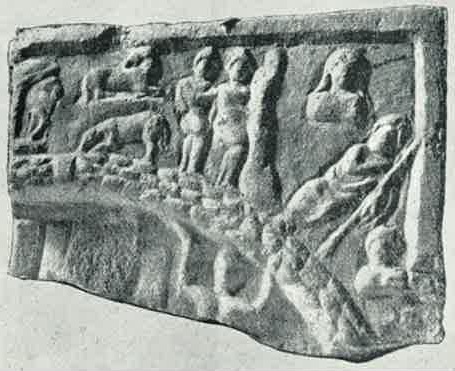
White marble statuette from Budapest, ancient Aquincum or vicinity, depicting a badly damaged Mithras killing the bull with dog and serpent; the god's head is lost.
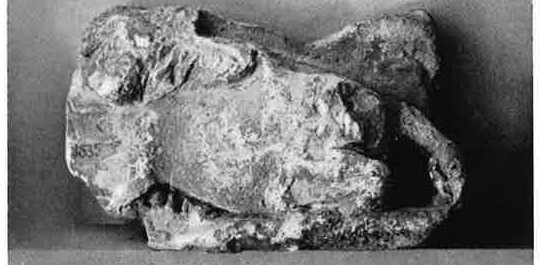
Fragment of a sandstone tauroctony relief from Schwadorf area, ancient Aequinoctium in Pannonia Superior, depicting Mithras killing the bull; the upper part of Mithras's body, the head, and parts of the bull are lost.
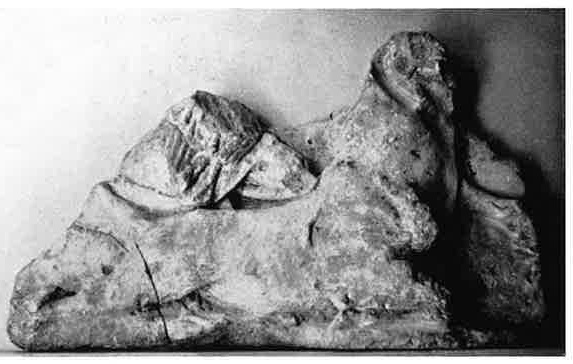
Fragment of a large sandstone tauroctony relief from Schwadorf, ancient Aequinoctium, depicting Mithras killing the bull; the upper part of the god's body, his head, the end of the tail, and the scorpion are lost.
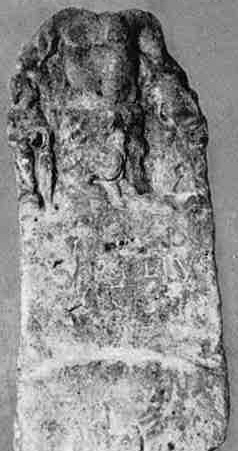
Limestone relief from Schwadorf, ancient Aequinoctium in Pannonia Superior, depicting the naked Mithras being born from the rock with a serpent encircling it, flanked by torchbearers; one of the finest examples of this iconographic type from the Danubian region…
Small Mithraic sanctuary (9.28 × 4.52 m) found at Modrič near Našice in Slavonia, Pannonia Superior, in 1911; the sanctuary has the standard corridor and bench division with a water-basin in the pronaos, and yielded a rich assemblage of marble reliefs…
Marble altar from Hrastnik near Trojane, ancient Atrans in Pannonia Superior, dedicated to Deo invicto Mithrae by Eutyches, contrascrip of the conductores portorii publici, slave of the Iulii, acting as vicarius of Benignus, vilicus of the statio Atrantiana…
Right portion of a sandstone altar from Topusko, Pannonia Superior, formerly used as a step in a bathing establishment, dedicated to Invicto Mithrae by Maximus with his companions.
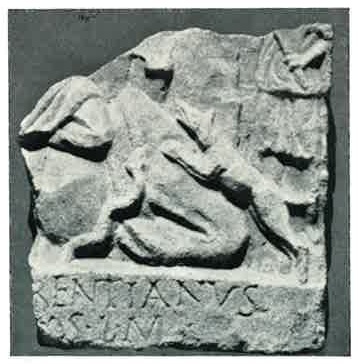
Right portion of a marble tauroctony relief from near Pregrade, Pannonia Superior, preserving Mithras killing the bull with dog, serpent, and scorpion; the greater part of the god and the bull's head are lost.
Small limestone altar from near Višnja Gora, Pannonia Superior, dedicated to Fonti perenni — the eternal spring — a dedication associated with the Mithraic water cult.
Limestone slab from the Mithraeum at Pohanica, Noricum, elaborately carved on both faces; a metal plate originally attached by pins to its interior was removed, probably by the Mithraists themselves — paralleled at Poetovio.
Sandstone altar with akroteria from the Mithraeum at Pohanica, Noricum, dedicated to Deo invicto Mithrae by Marcianus; the frame bears two outward-pointing darts as a decorative motif.
Small Mithraic sanctuary found in the slope of a ravine called Zlodjer (Devil's Ditch) at Ober-Pohanica near Zdole, Noricum; the finds are among the finest marble Mithraic sculpture from the eastern Alpine provinces.
Left upper corner of a sandstone tauroctony relief from Celje, ancient Celeia in Noricum, preserving the bust of Sol, the head of a torchbearer, and the head of Mithras himself.
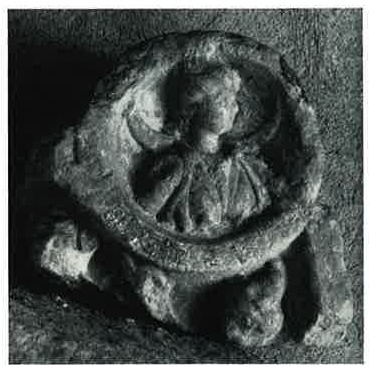
White marble relief fragment from near Klein-Wagna, ancient Flavia Solva in Noricum, preserving part of a tauroctony scene including the bull, Mithras's dagger, and the torchbearers.
Natural grotto called the Bichl on the south slope above the Glanegg lake near St. Urban, Noricum, adapted as a Mithraic sanctuary; part of the grotto floor was paved and remnants of water installations survive.
Altar from the Drave valley between Teurnia and Virunum, Noricum, now reused as a pedestal for a cross, dedicated to Invicto deo Mithrae for the welfare of Marcus Publius Potens by his freedman Ursulus.
