Your search Cerro de San Albín gave 592 results.

Sandstone statue from near Mithraeum III at Aquincum, Pannonia Inferior, depicting a lion to the right with an open frontal mouth, holding an ox head between its forefeet with a red-painted tongue.
Sandstone statue from near Mithraeum III at Aquincum, Pannonia Inferior, probably depicting Mithras's rock-birth.
Third Mithraic sanctuary at Aquincum, Pannonia Inferior, between the Amphitheatre and the Krempelmühle, attested by five altars and a decorated mosaic; the building itself is not fully known.
Second Mithraic sanctuary discovered at Altofen in 1888, Pannonia Inferior; rectangular (15.03 × 7.06 m) and raised two metres above ground, with benches and a cult niche; one of the most fully excavated Mithraea from the Danubian region.
Sandstone altar from Carnuntum, Pannonia Superior, found near the theatre in 1890, dedicated to Deo Soli by Aurelius Exuperatus.
Sandstone altar from Carnuntum, Pannonia Superior, dedicated to Soli deo by Iulius Iulianus.
Small sandstone altar from Carnuntum, Pannonia Superior, dedicated to Deo Soli invicto by a dedicant whose name reads Sacellus; found in the Burgfeld in 1878.
Lost sandstone altar from Carnuntum, Pannonia Superior, dedicated to Soli invicto deo.
Sandstone altar from Carnuntum, Pannonia Superior, dedicated jointly to Invicto deo by Baebius Martialis and Ulpius Breucianus.
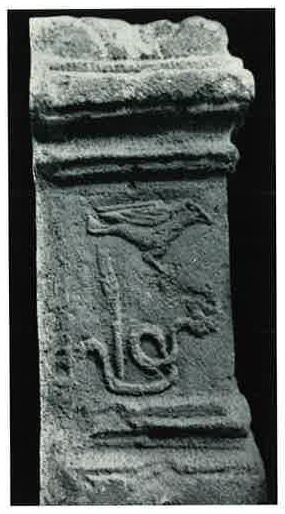
Sandstone altar from Carnuntum, Pannonia Superior, found in a flue of Building VII in 1899, decorated on the left with a raven, corn-ear, and serpent stacked vertically and on the right with a lying lion; dedicated to Invicto deo Mithrae.
Minor finds from Mithraeum III at Carnuntum, Pannonia Superior, including lamps, bricks, pottery, and serpent-vase fragments; a coin of Macrinus (AD 217) from the entrance may provide a terminus, and the sanctuary is attested as restored in AD 307.
Small sandstone altar from Mithraeum III at Carnuntum, Pannonia Superior, dedicated by Munatius, a centurion of an unspecified legion.
Sandstone plate from Mithraeum III at Carnuntum, Pannonia Superior, dedicated to Deo invicto by Caius Iulius Propinquus, who built a wall ex voto; traces of red on the rim.
Two sandstone fragments from Mithraeum III at Carnuntum, Pannonia Superior, comprising a base with one leg and a downward torch, and a Phrygian-capped head of Cautopates; probably stood at the beginning of the benches alongside the Cautes statue.
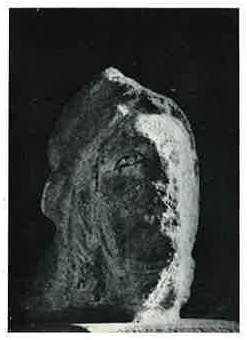
Two sandstone fragments from Mithraeum III at Carnuntum, Pannonia Superior, belonging to a torchbearer statue probably of Cautes, comprising a Phrygian-capped head with painted eyes and a body fragment; the statues probably stood at the beginning of the benches…
Inscription from Mithraeum III at Carnuntum, Pannonia Superior, recording that Titus Flavius Viator built or founded something for Deo invicto; the verb condi fecit is interpreted as referring to the construction of the sanctuary.
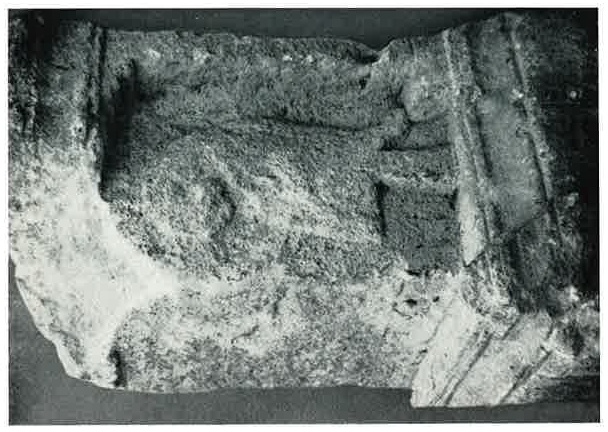
Sandstone altar from Mithraeum I at Carnuntum, Pannonia Superior, decorated on each lateral face with a Phrygian cap upon a dagger — a distinctive Mithraic iconographic pairing — and bearing an inscription on the front.
Large sandstone altar from Mithraeum I at Carnuntum, Pannonia Superior, with Cautopates cross-legged carved on the left side and Cautes walking on the right, both holding their torches with two hands; the front bears an inscription.
Cone-shaped sandstone stone encircled by a serpent from Mithraeum I at Carnuntum, Pannonia Superior, probably forming the base of a rock-birth group.
Sandstone statue from Mithraeum I at Carnuntum, Pannonia Superior, depicting a lying lion with a bull's head before its forefeet; a large opening at the back of the head communicated with a channel below, suggesting use as a cult water outlet.
