Your search Farid ud-Din Attar gave 891 results.

A white marble statue from the Mithraeum at Walbrook in London, depicting Bonus Eventus standing in a long hanging cloak, leaning on a ship's stem, holding a cornucopia against his shoulder and a patera above a burning altar from the back of which a…
Mithraic sanctuary found at Sárkeszi near Székesfehérvár, Pannonia Inferior, in a place called Ságvölgyi; yielding altars, tauroctony reliefs, and cult objects.
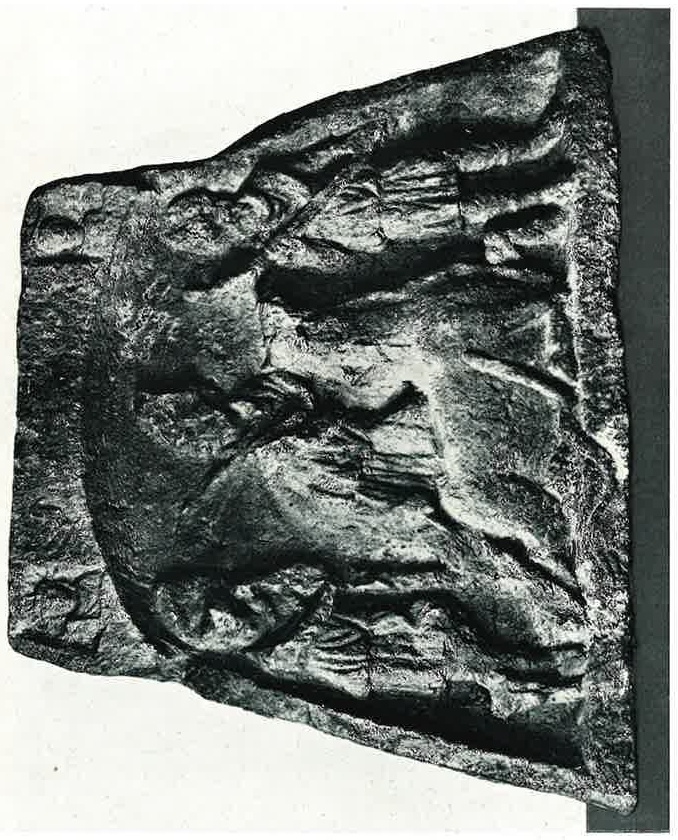
Mithraic sanctuary found in the district of Campona near Nagytétény, Pannonia Inferior, in 1934, yielding three inscribed altars, statue fragments, and other cult objects.
Stone lamp installation, vessels and bronze chain links associated with ritual activity inside the Mithraeum of Vindobala.
Sandstone ritual basin discovered in situ beside the north bench of the Vindobala Mithraeum.
Sculpted stone heads and statue fragments belonging to Mithraic torchbearers from the nave of the Vindobala Mithraeum.
Mithraic statue from Vindobala discovered in 1844 and subsequently broken up.
Group of five uninscribed ritual altars discovered at different points inside the Mithraeum of Vindobala.
Oolitic stone statuette of the torchbearer Cautopates discovered in Drury Lane, Londinium.
Major Mithraic sanctuary in the City of London with east-west orientation, multiple building phases and rich sculptural finds.
Base from Aquincum, Pannonia Inferior, recording that Marcus Aurelius Frontinianus and Marcus Aurelius Fronto, soldiers of Legio II Adiutrix and fratres, built a temple to Soli socio; dated to the consulship of Antoninus, either AD 213 or 222.
Marble tauroctony relief from Aquincum or possibly Budaörs, Pannonia Inferior, depicting the bull-slaying scene with cypress trees between the torchbearers and the central group.
Marble tauroctony relief from Aquincum, Pannonia Inferior, found at Budapest III, Fötér, depicting Mithras as bull-slayer with both torchbearers flanking the central group.
Terracotta relief from Aquincum, Pannonia Inferior, depicting a Venus-like goddess in the company of a child holding a fruit basket; its association with the Mithraeum is probable but not certain.
Fourth Mithraic sanctuary discovered near the southern town-wall of Aquincum, Pannonia Inferior, between a rectangular building and an apsidal structure; excavated in 1941–42 and yielding the most complete sculptural assemblage from the city.
Sandstone statue from near Mithraeum III at Aquincum, Pannonia Inferior, depicting a lion to the right with an open frontal mouth, holding an ox head between its forefeet with a red-painted tongue.
Third Mithraic sanctuary at Aquincum, Pannonia Inferior, between the Amphitheatre and the Krempelmühle, attested by five altars and a decorated mosaic; the building itself is not fully known.

Vicus Baudobriga was a Roman settlement on the left bank of the Rhine, founded during the conquest of Gaul. Its development reflects the Rhine’s shifting role as frontier, trade route, and fortified border before Roman withdrawal.
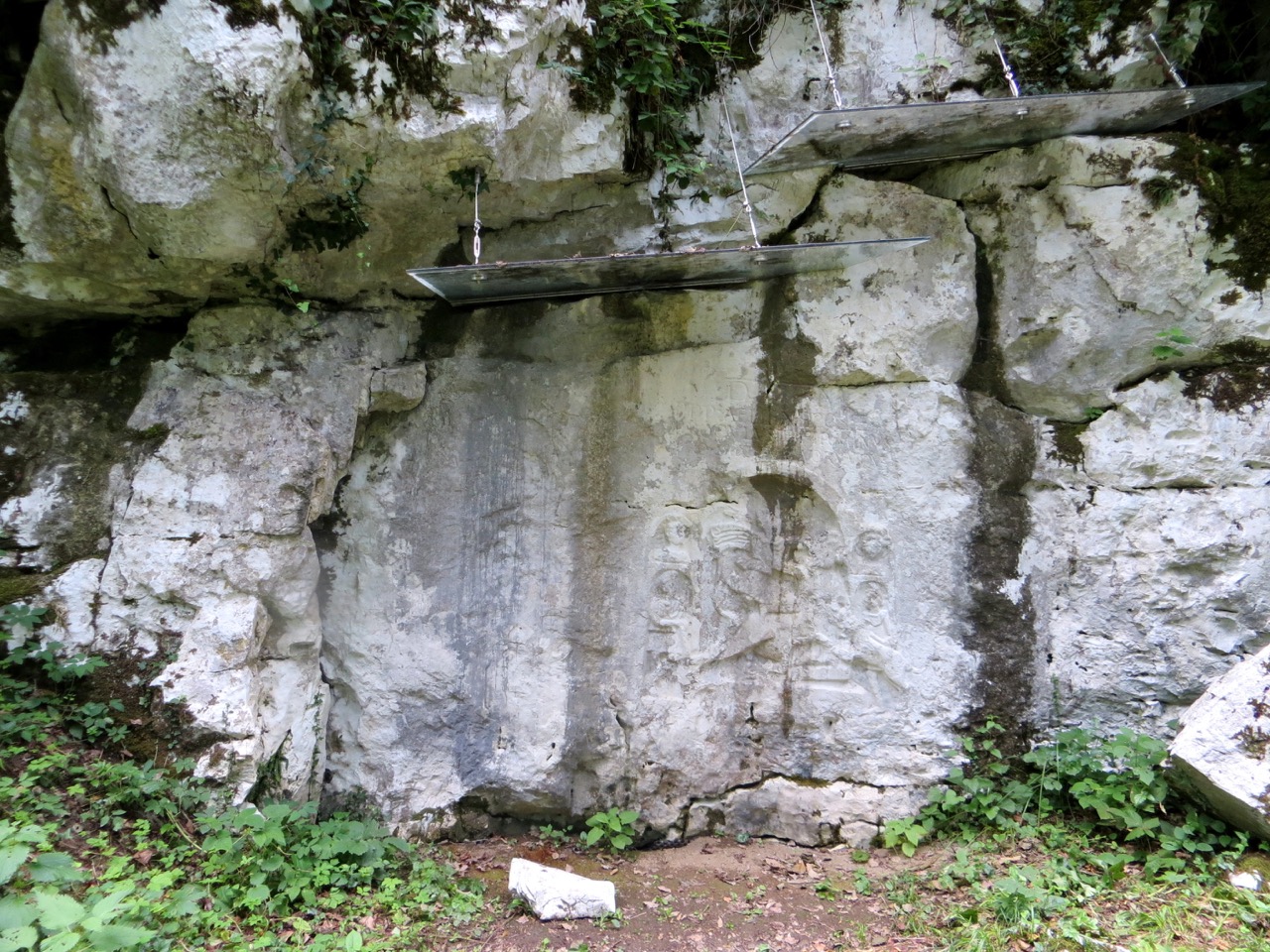
According to Hitzinger remnants of animal bones were found in front of the relief of the Mithraeum at Rozanec.