Your search Frankfurt am Main gave 1171 results.

Sandstone stele from Mithraeum I at Stockstadt depicting Cautes cross-legged in Oriental dress, resting his left hand on a pedum
Sandstone stele from Mithraeum I at Stockstadt showing Cautopates in Oriental dress, cross-legged, holding a burning torch down and resting on a pedum
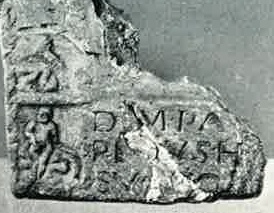
Lower portion of a red sandstone stele of Cautes from Mithraeum I at Stockstadt, cross-legged, with a dedicatory inscription on the base
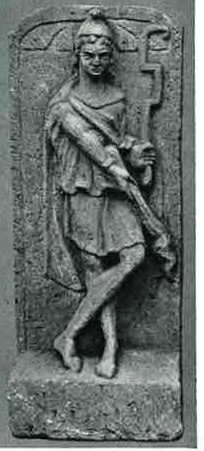
Red sandstone stele from Mithraeum I at Stockstadt depicting Cautopates in Oriental dress, cross-legged, holding a downward torch
Votive altar from Mithraeum I at Stockstadt, dedicated to Deo invicto Mithrae by Perpetuus, a haruspex, at his own expense
Double-sided white sandstone relief from Mithraeum I at Stockstadt, with Mithraic imagery on both faces
Fragment of a sandstone relief from Mithraeum I at Stockstadt depicting a beardless figure in a velum, identified as a wind or winter deity

The Mithraeum II in Stockstadt was in fact the first one known built in the vicus. It was destroyed by fire around 210.
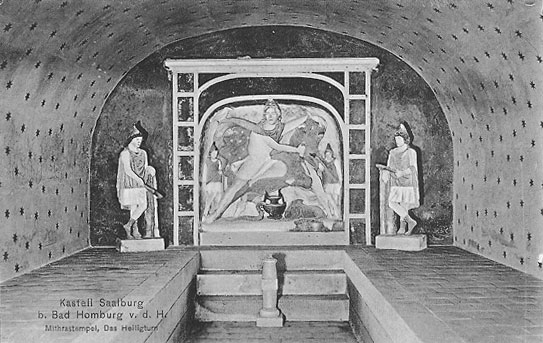
In the 1900s a model Mithraeum was built in Saalburg in the mistaken belief that there was an original temple of Mithras in an ancient Roman building.
The Mithraeum of Pamphylia was cut back into the rock to form a cave, with a separate relief of Mithras killing the bull.
This inscription by Luccius Crispus was found near the entrance of the Mithraeum at Pamphylia.
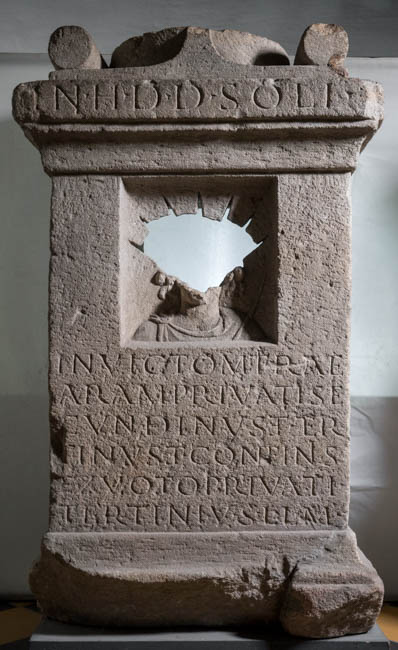
The altar of the Sun god belongs to the typology of the openwork altar to be illuminated from behind.

One of the few Mithraists whose progression from Nymphus to Miles and eventually to Pater may be traced epigraphically at Dura Europos.

Late Roman senator and governor of Numidia whose inscriptions present him as a Mithraic pater and initiate in several mystery cults.
Limestone slab dedicated to the invincible Sun by the governor Marcus Aurelius Decimus near the temple of Aesculapius.

Solicinium occupied an important position within the frontier region of southwestern Germania.
The Neusiedl lake region formed part of the western frontier landscape of Roman Pannonia.
Camulodunum, modern Colchester, was among the earliest coloniae established in Britannia after the Roman conquest.
Campona occupied a strategic position south of Aquincum along the Danube frontier.
Bingen occupied a strategic position at the confluence of the Rhine and Nahe rivers.
