Your search Freiberg am Neckar gave 1045 results.

Marble altar rim from Mithraeum I at Carnuntum, Pannonia Superior, preserving only the beginning of the dedicant's name: Caius Fron-.
Inscription from Carnuntum, Pannonia Superior, recording the restoration of a collapsed Mithraic spelaeum by Caius, identified only by the first three letters of his name; whether dedicated to Deo invicto or Soli invicto is disputed.
Fragmentary marble inscription from Stix-Neusiedl, Pannonia Superior, preserving only the end of a dedicant's name (-mus) and the abbreviated closing formula.
Marble altar fragment from Mithraeum III at Ptuj, ancient Poetovio, dedicated to Deo invicto Mithrae by a dedicant whose name is partially preserved as -us Candidus.
Damaged marble relief from Mithraeum III at Ptuj, ancient Poetovio, preserving Cautopates with torch downward on the right and the outline of a standing Cautes on the other side, with a fragmentary inscription in the lower border.
Corner of a marble altar from Mithraeum III at Ptuj, ancient Poetovio, dedicated to Deo Soli invicto Mithrae for the welfare of persons whose names begin Atti- and Saturni-; the rest, including the dedicant, is lost.
Fragment of a large marble cornice from Mithraeum III at Ptuj, ancient Poetovio, preserving only the beginning of the name Iulian- from the inscription below.
Fragmentary inscription from Mithraeum II at Ptuj, ancient Poetovio, preserving only the beginning of a name: Titus V-.
Fragment of a marble relief from Mithraeum II at Ptuj, ancient Poetovio, preserving a woman's head adorned with a wreath; probably a secondary deity from the sanctuary's sculptural programme.
Marble inscription fragment from Mithraeum II at Ptuj, ancient Poetovio, preserving only the beginning of a name: Aulus Po-.
Marble torso from Mithraeum II at Ptuj, ancient Poetovio, probably representing a winged, reclining bull with two vertical attachment ligaments on the reverse.
Fragmentary inscription from Mithraeum II at Ptuj, ancient Poetovio, preserving only the end of a dedicant's name (-ciano) and the closing formula.
Inscription from Mithraeum II at Ptuj, ancient Poetovio, dedicated to Deo Soli invicto Mithrae by Ulpius, a veteran, for himself and his family.
Upper portion of a marble altar from Mithraeum II at Ptuj, ancient Poetovio, dedicated to Deo Soli invicto Mithrae for the welfare of Aurelius; the rest of the name is lost.
Marble statue on base from Mithraeum II at Ptuj, ancient Poetovio, depicting the naked Mithras entwined by a serpent as he emerges from the rock; the breast is damaged, and the head and arms are lost.
Inscription on the column base from Mithraeum II at Ptuj, ancient Poetovio, dedicated to Deo invicto Mithrae for the welfare of the Emperors and Geta Caesar by Salvianus, contrascrip of the statio Atrantiana; Geta's name was subsequently erased.
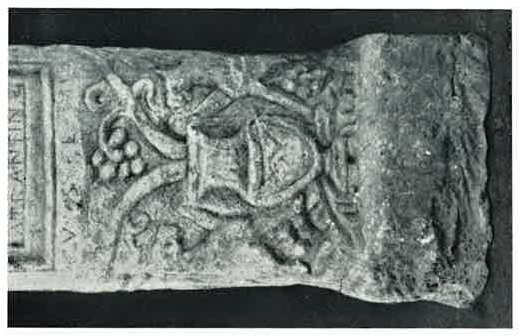
Marble column from the entrance of Mithraeum II at Ptuj, ancient Poetovio, serving as a statue base, its front decorated with a kantharus between panthers and vine tendrils; the inscription names Salvianus, contrascrip of the statio Atrantiana.
Fragmentary marble altar from Ptuj, ancient Poetovio, dedicated to Deo Soli invicto Mithrae by a dedicant identified with the publicum portorium Illyricum; the name may be Iulius or Iulianus.
Fragment of a small altar from Ljubljana, ancient Emona in Pannonia Superior, preserving a dedication to Invicto Mithrae by a dedicant whose name ends in -quartus; the Mithraic attribution is not entirely certain.
Altar from Töltschach am Zollfeld, Noricum, dedicated to Soli invicto Mithrae for the welfare of the Augustus in honour of the Domus Divina by Hilarus, imperial freedman and tabularius patrimonii regni Norici, and Epictetus, imperial arkarius…
