Your search Mühltal am Inn gave 1066 results.
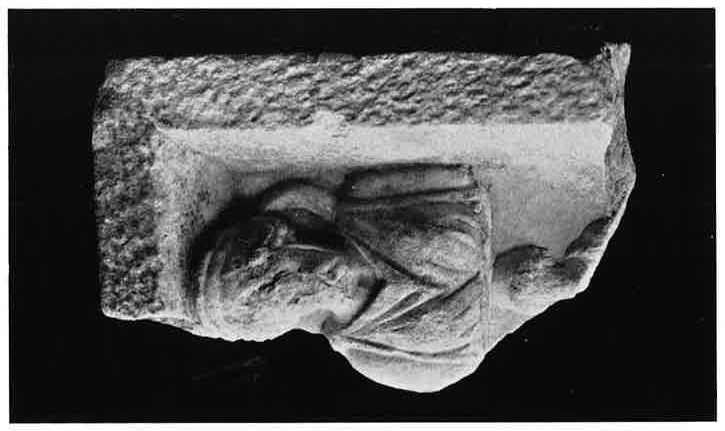
Right upper corner of a white marble bordered tauroctony relief from Salona or its surroundings, Dalmatia, with framing elements and part of the bull-slaying iconography.

Plate fragment from Intercisa, Pannonia Inferior, bearing a fragmentary inscription beginning Soli... Aug-.
Marble relief fragment from Intercisa, Pannonia Inferior, too damaged for the original subject to be identified.
Large limestone altar from near Mithraeum III at Aquincum, Pannonia Inferior, with a hole in the base probably designed to hold a cult object; the detailed iconographic programme of this altar is notable within the Aquincum Mithraic assemblage.
Third Mithraic sanctuary at Aquincum, Pannonia Inferior, between the Amphitheatre and the Krempelmühle, attested by five altars and a decorated mosaic; the building itself is not fully known.
Two marble reliefs of the same height from Brigetio, Pannonia Superior, each depicting a cross-legged torchbearer in Oriental dress — Cautes and Cautopates — holding their torches.
Small sandstone altar from Carnuntum, Pannonia Superior, dedicated to Deo Soli invicto by a dedicant whose name reads Sacellus; found in the Burgfeld in 1878.
Altar from Petronell, ancient Carnuntum, Pannonia Superior, dedicated to Soli divino ex visu by Lucius Aelius Leo — possibly the same individual who dedicated a further altar identifying himself as a miles of Legio XIIII Gemina.
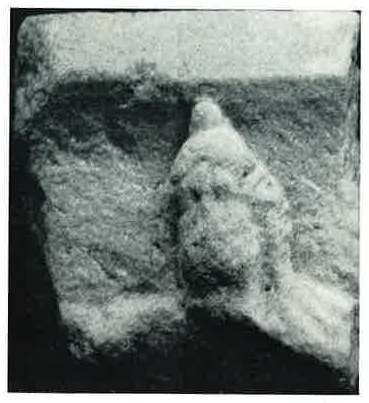
White marble relief fragment from Carnuntum, Pannonia Superior, preserving the upper part of a figure in Oriental dress with the beginning of an upraised right arm — probably Cautes.
Altar from Petronell, ancient Carnuntum, Pannonia Superior, dedicated to Deo invicto Mithrae by Aurelius, whose name is only partially preserved.
Minor finds from Mithraeum III at Carnuntum, Pannonia Superior, including lamps, bricks, pottery, and serpent-vase fragments; a coin of Macrinus (AD 217) from the entrance may provide a terminus, and the sanctuary is attested as restored in AD 307.
Two sandstone fragments from Mithraeum III at Carnuntum, Pannonia Superior, comprising a base with one leg and a downward torch, and a Phrygian-capped head of Cautopates; probably stood at the beginning of the benches alongside the Cautes statue.
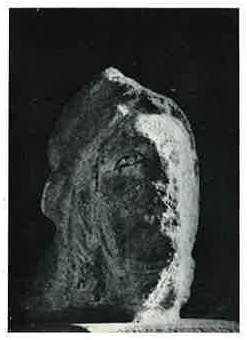
Two sandstone fragments from Mithraeum III at Carnuntum, Pannonia Superior, belonging to a torchbearer statue probably of Cautes, comprising a Phrygian-capped head with painted eyes and a body fragment; the statues probably stood at the beginning of the benches…
Minor finds from Mithraeum I at Carnuntum, Pannonia Superior, comprising legionary brick stamps, burnt coal and wood, ash with ox, sheep, and goat bones, and fragments of serpent-vases; the coin evidence points to a terminus ante quem in the early third century…
Inscription from Carnuntum, Pannonia Superior, recording the restoration of a collapsed Mithraic spelaeum by Caius, identified only by the first three letters of his name; whether dedicated to Deo invicto or Soli invicto is disputed.
Fragmentary marble inscription from Stix-Neusiedl, Pannonia Superior, preserving only the end of a dedicant's name (-mus) and the abbreviated closing formula.
Marble altar fragment from Mithraeum III at Ptuj, ancient Poetovio, dedicated to Deo invicto Mithrae by a dedicant whose name is partially preserved as -us Candidus.
Damaged marble relief from Mithraeum III at Ptuj, ancient Poetovio, preserving Cautopates with torch downward on the right and the outline of a standing Cautes on the other side, with a fragmentary inscription in the lower border.
Corner of a marble altar from Mithraeum III at Ptuj, ancient Poetovio, dedicated to Deo Soli invicto Mithrae for the welfare of persons whose names begin Atti- and Saturni-; the rest, including the dedicant, is lost.
Fragment of a marble relief from Mithraeum II at Ptuj, ancient Poetovio, preserving a woman's head adorned with a wreath; probably a secondary deity from the sanctuary's sculptural programme.
