Your search Monteu da Po gave 2934 results.

Marble altar from Poljčane between Celje and Maribor, Pannonia Superior, dedicated to Deo invicto Mithrae by Lucius Annius Serecinus for the welfare of his grandson Lucius Annius Verus — a rare three-generation Mithraic dedication.
Fragmentary inscription from Pola preserving a possible reading of the name Atticus.
An earthen lamp bearing the name of C. Dessi along with two coins of Constantine and one of Gratianus, found in the Mithraeum at Spoleto in Umbria.
An oxidized sacrificial knife found in the Mithraeum at Spoleto in Umbria.
A terracotta arm found near the cone-shaped stone in the Mithraeum at Spoleto, the hand holding a broken object possibly from a representation of Mithras's rock-birth.
A small bone statuette from the Mithraeum at Spoleto, depicting a youth dressed in tunic and long cloak with a laurel wreath around the head.
Two surviving wall paintings from the side-benches of the Mithraeum at Spoleto, out of an original six, depicting a cloaked bearded man identified as Saturn holding a sickle and a youth in a red shoulder-cape holding a money-bag, probably representing the seven planets…
A triangular prism in cipollino marble with a hollow on the upper side, found standing in front of the cone-shaped stone in the Mithraeum at Spoleto.
A cone-shaped piece of stone with a square hole found to the left of the altar in the Mithraeum at Spoleto, unlikely to have supported a representation of Mithras's rock-birth despite earlier suggestions, given that the stone tapers slightly.
A travertine altar bearing a brief dedication to Sol Invictus Mithras, found before the main niche in the Mithraeum discovered at Spoleto in 1878 near the Porta S. Gregorio.
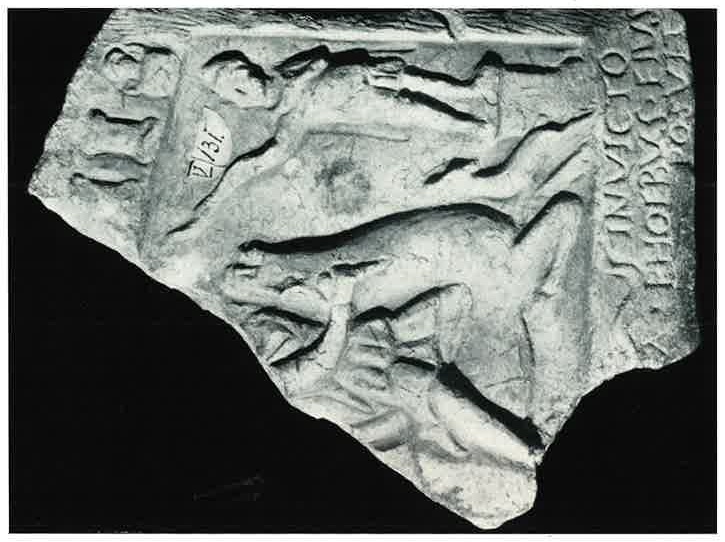
White marble tauroctony relief fragment from Romula, Dacia, now in Turnu Severin; the composition is partially preserved.
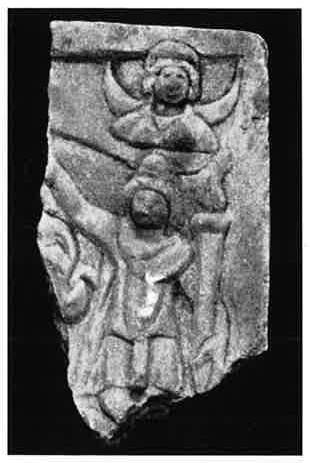
White marble tauroctony fragment from Turda, Dacia, preserved in the Deva Museum, showing only the forepart of Mithras killing the bull with the god's snout.
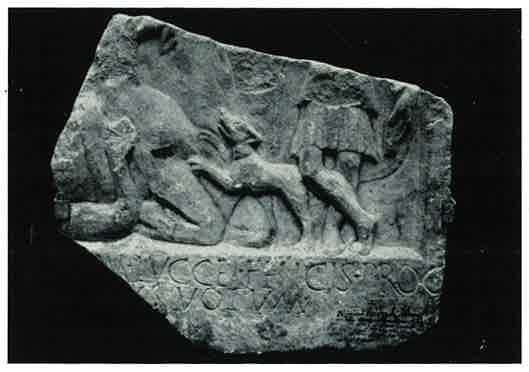
Marble tauroctony relief from Sarmizegetusa, Dacia, found at Zám and subsequently in various private collections; depicting the standard bull-slaying.
Three white limestone fragments from the Mithraeum at Sarmizegetusa, Dacia, preserving the hind leg of a lion in a vertical position and a serpent apparently moving towards a rock — possibly a rock-birth scene.
Small marble fragment from the Mithraeum at Sarmizegetusa, Dacia, preserving small parts of the bull and Mithras's dagger.
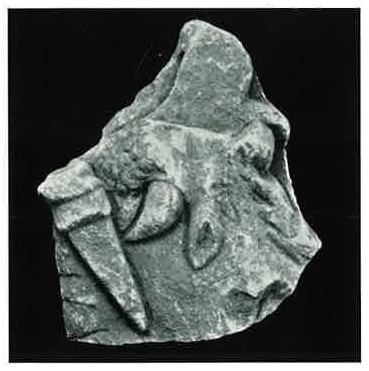
Marble fragment from the Mithraeum at Sarmizegetusa, Dacia, preserving the neck and head of the bull together with Mithras's dagger.
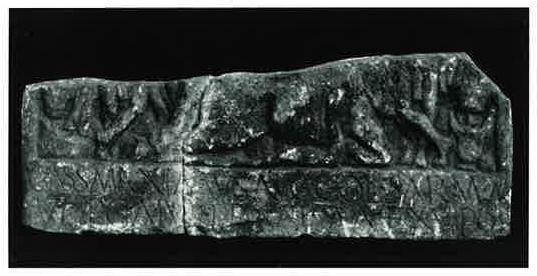
Two sandstone tauroctony relief fragments from the Mithraeum at Sarmizegetusa, Dacia, preserving the lower right portion of the bull-slaying scene.
Fragment of a bluish marble tauroctony from the Mithraeum at Sarmizegetusa, Dacia, preserving the border of Mithras's tunic, the sheath of the dagger, and his right foot.
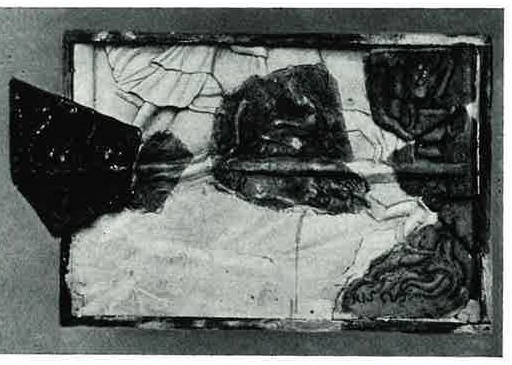
Seven fragments of a marble tauroctony relief from the Mithraeum at Sarmizegetusa, Dacia, preserving Mithras's breast, parts of the bull, and subsidiary scenes.
Inscription from Apulum, Dacia, dedicated to Soli invicto Mithrae by Turranius Marcellinus and Antonius Senecio Iunior, conductores armamentarii — managers of the imperial arms depots.
