Your search Roman cemetery of St. Matthias gave 2751 results.

Group of Mithraic finds distributed across different localities named San Zeno along the Verona–Brenner route.
Second-century Mithraeum discovered in the lower storey of the Curia complex at Cosa.
Group of Mithraic and other cult remains possibly originating from several neighbouring sanctuaries destroyed or abandoned in Late Antiquity.
Archaeological remains connected with the Praetorian camp and the presence of Mithraic worship among the imperial guard.
Marble cippus from the Quirinal residence of Ceionius Iulianus Kamenius preserving references to his Mithraic and other priestly functions.
Monumental inscription honouring the senator and Mithraic pater Kamenius together with his numerous priestly offices and initiatory roles.
Inscription now preserved in the Palazzo Ducale of Urbino whose wording may point to the existence of a Mithraic community.
Group of nearby religious dedications associated with soldiers of the Legio III Augusta and the wider sacred landscape around the Mithraeum.
Reworked limestone altar dedicated by the governor of Numidia during the period of the Diocletianic persecutions.
Limestone altar dedicated to Sol Invictus Mithras by the governor and military commander Marcus Valerius Maximianus.
Architectural and numismatic finds from the Mithraeum at Serdica, Thracia, comprising a door cornice, a capital fragment, two pilaster pieces, a stone water-basin, and two coins of Arcadius deposited when the sanctuary was reused as a cellar.

White marble tauroctony relief from Sofia, ancient Serdica in Thracia, found near the Church of St. Kral, depicting the standard bull-slaying with the full iconographic programme.
Inscription from Viminacium, Moesia Superior, recording that Caius Iulius Valerius, veteran of Legio VI Claudia, restored a Mithraic sanctuary destroyed by lightning at his own expense.
Inscription from Smederevo, Moesia Superior, dedicated to Deo invicto Mithrae by Publius Aelius Valerianus, vestiarius — a clothing-dealer or military garment officer.
Right portion of a limestone Cautes relief from Kostolac, ancient Viminacium in Moesia Superior, depicting Cautes standing on an elevation in Oriental dress — not cross-legged — with a semicircle above him, probably Sol's nimbus.
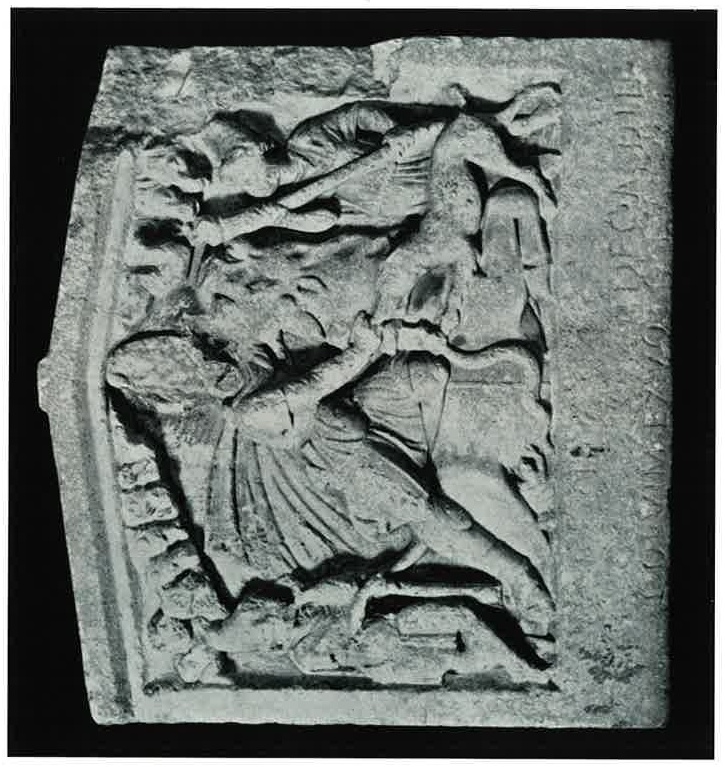
White marble tauroctony relief from Kostolac, ancient Viminacium in Moesia Superior, formerly walled into the Castle of George Branković at Smederevo, depicting the standard bull-slaying.
Sandstone altar from Romula, Dacia, dedicated to Deo invicto Mithrae by Aurelius Rufus ex voto, with the busts of Sol and Luna flanking the text.
Fragment of the right part of a marble relief from Romula, Dacia, depicting Sol standing in a four-horse chariot.
Marble altar fragment from Romula, Dacia, with only the letters DE carved out, tentatively supplemented as De[o Soli invicto]; the attribution is questionable.
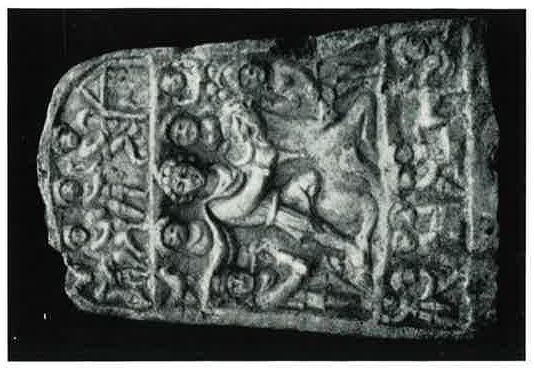
Yellow marble tauroctony relief from Romula, Dacia, found in 1912, depicting the standard bull-slaying with Sol and Luna in the upper corners.
