Your search San Giovanni al Timavo gave 3161 results.

Two marble frieze fragments with incised busts of Sol, Luna, Mars, Jupiter, and Venus, one found in 1890 in the outer porticus of the Theatre and one found in 1938 near the Mithraeum at Ostia.
Inscription dedicated to Sol Invictus, Omnipotent and Holy Caelestis, with Fortuna Lares and Tutelae, found near the Mitreo Sabazeo at Ostia, dedicated by Venerandus.
Marble slab recording the exedra of Arpocrates, reused in the pavement of the floor of the Mitreo Sabazeo at Ostia.
Lower part of a torchbearer statue, cross-legged in anaxyrides and short tunic, from one of the bases at the beginnings of the podia in the Mitreo delle Sette Porte at Ostia.
Fragments of a green-glazed maiolica krater with silver sheen, probably decorated with a dodekatheon showing Minerva, Jupiter, Dionysus, and Hercules, from the Mitreo delle Sette Porte at Ostia.
Fragmentary marble tablet inscription mentioning Sol Invictus Mithras and a priest, from Tivoli (ancient Tibur), possibly of urban origin.
Two marble busts of youthful figures with Phrygian caps, probably representing the torchbearers Cautes and Cautopates, from the Villa Borghese collection, found at Formiae.
White marble plate inscription dedicated to Soli Invicto pro salute, from Caesarea of Mauretania (modern Cherchel).
Inscription dedicated to Sol Invictus with a votive formula pro salute, from Mozaïaville.
Relief depicting Mithras killing the bull in scaled armour, with Luna and Sol busts in the upper corners, found at the cavalry barracks of Sétif in 1861.
Inscription dedicated to Deus Sol Invictus for the wellbeing of Emperor Probus and the municipality, from Chidibbia, dated 276-282 A.D.
Limestone statue of a standing lion with mouth half-open, legs and tail lost, from the Mithraeum near Memphis, Egypt.
Fragment of a white marble relief depicting the head of Mithras with Phrygian cap and nimbus, found on the Syrian coast between Lattakieh and Tartous, first half of 2nd century A.D.
Engraved Nâma inscription addressed to Antoninus, a pious syndexios, from the Mithraeum of Dura-Europos, Syria.
Painted inscription naming the patres and other initiates of the Mithraeum, above the podium in the south-west corner of the Mithraeum of Dura-Europos, Syria.
Fragment of a figure dressed like Mithras in the banquet scene, found in the rubble of the Mithraeum of Dura-Europos, Syria.
Painted zodiac signs covering earlier figures in Phrygian cap in the arched niche of the Later Mithraeum of Dura-Europos, Syria, 3rd century A.D.
Great royal inscription of Antiochus I of Commagene carved on the thrones at Nemrud Dağı, invoking Apollo-Mithras-Helios among the guardian deities of the kingdom, 69–34 B.C.
Fragments of censers (Räucherschalen), thirteen lamps, and bronze and iron fittings from Mithraeum II at Stockstadt
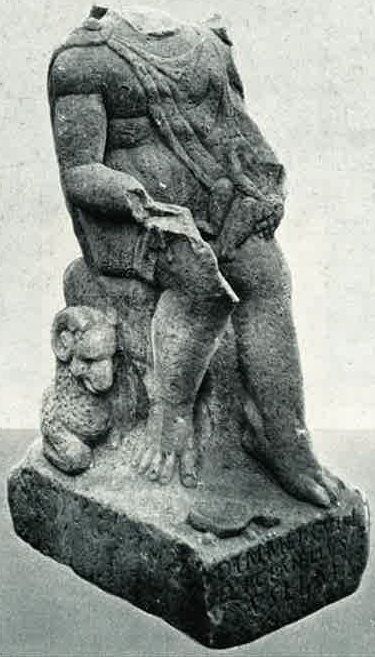
Sandstone statue of Mercury seated on a rock from Mithraeum II at Stockstadt, found near location 5 in the sanctuary
