Your search San Giovanni al Timavo gave 3157 results.
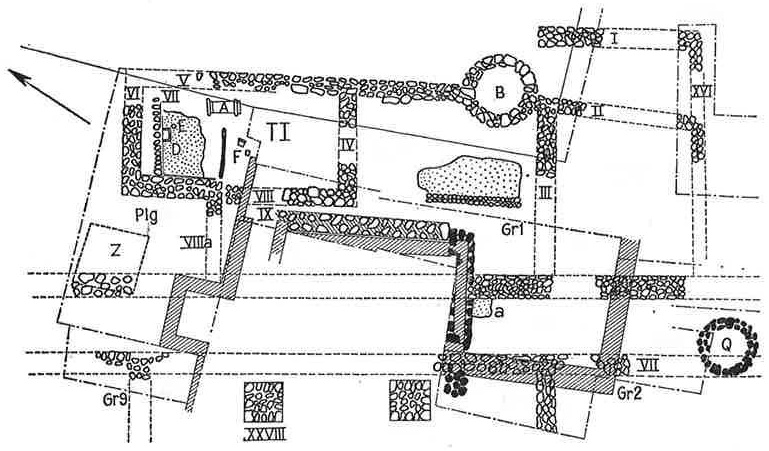
Mithraic sanctuary found in the Tummelplatz at Linz, ancient Lentia in Noricum, constructed within an existing building; the sanctuary yielded marble reliefs, an altar, cult pottery, and a silver votive object.

Small Mithraic sanctuary (8 × 8 m) excavated in 1950–52 on a slope west of Schloss Moosham, Noricum, on the left bank of the river Mur; the finds include a marble epistylium, a Mithras head, and fragmentary altars.
A skull and two human femora, the lower jaw missing, recovered from a small circular pit within the Mithraeum at Königshoffen; interpreted by Cumont as a parallel to ritual deposits of human remains in other Oriental sanctuaries on the Janiculum.
Square sandstone fire-basin from the Mithraeum at Königshoffen bearing a partially legible dedication to Deo Mithrae; found near the entrance area.
Grey sandstone slab from the Mithraeum at Königshoffen, a companion piece to the preceding, recording the same act of repainting a cult image by Caius Celsinius Matutinus, veteran of Legio VIII Augusta Alexandriana.
Grey sandstone tauroctony relief from the Mithraeum at Königshoffen, heavily restored, depicting Mithras killing the bull with Cautes and Cautopates and the busts of Sol and Luna; only the lower part of Cautopates and the crossed legs are original.
Small sandstone relief fragment from the Mithraeum at Königshoffen preserving a naked male figure from the thighs to the head, possibly part of a rock-birth scene.
Grey sandstone hand holding a globe from the Mithraeum at Königshoffen, with a lead bar indicating attachment to a larger statue; a second globe with a partial hand was found at the same spot.
Sandstone plate from Beihingen in the Neckar valley, depicting on one side a youth in Oriental dress with a bow in an arched niche, and on the other a corresponding figure; both may represent torchbearers or Mithraic grades.
Sandstone lion from Brumath, ancient Brocomagus, with a votive inscription on its base recording a dedication by Tertius; a common Mithraic cult animal.

Large grey sandstone tauroctony relief from Fellbach near Cannstatt, depicting the bull-slaying in a vaulted grotto with torchbearers, Sol, Luna, and subsidiary Mithraic scenes along the border.
Two rectangular sandstone reliefs from Zasenhausen near Cannstatt, ancient Clarenna, each depicting a male bust with astral symbols on the forehead, arranged in opposing directions.
Small sandstone head in Phrygian cap from Cannstatt, ancient Clarenna, probably belonging to a statue of Cautes or Cautopates.
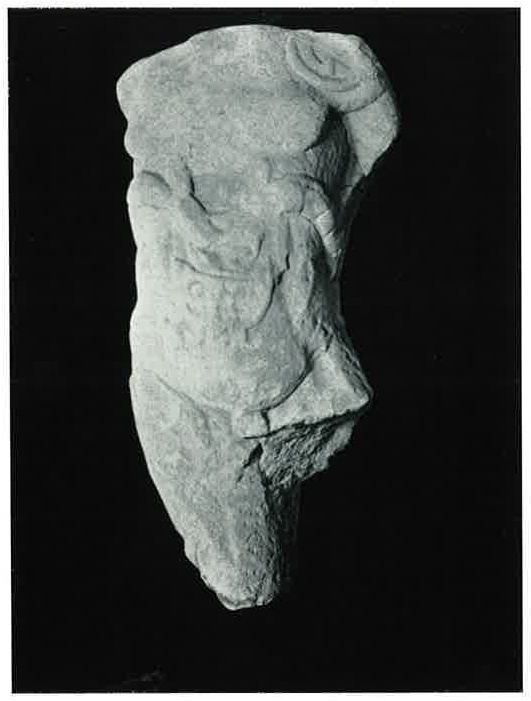
Sandstone statue from Wahlheim, Germania Superior, depicting a naked torso encircled by two serpents holding their heads towards the figure's face — the characteristic iconography of the leontocephaline Aion.
Various altar and base fragments, two sandstone balls, and two millstone fragments from the Mithraeum at Dieburg
Small red sandstone fragment from the Mithraeum at Dieburg preserving a head in a Phrygian cap
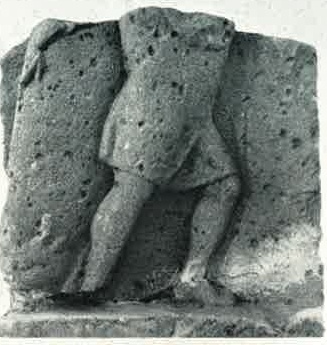
Red sandstone relief from the Mithraeum at Dieburg showing Mithras in Oriental dress carrying the bull on his shoulders
Group of Mithraic monuments preserved in the museums of Liège.
Fragmentary ceramic mould preserving the lower part of a cross-legged Mithraic torchbearer.
Terracotta matrix used to produce vessels decorated with the bull-killing scene of Mithras.
