Your search San Valentino in Abruzzo Citeriore gave 587 results.

Small Mithraic sanctuary (9.28 × 4.52 m) found at Modrič near Našice in Slavonia, Pannonia Superior, in 1911; the sanctuary has the standard corridor and bench division with a water-basin in the pronaos, and yielded a rich assemblage of marble reliefs…
Right portion of a sandstone altar from Topusko, Pannonia Superior, formerly used as a step in a bathing establishment, dedicated to Invicto Mithrae by Maximus with his companions.
Sandstone altar with akroteria from the Mithraeum at Pohanica, Noricum, dedicated to Deo invicto Mithrae by Marcianus; the frame bears two outward-pointing darts as a decorative motif.
Sandstone altar with akroteria from the Mithraeum at Pohanica, Noricum, dedicated to Deo invicto Mithrae by Metilius Iustinianus; the sculptor initially misspelt the name Justianus before correcting it.
Small Mithraic sanctuary found in the slope of a ravine called Zlodjer (Devil's Ditch) at Ober-Pohanica near Zdole, Noricum; the finds are among the finest marble Mithraic sculpture from the eastern Alpine provinces.
Sandstone altar found between Celeia and Emona, Noricum, dedicated to Invicto Mithrae by Surio; the misspelling Mitre for Mithrae reflects local phonology.
Left upper corner of a sandstone tauroctony relief from Celje, ancient Celeia in Noricum, preserving the bust of Sol, the head of a torchbearer, and the head of Mithras himself.
Column found at Sankt Peter in Holz, ancient Teurnia in Noricum, dedicated to Cautes by Lucius Albius Atticus and Caius Albius Avitus — probably father and son — making it a rare joint family dedication to a Mithraic torchbearer.
Several thin silver fragments from the Mithraeum at Linz, ancient Lentia, reconstructed as a votive object surmounted by a crescent or two horns; paralleled in sanctuaries of Jupiter Dolichenus.

Three-fragment terracotta plate from the Mithraeum at Linz, ancient Lentia, with a seven-hole border and a graffito in the centre invoking Iupiter Optimus Maximus; found in the second room of the sanctuary.
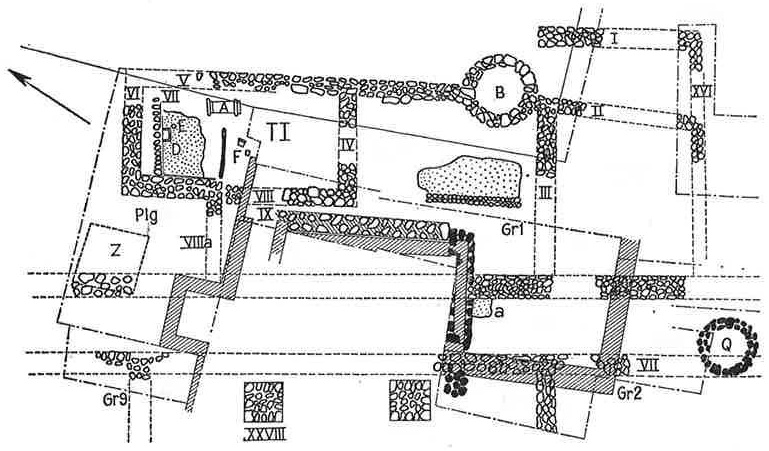
Mithraic sanctuary found in the Tummelplatz at Linz, ancient Lentia in Noricum, constructed within an existing building; the sanctuary yielded marble reliefs, an altar, cult pottery, and a silver votive object.
Small Mithraic sanctuary (8 × 8 m) excavated in 1950–52 on a slope west of Schloss Moosham, Noricum, on the left bank of the river Mur; the finds include a marble epistylium, a Mithras head, and fragmentary altars.
Life-sized sandstone head with long curly hair and Phrygian cap, found at the foot of the Hohenklingen near Stein am Rhein, Raetia; probably belonging to a statue of Cautes or Cautopates.
Square altar from Zwiefalten near Ulm, Raetia, found reused in the apse of a church; local tradition places the original sanctuary on a hilltop between Zell and Zwiefalten, or alternatively near Reichenstein.
Fragmentary limestone relief from Thun-Allmendingen of the same dimensions as the bull relief, depicting a swine; both may have formed part of the sanctuary's ritual décor.
Site excavated by C. F. L. Lohner in 1824–25 at the Renzenbühl near Thun-Allmendingen, Germania Superior, where the outline of five rooms was identified, one or more of which may have served as a Mithraic sanctuary.
Two fragments of a sandstone inscription from Gran in the Vosges, dated to the late second century, recording a dedication to Soli deo invicto by a servant of the dedicant, with possible mention of a portico and columns.
A skull and two human femora, the lower jaw missing, recovered from a small circular pit within the Mithraeum at Königshoffen; interpreted by Cumont as a parallel to ritual deposits of human remains in other Oriental sanctuaries on the Janiculum.
Animal bones from the refuse pit of the Mithraeum at Königshoffen, comprising goat, hen, ox, and deer remains, attesting to ritual feasting within the sanctuary.
Circular sandstone fire-basin with a spout from the Mithraeum at Königshoffen, found near the entrance; one of three fire-basins attested in the sanctuary.
