Your search Sankt Johann im Pongau gave 1046 results.

Ulmetum formed part of the fortified network protecting the lower Danube frontier.
Drmno lies near the important Roman site of Viminacium on the Danube frontier.
St. Wendel is associated with archaeological material from the Roman-period Moselle-Saar region.

A torch end held by a hand in the pose of a dadophore, and another hand holding a small offering, found at the south-east cemetery adjacent to the Mithraeum of Les Bolards (ancient Venetonimagus) in Lugdunensis.
Three epigraphical fragments that together form the word magister, with traces of fire, found at the Mithraeum of Les Bolards (ancient Venetonimagus) in Lugdunensis.
A fine white marble bust of Venus, a head of a helmeted deity possibly Minerva, small female heads, and bronze eye-plaques analogous to those from the temples of Sequana and Apollo Vindonnus, found at the building south-west of the Mithraeum at Les…
A large red and white granite marble disc surrounded by rays, possibly representing the sun, found at the building south-west of the Mithraeum at Les Bolards (ancient Venetonimagus) in Lugdunensis.
Architectural elements including marble plaques, mouldings, entablature sections, and acanthus friezes, found in a building about 30–40 metres south-west of the Mithraeum at Les Bolards (ancient Venetonimagus) in Lugdunensis, suggesting the possible existence of a second sanctuary…
Two small stone fragments, possibly from a base, found at the Mithraeum of Les Bolards (ancient Venetonimagus) in Lugdunensis.
Fragments of a slab bearing an inscription mentioning Sol Aeternus and cohors II, found at the Mithraeum of Les Bolards (ancient Venetonimagus) in Lugdunensis.
A small white marble column decorated in high relief with spiral oak-leaves and acorns, together with fragments of two legs and two hands holding votive offerings, found at the Mithraeum of Les Bolards (ancient Venetonimagus) in Lugdunensis.
A small woman's head crowned with flowers, found at the Mithraeum of Les Bolards (ancient Venetonimagus) in Lugdunensis.
Two small heads in Phrygian caps, possibly belonging to a tauroctony of Mithras, together with a fragment of a bull's foot and the mouth and neck of the dog, found at the Mithraeum of Les Bolards (ancient Venetonimagus) in Lugdunensis.
Fragmentary remains of a statuette of Cautopates in a short tunic, including a thigh, knee, and hand holding the end of a torch, found near the entrance of the Mithraeum at Les Bolards (ancient Venetonimagus) in Lugdunensis.

First Roman emperor of African origin and founder of the Severan dynasty, which ruled the empire for over four decades.
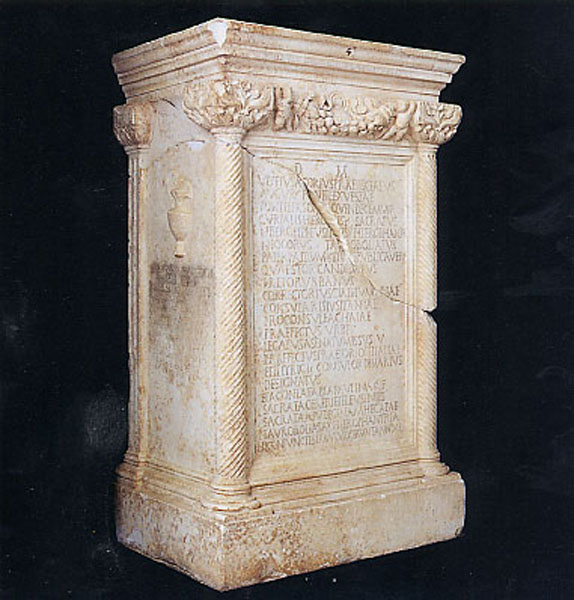
The marble altar mentions Vettius Agrorius Praetextatus as Pater Sacrorum and Patrum and his wife Aconia Fabia Paulina.
Limestone altar fragment from the apsidal construction at Ulmetum, Moesia Inferior, bearing a partially preserved inscription mentioning fonte dei — the spring of the god; the Mithraic attribution is uncertain.
Marble tauroctony relief fragment from the Byzantine camp at Pontelimonul de sus, ancient Ulmetum in Moesia Inferior, found reused in the masonry; the subject is partly identifiable.
Inscription from Smederevo, Moesia Superior, dedicated to Deo invicto Mithrae by Publius Aelius Valerianus, vestiarius — a clothing-dealer or military garment officer.
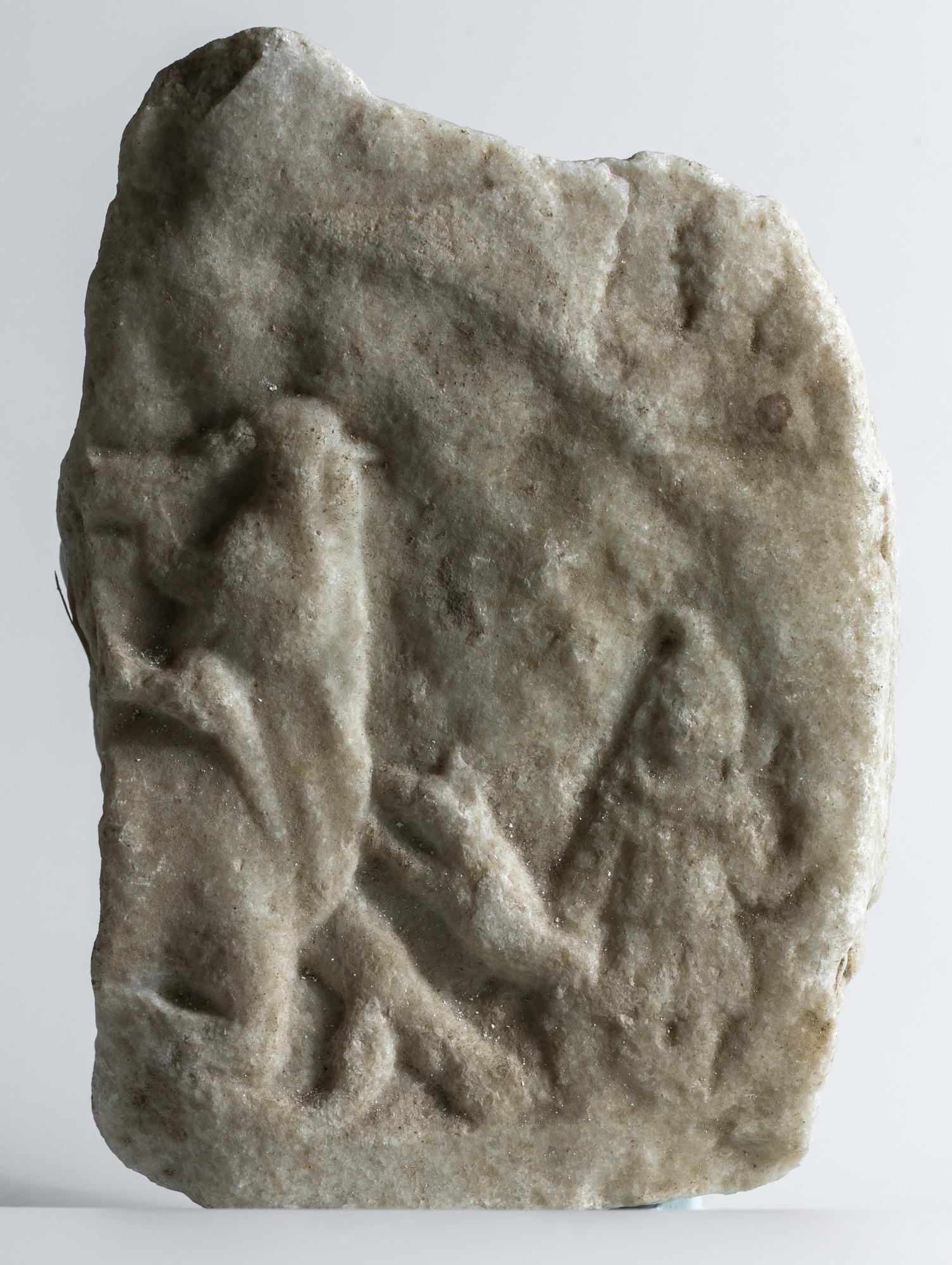
This weathered marble fragment from Viminacium preserves part of a tauroctony with Luna, Cautopates, the serpent, and the dog.
