Your search Sankt Johann im Pongau gave 1046 results.

Altar from Petronell, ancient Carnuntum, Pannonia Superior, dedicated to Soli divino ex visu by Lucius Aelius Leo — possibly the same individual who dedicated a further altar identifying himself as a miles of Legio XIIII Gemina.
Sandstone plate from Mithraeum III at Carnuntum, Pannonia Superior, dedicated to Deo invicto by Caius Iulius Propinquus, who built a wall ex voto; traces of red on the rim.
Altar from Mithraeum I at Carnuntum, Pannonia Superior, dedicated to Deo invicto by Iulius Pacatus ex voto, with Marcus Valerius serving as sacerdos for the second time — one of the few attestations of the Mithraic title sacerdos from Pannonia.
Marble altar from Stix-Neusiedl, Pannonia Superior, dedicated to Invicto deo sacrum by Longinus Secundus, with a triangle in the right rim and red-painted lettering.
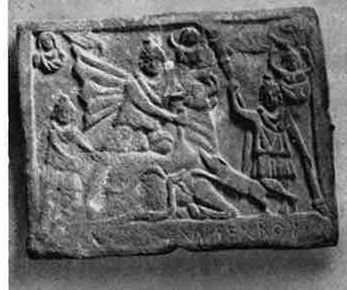
White marble tauroctony relief from Stix-Neusiedl, Pannonia Superior, depicting Mithras killing the bull with the raven perched on the rim of the god's flying cloak — an unusual detail placing the raven on the cloak rather than on the grotto border…
Inscription from Mithraeum III at Ptuj, ancient Poetovio, dedicated to Invicto Augusto sacrum by an imperial slave serving as hereditatum tabularius — an officer for death-duties — one of the rarer administrative titles attested in Mithraic epigraphy.
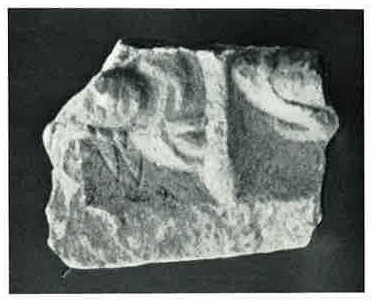
Left upper corner of a marble relief from Mithraeum II at Ptuj, ancient Poetovio, with the dressed bust of Sol in radiate crown above a horizontal rim, beneath which the head of a torchbearer, probably Cautopates.
Left upper corner of a marble relief from Mithraeum II at Ptuj, ancient Poetovio, preserving part of the grotto's border, Sol's head, and below it a primitive torchbearer's head.
Marble statuette fragments from Mithraeum II at Ptuj, ancient Poetovio, preserving the torsos and partial bodies of Sol's horses together with a two-wheeled car — a rare three-dimensional representation of this scene.
Inscription from Mithraeum II at Ptuj, ancient Poetovio, dedicated to Deo Soli invicto Mithrae by Ulpius, a veteran, for himself and his family.
Marble lion from Mithraeum II at Ptuj, ancient Poetovio, holding a swine's head under its left fore-leg — a sacrificial animal pairing associated with the Mithraic lion grade.
Right portion of a marble tauroctony relief from Mithraeum II at Ptuj, ancient Poetovio, preserving standing Cautes with upraised torch and the bust of Luna above him.
Marble altar with akroteria from Mithraeum I at Ptuj, ancient Poetovio, dedicated to Invicto Mithrae by Festus, vicarius of Primus, vilicus of the publicum portorium.
Inscription from Sisak, ancient Siscia, dedicated to Iovi optimo maximo, Soli invicto, and the Genius loci by Aurelius Antiocianus; the Mithraic character is uncertain.
Inscription from the area of the castellum at Sisak, ancient Siscia, recording that Iucundus, imperial dispensator of Pannonia Superior, built a portico and an aparatorium for Deo invicto Mithrae ex voto.
Altar from Töltschach am Zollfeld, Noricum, dedicated to Soli invicto Mithrae for the welfare of the Augustus in honour of the Domus Divina by Hilarus, imperial freedman and tabularius patrimonii regni Norici, and Epictetus, imperial arkarius…
Inscription from Virunum, Noricum, dedicated to Deo Soli invicto by Iuventinus, who identifies himself with the Mithraic grade leo — one of the clearest grade attributions in the epigraphic record of Noricum.
White marble slab from the Zollfeld at Virunum, Noricum, dedicated to Deo invicto Mithrae by Diadumenus, arcar(ius) of the imperial dispensator Nicolaus for the kingdom of Noricum.
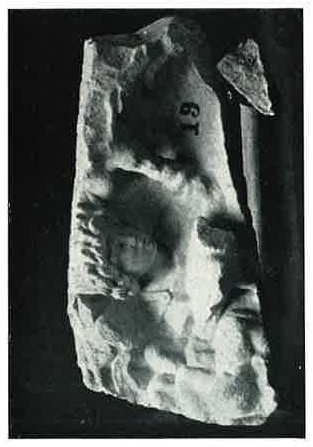
Three Italian marble fragments from the Zollfeld at Virunum, Noricum, forming a tauroctony relief; the iconography is well preserved and the use of imported Italian marble reflects the high status of the dedicants.
Fragment of a limestone altar from Wiesbaden, ancient Aquae Mattiacae, preserving the crossed legs of a torchbearer
