Your search Sidi Ali Belkacem (سيدي علي بلقاسم) gave 1194 results.

Head in Phrygian cap with a sorrowful expression, used as a protome in the Amphitheatre of Capua and interpreted as a head of Mithras.
Fragmentary inscription on wall plaster from the Mithraeum of Dura-Europos, Syria, with partially legible text.
Minute engraved inscription with the words eisodos and exodos (entrance and exit), from column 3 of the Mithraeum of Dura-Europos, Syria.
Engraved inscription naming Maximus as magus, from column 1 of the Mithraeum of Dura-Europos, Syria.
Engraved Nâma inscription addressed to Antoninus, a pious syndexios, from the Mithraeum of Dura-Europos, Syria.
Painted inscription naming the patres and other initiates of the Mithraeum, above the podium in the south-west corner of the Mithraeum of Dura-Europos, Syria.
Graffito bearing the Mithraic salutation Nâma, engraved on column 1 of the Mithraeum of Dura-Europos, Syria.
Painted inscription naming a tribune Archelao, found on a column or wall of the Mithraeum of Dura-Europos, Syria.
Fragment of a figure dressed like Mithras in the banquet scene, found in the rubble of the Mithraeum of Dura-Europos, Syria.
Fragments of wall plaster decorated with green leaves and tree branches, adhering to the south wall of the Mithraeum of Dura-Europos, Syria.
Fragments of large-scale painted heads belonging to paintings of considerable size, from the Mithraeum of Dura-Europos, Syria, 3rd century A.D.
Painted zodiac signs covering earlier figures in Phrygian cap in the arched niche of the Later Mithraeum of Dura-Europos, Syria, 3rd century A.D.
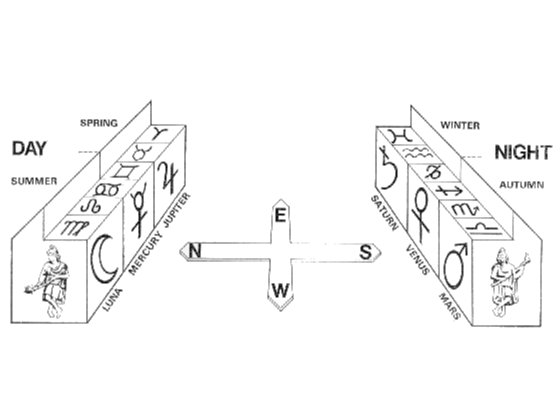
The rich mosaics of the Mithraeum of the Seven Spheres include the the signs of the Zodiac.
The inscription is carved into two pieces of marble cornice.
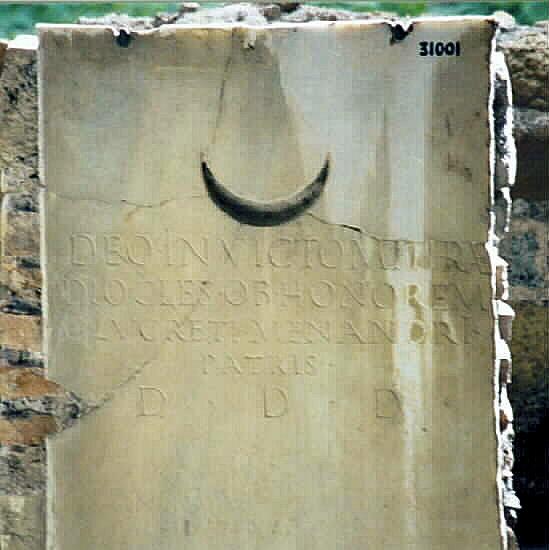
The brick altar of the Mithraeum Menander was covered with marble slabs bearing a crescent and an inscription.
Fragmentary marble relief with the hind legs of a bull once interpreted as Mithraic but considered doubtful by Vermaseren.
Second-century Mithraeum discovered in the lower storey of the Curia complex at Cosa.
Group of Mithraic and other cult remains possibly originating from several neighbouring sanctuaries destroyed or abandoned in Late Antiquity.
Mithraic monuments associated with Ceionius Iulianus Kamenius and linked with the inscriptions discussed in entries 395A–B.
Mithraic material whose correct archaeological attribution belongs to Regio XII of ancient Rome.
