Your search St. Egyden gave 3393 results.

Inscription from the Mithraeum at Sarmizegetusa, Dacia, dedicated to Soli invicto Mithrae by S. Spedius Valerianus, Augustalis coloniae.
Altar from Aquincum, Pannonia Inferior, dedicated to Soli invicto Mithrae for the welfare of Sextus Iuventius Severus, legatus Augusti pro praetore, by Caius Iulius Victor, beneficiarius consularis.
Altar found at Altofen in 1855, ancient Aquincum, dedicated to Deo Arimanio — Ahriman, the Zoroastrian adversary — by Libella, leo, as a votive dedication to the fratres; one of the very few Mithraic dedications to Ahriman from the Roman world.
Large limestone altar from near Mithraeum III at Aquincum, Pannonia Inferior, with a hole in the base probably designed to hold a cult object; the detailed iconographic programme of this altar is notable within the Aquincum Mithraic assemblage.
Four uninscribed altars and fragments of torchbearer statues from Mithraeum III at Aquincum, Pannonia Inferior.
Sandstone statue from near Mithraeum III at Aquincum, Pannonia Inferior, depicting a lion to the right with an open frontal mouth, holding an ox head between its forefeet with a red-painted tongue.
Limestone altar from Mithraeum III at Aquincum, Pannonia Inferior, dedicated to Invicto deo sacrum for the welfare of Caius Iulius Victorinus, decurio of the Colonia Aquincensium, by Caius Iulius Primus, his libertus.
Third Mithraic sanctuary at Aquincum, Pannonia Inferior, between the Amphitheatre and the Krempelmühle, attested by five altars and a decorated mosaic; the building itself is not fully known.
Second Mithraic sanctuary discovered at Altofen in 1888, Pannonia Inferior; rectangular (15.03 × 7.06 m) and raised two metres above ground, with benches and a cult niche; one of the most fully excavated Mithraea from the Danubian region.
Altar from Aquincum, Pannonia Inferior, dedicated to Soli deo by Callistus ex voto, decorated with akroteria bearing palmettes.
Altar from Mithraeum I at Aquincum, Pannonia Inferior, dedicated to Leoni, suggesting a dedication to the Mithraic grade leo or to the lion as a cult animal.
Sandstone relief fragment from the Mithraeum at Gimmeldingen preserving the upper bodies of two standing deities: a bearded male, possibly Vulcanus, and a helmeted Minerva with lance.
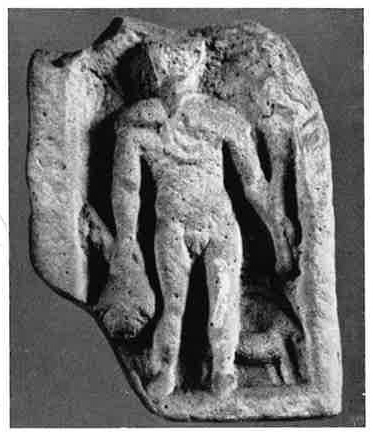
Sandstone relief from the Mithraeum at Gimmeldingen depicting a standing Mercury with caduceus and purse, accompanied by a ram and a cock; the head and upper caduceus are damaged.
Lower portion of a sandstone relief from the Mithraeum at Gimmeldingen, preserving a cross-legged torchbearer in a long cloak, probably Cautes.
Triple-part sanctuary at Saalburg whose Mithraic interpretation remains uncertain despite serpent-vases and possible Aion fragments.
Small inscribed plaque invoking Mithras and Mercury attached to a sandstone column inside the sanctuary.
Sandstone basin from the pronaos of the sanctuary originally mounted on a short column.
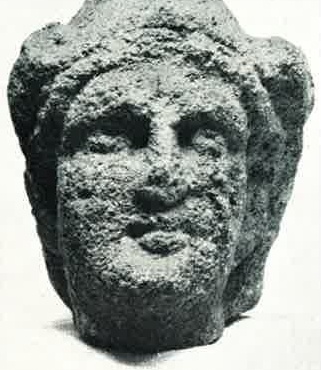
Sandstone fragment from Mithraeum I at Heddernheim, ancient Nida, probably the damaged head of a torchbearer, often misidentified as Mercury.
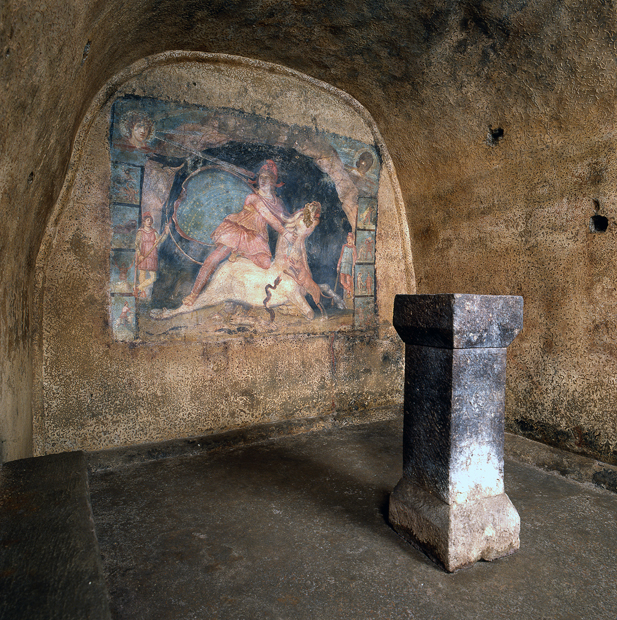
The Marino Mithraeum preserves one of the most elaborate painted cycles of Mithras’ myth, combining the tauroctony, planetary symbolism and scenes from the god’s sacred narrative.
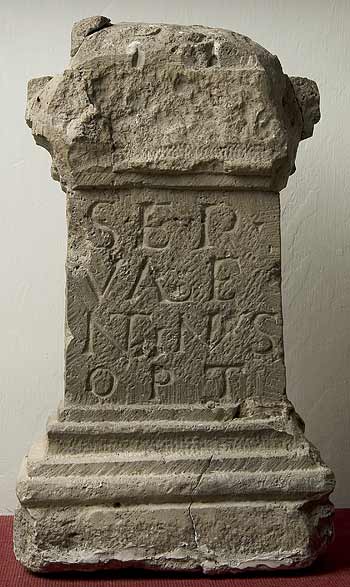
Limestone altar dedicated to Cautes by the Roman optio Septimius Valentinus, discovered in the Mithraeum of Sárkeszi in Pannonia Inferior.
