Your search Tal hal Hariri / Es-Sâlihiyeh / As Salhiyah gave 3730 results.

Sandstone altar from the Mithraeum at Königshoffen, dedicated to Deo invicto by a dedicant whose name begins Primu[s]; the remainder of the text is fragmentary.
Altar from the Mithraeum at Königshoffen, dedicated to Deo Cissonio — a Celtic god identified with Mercury — by Gittonius Pippausus; the dedicant's Celtic name may be etymologically connected to that of the deity.
Altar from the Mithraeum at Königshoffen, dedicated in honour of the Domus Divina to Deo invicto Mithrae by Matto, son of Gnatus.
Pair of large stone lions from the Mithraeum at Königshoffen, each holding a boar's head beneath its forepaws and painted red on a white ground; they were set at the ends of the podia, flanking the sanctuary.
Badly damaged sandstone statue of a togatus from the Mithraeum at Mackwiller, preserving only fragments of the head and garment.
Sandstone lion from Brumath, ancient Brocomagus, with a votive inscription on its base recording a dedication by Tertius; a common Mithraic cult animal.
Sandstone altar found together with the Vocco altar at Rottenburg am Neckar, ancient Solicinium, bearing a fragmentary dedication and decorated with trees on its lateral faces.

Large grey sandstone tauroctony relief from Fellbach near Cannstatt, depicting the bull-slaying in a vaulted grotto with torchbearers, Sol, Luna, and subsidiary Mithraic scenes along the border.
Inscription from Rheinzabern, ancient Tabernae, in which Tertius, slave of Rusticus, records a dedication of ten cult vessels to Deo invicto Mithrae.
Two rectangular sandstone reliefs from Zasenhausen near Cannstatt, ancient Clarenna, each depicting a male bust with astral symbols on the forehead, arranged in opposing directions.
Small sandstone head in Phrygian cap from Cannstatt, ancient Clarenna, probably belonging to a statue of Cautes or Cautopates.
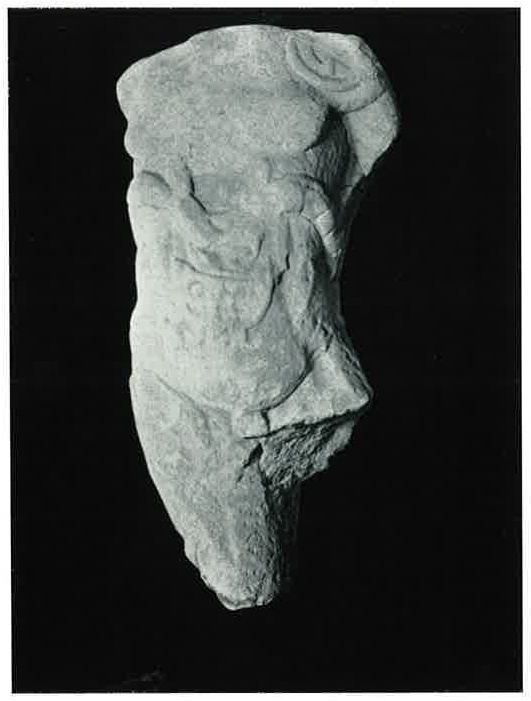
Sandstone statue from Wahlheim, Germania Superior, depicting a naked torso encircled by two serpents holding their heads towards the figure's face — the characteristic iconography of the leontocephaline Aion.
Large votive altar from Murrhardt, dedicated to Soli invicto Mithrae by Sextus Iulius Florus Victorinus, tribune of Cohors XXIV Voluntariorum civium Romanorum, recording the full restoration of a Mithraic temple from its foundations.
Rock-cut tauroctony relief at the Mithraeum near Schwarzerden, beginning at 0.70 metres from the floor, with clearly visible scorpion and serpent
Inscribed altar from Lengfeld near Aschaffenburg dedicated to Numini augusto deo invicto by Caius Atulius Maior ex voto
Large inscribed altar from Lengfeld near Aschaffenburg dedicated to Numini augusto Soli deo invicto by Lucius Trougillus ex voto
Stone head in a Phrygian cap found near Rothselberg in 1894, preserved in the Historisches Museum der Pfalz at Speyer, looking upwards
Grey limestone relief fragment from Rockenhausen found at the Pfingstborn spring, preserving part of the bull-slaying scene
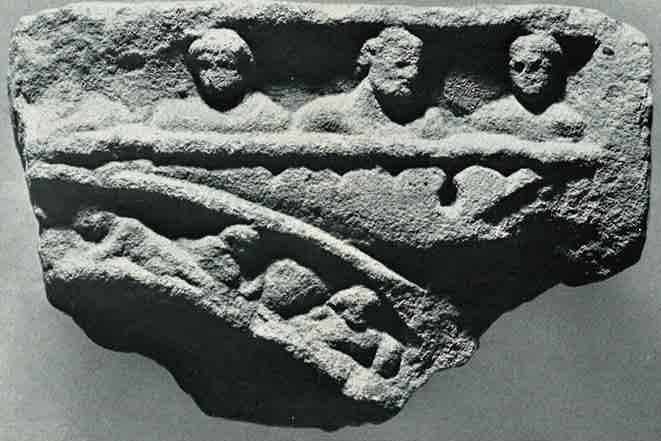
Fragment of a red sandstone relief found in the Frankfurterstrasse at Dieburg, depicting four divine busts in the upper corner of the composition
Various altar and base fragments, two sandstone balls, and two millstone fragments from the Mithraeum at Dieburg
