Your search Tal hal Hariri / Es-Sâlihiyeh / As Salhiyah gave 3731 results.

Inscription from the area of the castellum at Sisak, ancient Siscia, recording that Iucundus, imperial dispensator of Pannonia Superior, built a portico and an aparatorium for Deo invicto Mithrae ex voto.
Altar found in the Zollfeld at Virunum in March 1837, together with a statue of a bearded man holding a modius, dedicated to Invicto patrio by Ulbius Gaianus, praefectus vehiculorum — a rare reference to Mithras as a paternal deity.
Altar from Töltschach am Zollfeld, Noricum, dedicated to Soli invicto Mithrae for the welfare of the Augustus in honour of the Domus Divina by Hilarus, imperial freedman and tabularius patrimonii regni Norici, and Epictetus, imperial arkarius…
Inscription from Virunum, Noricum, dedicated to Deo invicto Mithrae in honour of the Domus Divina by Eppius, son of Ariminensis — a rare instance of filiation used as a sole identifier.
Small altar found at Töltschach in 1817, Noricum, decorated with the traces of two ram heads flanking foot-prints; the relief is no longer visible and only the inscription survives.
Inscription from Virunum, Noricum, dedicated to Deo Soli invicto by Iuventinus, who identifies himself with the Mithraic grade leo — one of the clearest grade attributions in the epigraphic record of Noricum.
Conglomerate statue from a layer of fire debris in the Mithraeum at Schachadorf, Noricum, depicting a naked Mithras without Phrygian cap being born from the rock with upraised hands; a coiling serpent is visible below.
Small rectangular Mithraic sanctuary (spelaeum 8.00 m long) found in 1935–36 in a gravel terrace at Schachadorf near Wartberg an der Krems, Noricum; the building is divided into a pronaos and an inner cult room, and shows traces of fire destruction.
Sandstone relief fragment from the Mithraeum at Gimmeldingen preserving the upper bodies of two standing deities: a bearded male, possibly Vulcanus, and a helmeted Minerva with lance.
Two sandstone altar fragments from Mainz, ancient Mogontiacum, with a partially preserved dedication to Deo invicto Mithrae
Yellow sandstone altar from Mainz, ancient Mogontiacum, dedicated to Deo invicto Mithrae on behalf of the salus of soldiers of Cohors I Ituraeorum
Two sandstone relief fragments from Rückingen, each preserving a woman's head looking to the left
Sandstone relief fragment from Rückingen showing the upper part of an undressed male figure in a niche, head and left arm lost
Lower part of a sandstone relief fragment from Rückingen preserving only the lower body of a walking figure, legs lost
Small sandstone relief fragment from Rückingen preserving only the upper part of a head wearing a Phrygian cap
Fragmentary Latin inscription from Rückingen recording a dedication to a goddess whose name is only partially preserved
Sandstone Mithras relief discovered in 1950 near Rückingen, proving the existence of a Mithraeum there from the late second to early third century AD
Iron ritual bell from Mithraeum III at Heddernheim, ancient Nida, likely used during cult ceremonies
Small iron box with hinges and bronze nails from Mithraeum III at Heddernheim, ancient Nida
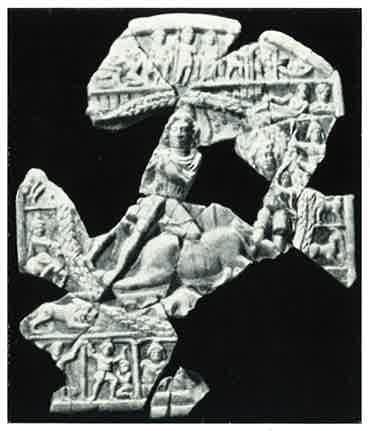
Fragments of a white marble arched tauroctony from Mithraeum III at Heddernheim, ancient Nida, showing Mithras killing the bull in a leaf wreath
