Your search Tal hal Hariri / Es-Sâlihiyeh / As Salhiyah gave 3730 results.

Fragment of a white marble relief depicting the head of Mithras with Phrygian cap and nimbus, found on the Syrian coast between Lattakieh and Tartous, first half of 2nd century A.D.
Great royal inscription of Antiochus I of Commagene carved on the thrones at Nemrud Dağı, invoking Apollo-Mithras-Helios among the guardian deities of the kingdom, 69–34 B.C.
Similar red painted vase from Mithraeum II at Stockstadt, preserving only the serpent's body and tail
White painted clay vase from Mithraeum II at Stockstadt with seven holes in the border and a serpent creeping round one handle
Red sandstone base from Mithraeum I at Stockstadt preserving the feet of a standing figure beside part of a serpent, possibly Aion
Sandstone stele from Mithraeum I at Stockstadt depicting Cautes cross-legged in Oriental dress, resting his left hand on a pedum
Sandstone stele from Mithraeum I at Stockstadt showing Cautopates in Oriental dress, cross-legged, holding a burning torch down and resting on a pedum
Lower portion of a red sandstone stele of Cautes from Mithraeum I at Stockstadt, cross-legged, with a dedicatory inscription on the base
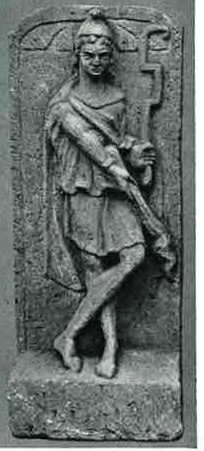
Red sandstone stele from Mithraeum I at Stockstadt depicting Cautopates in Oriental dress, cross-legged, holding a downward torch
Archaeological remains connected with the Praetorian camp and the presence of Mithraic worship among the imperial guard.
Series of small bronze plaques depicting zodiac signs and planetary figures discovered in Ostia and possibly connected with the decoration of a Mithraic sanctuary.
Group of nearby religious dedications associated with soldiers of the Legio III Augusta and the wider sacred landscape around the Mithraeum.
Marble relief fragment from the Mithraeum at Sarmizegetusa, Dacia, preserving Cautes in Oriental dress from the hips to the knees.
Marble fragment from the Mithraeum at Sarmizegetusa, Dacia, preserving a head of Mithras in Phrygian cap; a small elevation at the side may be the shoulder of a torchbearer.
Marble relief fragment from the Mithraeum at Sarmizegetusa, Dacia, preserving a very fine head of Mithras in Phrygian cap — described by Kiraly as among the best-executed heads from the sanctuary.
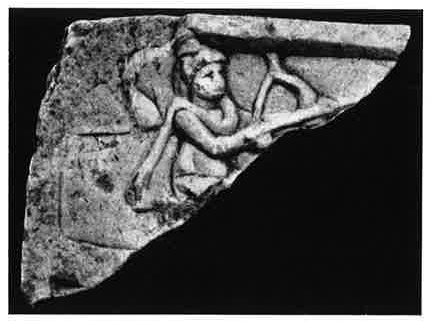
Fragment of a white limestone relief from the Mithraeum at Sarmizegetusa, Dacia, preserving the dressed bust of Sol and beside him a sitting Mithras visible to the knees, with an arch above.
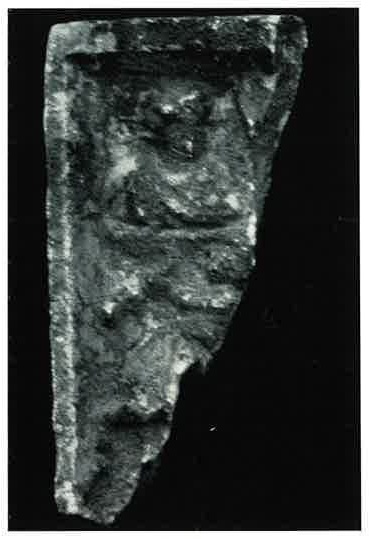
Fragment of a yellowish marble relief from the Mithraeum at Sarmizegetusa, Dacia, preserving the left upper corner with the bust of Sol and below it Mithras riding the bull.
Fragment of a bluish marble tauroctony from the Mithraeum at Sarmizegetusa, Dacia, preserving the left upper corner with the bust of Sol and beside it the upper part of a person in Phrygian cap — probably Mithras as an archer.

Upper portion of a vaulted marble tauroctony from the Mithraeum at Sarmizegetusa, Dacia, with the bull-slaying and above Cautes a scene of Mithras's rock-birth; Sol and Luna busts appear in the upper corners.
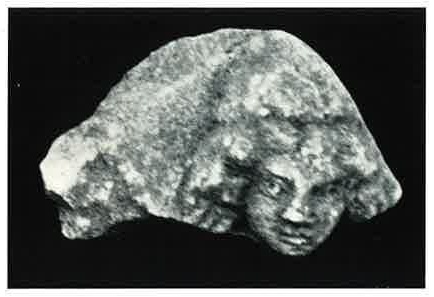
Small marble relief fragment from the Mithraeum at Sarmizegetusa, Dacia, preserving the head of Mithras in Phrygian cap.
