Your search Tal hal Hariri / Es-Sâlihiyeh / As Salhiyah gave 3733 results.

Miscellaneous small finds from the S. Prisca Mithraeum including a marble mortar, pieces of glass, plates, dishes and lamps dating from the first four centuries A.D.
Terracotta relief showing Victoria slaying a bull from the S. Prisca Mithraeum; a similar relief was found in 1953 and probably does not belong to the original Mithraic inventory.
Two fragments of greyish marble from the Palazzo dei Musei Mithraeum with a partially legible inscription referring to the pontifex maximus and tribunicia potestas for the twentieth time, attributed to Trajan or Hadrian.
Fragment of a marble slab from the Palazzo dei Musei Mithraeum preserving a partially legible dedication by L. Mo[...] Magnus, described as devotus.
Miscellaneous small finds from the Mithraeum at the Palazzo dei Musei, Rome, including animal bones, tusks of boars, marble pieces, bronze objects, glass fragments, and a tile with a Domitianic inscription.
Wall-painting on the last column of the left bench in the Palazzo Barberini Mithraeum, showing a standing person pressing his left hand to his breast and extending his right hand towards a kneeling person whose head is covered with ivy.
Black and white mosaic floor of the underground room used as a Mithraeum in the house of the Nummi Albani on the Quirinal; the mosaic ends about 1 metre from the side-walls, suggesting side-benches; Nummius Albinus was consul in 345 A.D.
Possible Mithraeum discovered in 1869 near the previous sanctuary in Muti's gardens, described by Lanciani as a spelaeum cut in tufa with vestibule and cell with niches and altar, at the corner of the Via Nazionale and Via Venezia.
Fragment of a large marble tablet with large letters of poor 5th-century workmanship, found on the Monte Quirinale near the Via Nazionale, bearing poetic Mithraic references to the mystes of Ceres and the Invincible Mithras.
Marble statuette representing a bearded person as the Good Shepherd, found in the Dominicum Clementis opposite the Mithraeum of San Clemente; it definitively represents S. Peter, not a Mithraic father of the mysteries.
Inscription dedicated to the Numen Caelesti by P. Clodius Flavius Venerandus, sevir augustalis, who acted in response to a dream, from the Mitreo Sabazeo at Ostia.
Lower part of a torchbearer statue, cross-legged in anaxyrides and short tunic, from one of the bases at the beginnings of the podia in the Mitreo delle Sette Porte at Ostia.
A group of small finds from an Ostia Mithraeum, including three tuff altars, two trapezophores, a column fragment, lamps, vases, and a marble Silen.
Fragmentary marble tablet inscription mentioning Sol Invictus Mithras and a priest, from Tivoli (ancient Tibur), possibly of urban origin.
Finds discovered near the crossing of the criptoporticus of the Mithraeum at Capua, including marble plate fragments, a tuff base, red lamps, and animal bones.
Miscellaneous finds from the middle of the Mithraeum of Capua, including a terracotta antefix with centaurs, basins, marble bases, lamps with a Sol head, and coins of M. Aurelius and Constantine.
Head in Phrygian cap with a sorrowful expression, used as a protome in the Amphitheatre of Capua and interpreted as a head of Mithras.
Sepulchral inscriptions from Lycaonia bearing the titles leo and aetos, previously interpreted as Mithraic grades but now understood as referring to tomb architecture.
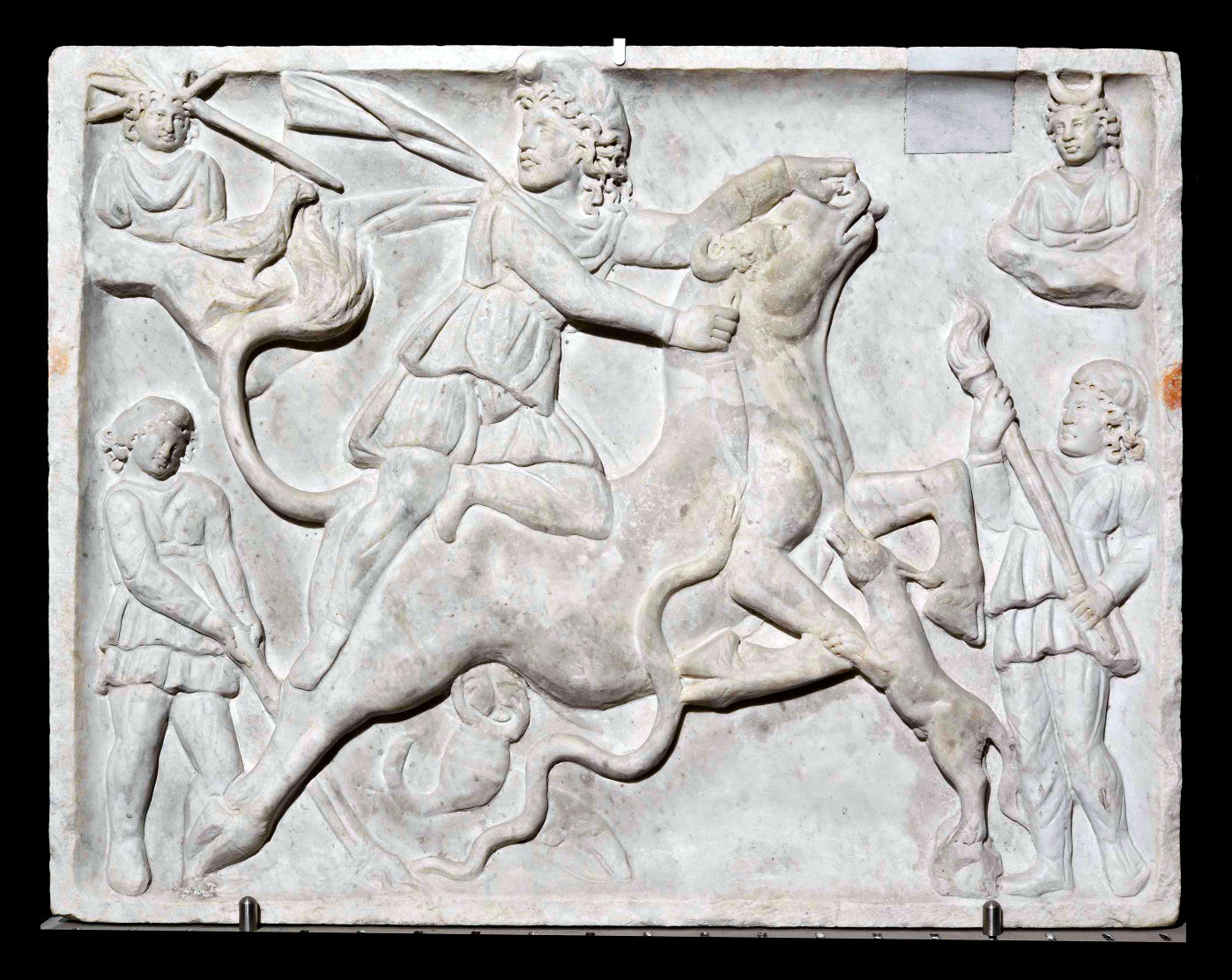
It is not certain that the marble relief of Mithras killing the bull was found on Capri, in the cave of Matromania, where a Mithraeum could have been established.
