Your search Tirowite (Old town of Plovdiv) gave 279 results.

Yellow sandstone altar from the Mithraeum at Königshoffen decorated with volutes enclosing small globes and a patera holding two iron rings; traces of fire or smoke are visible on the surface.
Grey sandstone hand holding a globe from the Mithraeum at Königshoffen, with a lead bar indicating attachment to a larger statue; a second globe with a partial hand was found at the same spot.
Stone fragment from the Mithraeum at Königshoffen preserving a human thigh against which a hand holds a bunch of grapes; probably part of a larger sculptural group.
Pair of large stone lions from the Mithraeum at Königshoffen, each holding a boar's head beneath its forepaws and painted red on a white ground; they were set at the ends of the podia, flanking the sanctuary.
Stone statue fragments from the Mithraeum at Mackwiller depicting Mithras's rock-birth, preserving the head in Phrygian cap, torso, and right hand holding part of a torch.
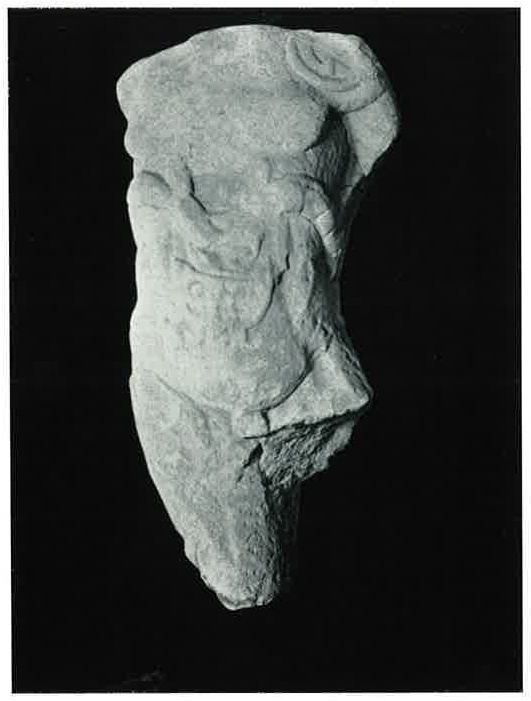
Sandstone statue from Wahlheim, Germania Superior, depicting a naked torso encircled by two serpents holding their heads towards the figure's face — the characteristic iconography of the leontocephaline Aion.
Twenty-three fragments of a yellow sandstone statue of Mercury from the Mithraeum at Dieburg, dressed in a short mantle and holding a caduceus
A terracotta arm found near the cone-shaped stone in the Mithraeum at Spoleto, the hand holding a broken object possibly from a representation of Mithras's rock-birth.
Two surviving wall paintings from the side-benches of the Mithraeum at Spoleto, out of an original six, depicting a cloaked bearded man identified as Saturn holding a sickle and a youth in a red shoulder-cape holding a money-bag, probably representing the seven planets…
A small marble cippus found in an old wall near the church of San Niccolò in Arezzo (ancient Arretium), bearing a dedication by Myron, a slave, to the Invincible Holy and Safe god for the welfare of his master Prunicianus.
Small bronze figure from Rome, probably used as a handle for a patera or knife, depicting the lion-headed Aion with four large wings, entwined in three coils of a serpent, holding a torch in his right hand and a key in his left.
Marble altar in the Museo Capitolino, Rome, bearing a bust of Sol and a dedication by P. Aelius Amandus, a soldier of the equites singulares Augusti, in fulfilment of a vow on receiving his honourable discharge, dated to 158 A.D.
Fragment of a large dolium from the Palazzo dei Musei Mithraeum, decorated with two small columns supporting a facade and a youth standing between them playing the flute and holding a stick in his left hand.
Small lamp decorated with a flying Victoria holding a crown in her right hand and a palm-branch in her left, from the Mithraeum at the Palazzo dei Musei, Rome.
Marble statue of the naked Mithras emerging from the rock, holding a dagger in his right hand and a torch in his left, visible to the knees, from the Mithraeum of S. Lorenzo in Damaso; the head is lost.
Mithraeum discovered towards the end of the 16th century in a vineyard of Horazio Muti opposite S. Vitale, between the Quirinal and Viminal hills, known from Vacca's report of a sealed room with many terracotta lamp-holders.
Altar dedicated to Deo Soli, Honori et Virtuti pro salute, found at the foot of the West gate of the Roman town at Hr. Kaussât, near Ucubi.
Marble head with locks of hair and Phrygian cap, probably depicting Mithras as bull-killer, found under the threshold of the Iseum at Cyrene.
Two limestone figures of women, possibly from the Mithraeum near Memphis, one standing cross-legged holding a branch with flowers, Egypt.

Sutri is an Ancient town, modern comune and former bishopric in the province of Viterbo, about 50 kilometres from Rome and about 30 kilometres south of Viterbo. The modern comune of Sutri has a few more than 5,000 inhabitants.
