Your search Tulln an der Donau gave 577 results.

Underground oblong room at Nyon, ancient Colonia Iulia Equestris, situated on the edge of a second Forum dating to the second half of the first century AD, with a series of pillars along the side walls consistent with Mithraic architecture; its interpretation as a Mithraeum remains tentative…
Sandstone altar from the Mithraeum at Königshoffen, dedicated to Deo invicto by a dedicant whose name begins Primu[s]; the remainder of the text is fragmentary.
Stone torso of a naked winged figure from the Mithraeum at Königshoffen, identified as Aion; the head is lost, but remnants of a wing survive at the right shoulder, and the statue likely stood on a preserved base with traces of two feet.
Reconstructed tauroctony relief from the Mithraeum at Mackwiller, assembled from multiple stone fragments and preserving Mithras's head, shoulders, dagger hand, flying cloak, and parts of the bull and torchbearers.

Large grey sandstone tauroctony relief from Fellbach near Cannstatt, depicting the bull-slaying in a vaulted grotto with torchbearers, Sol, Luna, and subsidiary Mithraic scenes along the border.
Terra-sigillata vase from Rheinzabern, ancient Tabernae, bearing a Mithraic graffito on its flat border.
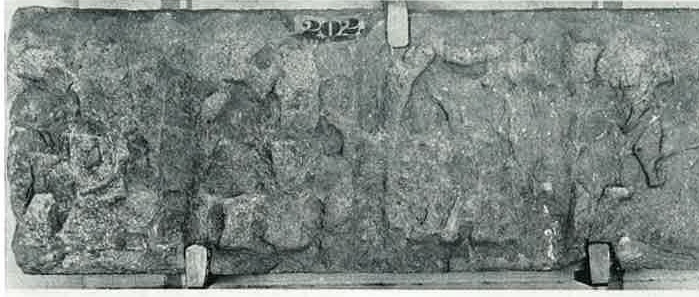
Badly damaged red sandstone relief from Hölzern, Germania Superior, depicting the standard bull-slaying scene; possibly forming part of the border zone of a larger composition.
Stone head in a Phrygian cap found near Rothselberg in 1894, preserved in the Historisches Museum der Pfalz at Speyer, looking upwards
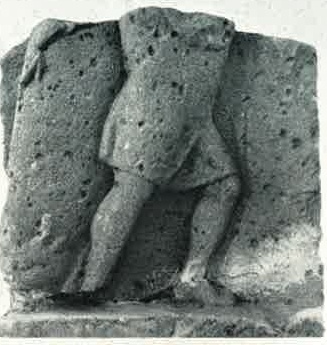
Red sandstone relief from the Mithraeum at Dieburg showing Mithras in Oriental dress carrying the bull on his shoulders

Styberra occupied an important position within the inland communications network of Roman Macedonia near modern Prilep.
Konjic is a city located in the Herzegovina-Neretva Canton of the Federation of Bosnia and Herzegovina, one of two entities that make up Bosnia and Herzegovina.
Evidence for a Mithraeum at Sentinum (modern Sassoferrato) in ancient Umbria, attested by a marble tauroctony group and three inscriptions, with a related mosaic found on the grounds of the Countess of Leuchtenberg and later given to King Louis of Bavaria…
A marble statue fragment found at Sentinum (modern Sassoferrato) in ancient Umbria, walled in the atrium of the Palazzo Raccamadoro-Ramelli, showing Mithras tauroctone with dog, serpent and scorpion, one foot pointing towards a torchbearer; the bull's head, tail and Mithras'…
Two surviving wall paintings from the side-benches of the Mithraeum at Spoleto, out of an original six, depicting a cloaked bearded man identified as Saturn holding a sickle and a youth in a red shoulder-cape holding a money-bag, probably representing the seven planets…
A lost Mithraic relief formerly at the Villa Borghese in Rome, known only through a brief mention in early modern antiquarian literature and no longer traceable.
Tauroctony relief formerly in the house of the Alterii near S. Marco in Rome, now of unknown whereabouts, described by Gruterus as showing Mithras pressing both knees onto the bull and grasping its horns with the knife in the shoulder, with scorpion, serpent, raven, Sol and Luna…
Fragment of a grey marble slab formerly in the Palazzo Caponii and now in the Vatican Musea, Galleria Lapidaria, with an inscription on two arched borders and a leaping ox in the blank space.
Marble base from the gardens of Julius III dedicated to Iunius Postumianus, vir clarissimus and pater patrum of Sol Invictus Mithras, pontifex of the sacerdotal order of the Sun, placed under the care of Flavius Herculus.
Graffito on the outside of the left wall of the niche in the S. Prisca Mithraeum, recording a birth before daybreak on 20 November 202 A.D., a Saturday with an eighteenth-day moon, under the consulate of Severus and Antoninus.
Very small relief showing Mithras slaying the bull, with some figures preserved on the broken lower border, from the Aventine sanctuary in Rome.
