Your search Val Camonica gave 183 results.

Two small heads in Phrygian caps, possibly belonging to a tauroctony of Mithras, together with a fragment of a bull's foot and the mouth and neck of the dog, found at the Mithraeum of Les Bolards (ancient Venetonimagus) in Lugdunensis.
Fragmentary remains of a statuette of Cautopates in a short tunic, including a thigh, knee, and hand holding the end of a torch, found near the entrance of the Mithraeum at Les Bolards (ancient Venetonimagus) in Lugdunensis.

Roman settlement of Dacia superior located in the area of present-day Sibiu in Romania. The site became an important urban and military centre, later developed into the medieval city known as Hermannstadt in German and Nagyszeben in Hungarian.
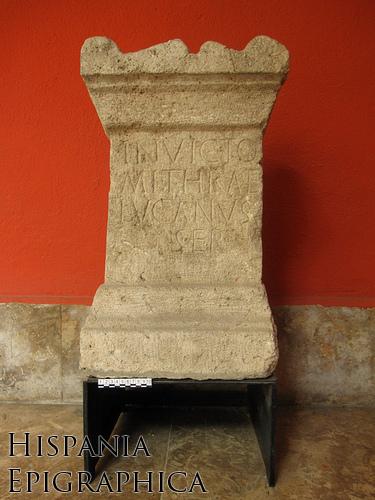
This altar found in Benifaió, València, was erected by a slave called Lucanus.
A badly damaged tauroctony relief carved in peperino, fixed high into a wall of the old farm known as Le Capanacce on the Via Cassia near Vicus Matrini in Etruria, showing Mithras as a bullkiller in a vaulted cave with serpent, the head and left arm of the god lost…
Altar from the Drave valley between Teurnia and Virunum, Noricum, now reused as a pedestal for a cross, dedicated to Invicto deo Mithrae for the welfare of Marcus Publius Potens by his freedman Ursulus.
Small altar found in 1843 at Sankt Johann in the Saan valley, Noricum, dedicated to Deo invicto Mithrae by Sextus Masclinus.
Lost stone altar from the thermal baths at Baden, ancient Aquae Helveticae, dedicated to Deo invicto by Tiberius Cassius Sanctus and Tiberius Sancteius Valens following a vision.
Sandstone plate from Beihingen in the Neckar valley, depicting on one side a youth in Oriental dress with a bow in an arched niche, and on the other a corresponding figure; both may represent torchbearers or Mithraic grades.
Poorly preserved subterranean Mithraic sanctuary discovered beneath a medieval convent.
A brief dedicatory inscription carved in the lower corner of the tauroctony relief from near Vicus Matrini on the Via Cassia in Etruria, recording L. Avillius Rufinus as dedicant.
Coins found in the lower sandy strata of the S. Prisca Mithraeum, ranging from the time of Claudius to the late 4th century, including issues of Commodus, Crispina, Diocletianus, Galerius, Constans and Valens.
Relief depicting Mithras killing the bull in scaled armour, with Luna and Sol busts in the upper corners, found at the cavalry barracks of Sétif in 1861.
Altar inscription dedicated to Sol Augustus by the decurion Valerius Carpus, from Timgad (ancient Thamugadi).
Oval relief fragment from the outskirts of Split near ancient Salona, Dalmatia, preserving two zodiacal signs — probably from a border decoration of a Mithraic monument.
Altar from Mithraeum I at Carnuntum, Pannonia Superior, dedicated to Deo invicto by Iulius Pacatus ex voto, with Marcus Valerius serving as sacerdos for the second time — one of the few attestations of the Mithraic title sacerdos from Pannonia.
Marble votive altar from Stix-Neusiedl, Pannonia Superior, recording that Valerius and Valerianus restored a collapsed Mithraic temple at their own expense for the welfare of Emperor Lucius Septimius; red-painted lettering is preserved.
Deposit of twenty-three coins from the Mithraeum at Schachadorf, Noricum, spanning from Claudius II to Valentinianus II and providing a terminus for the sanctuary's use.
Aosta is the principal city of the Aosta Valley, a bilingual region in the Italian Alps, 110 km north-northwest of Turin.
The Roman settlement overlooked a passage between the Hodna and the Sahara via the Aïn Rich plain and the valley of the Oued Chaïr, between the Ouled-Naïl and Zab mountains.
