Your search Val di Non gave 3037 results.
A large red and white granite marble disc surrounded by rays, possibly representing the sun, found at the building south-west of the Mithraeum at Les Bolards (ancient Venetonimagus) in Lugdunensis.
A marble head of a woman from the Mithraeum at Walbrook in London, originally crowned with a diadem.
The last pagan emperor of Rome, closely associated with Mithras and Neoplatonic interpretations of the Sun God.
Marble group of Dionysus accompanied by a Silenus on a donkey, a satyr and a menead.
The Mithraeum of Santa Prisca houses remarkable frescoes showing the initiates in procession.
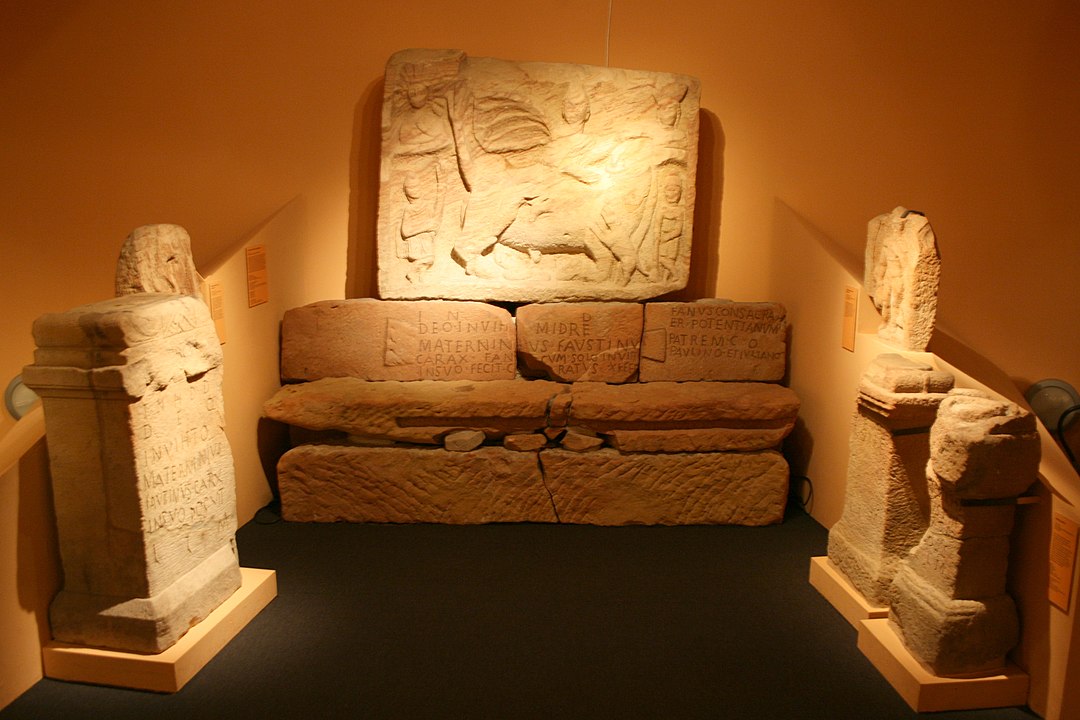
The marble relief of Mithras killing the bull in Naples bears an inscription that calls the solar god omnipotentis.
Inscription from Dionysopolis, Moesia Inferior, dedicated to Invicto Mithrae by Quintus Samacius Serenus, architectus salariarius of Legio XI Claudia.
Sandstone tauroctony relief from Balcic, ancient Dionysopolis in Moesia Inferior, depicting the standard bull-slaying scene; the attribution to Dionysopolis rather than another site is disputed.
Marble tauroctony relief from the surroundings of Küstendil, ancient Pautalia in Moesia Superior, depicting the bull-slaying with torchbearers and Sol and Luna busts in the upper corners.
Marble tauroctony relief fragment from Tekija in east Serbia, ancient Transdierna in Moesia Superior, depicting the standard bull-slaying scene.
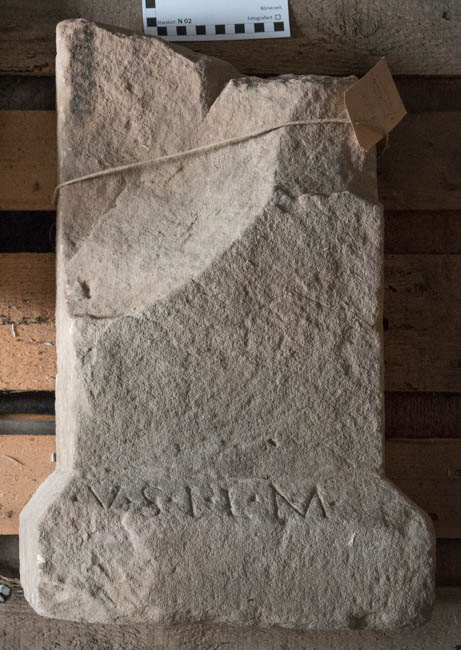
Votive stone found at Epfach in 1830, ancient Abudiacum in Raetia, dedicated to Soli sacrum by Tiberius Claudius Mace, son of Tiberius Claudius Mace, apparently a dedication by a son continuing his father's cult.
Dark-red clay vase from the refuse pit of the Roman camp at Windisch, ancient Vindonissa, with three handles each encircled by a coiling serpent; a vessel type closely associated with Mithraic ritual.
Site excavated by C. F. L. Lohner in 1824–25 at the Renzenbühl near Thun-Allmendingen, Germania Superior, where the outline of five rooms was identified, one or more of which may have served as a Mithraic sanctuary.
Fragment of a red sandstone relief found in the Frankfurterstrasse at Dieburg, depicting four divine busts in the upper corner of the composition
Assemblage of plates, jugs, dishes, cups, censers, two bronze coins, and animal bones from the Mithraeum at Dieburg
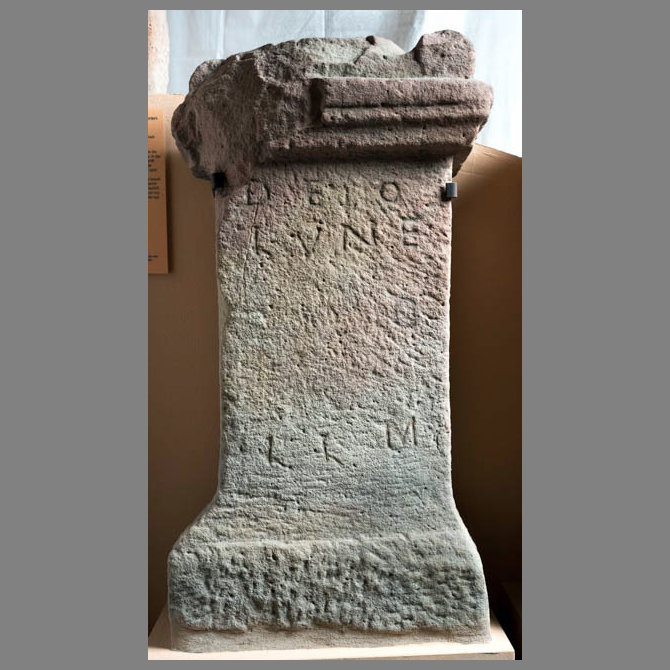
Small yellow-red sandstone altar from the Mithraeum at Dieburg dedicated to Deo sancto Mercurio
Bust of a diademed woman in red sandstone from the Mithraeum at Dieburg, probably representing Juno
Red sandstone fragment of a standing woman in a mantle from the Mithraeum at Dieburg, head and lower body lost, probably Minerva
Yellow sandstone relief from the Mithraeum at Dieburg depicting Hercules standing with the Nemean lion
The brick altar of the Mithraeum Menander was covered with marble slabs bearing a crescent and an inscription.