Your search Villa of Domitian at the Castel Gandolfo gave 3663 results.

White marble tauroctony relief from Slăveni-Romanați, Dacia, with the raven perched on the grotto's border; the right upper corner is broken off.
Two white marble tauroctony relief fragments from Slăveni-Romanați, Dacia, depicting the standard bull-slaying scene.
Mithraic sanctuary found in 1837 on the right bank of the river Olt near Slăveni-Romanați, Dacia; the construction of the building is not detailed.
Marble tauroctony relief from Doștat, Dacia, still at Dorstadt in 1723 but now lost; probably found together with the other Doștat monuments.
Altar from Doștat, Dacia, dedicated to Invicto Soli deo genitori by Publius Aelius Artemidorus, sacerdos creatus a Palmyrenis — a priest appointed by Palmyrene worshippers.
Inscription from Trojane, ancient Atrans in Pannonia Superior, recording that Quintilianus, beneficiarius consularis of Legio II Italica, restored a Mithraic temple that had collapsed through age, at his own expense.
Rectangular sandstone water-basin from the Mithraeum at Königshoffen, placed near the great tauroctony relief; only the bottom, front, and part of the left side survive, and the front inscription records the flow of water as a votive act.
Circular limestone water-basin from the entrance area of the Mithraeum at Königshoffen, equipped with a spout and two handles; traces of red paint survive on the interior.
Grey sandstone slab from the Mithraeum at Königshoffen, a companion piece to the preceding, recording the same act of repainting a cult image by Caius Celsinius Matutinus, veteran of Legio VIII Augusta Alexandriana.
Yellow sandstone altar from the Mithraeum at Königshoffen decorated with volutes enclosing small globes and a patera holding two iron rings; traces of fire or smoke are visible on the surface.
Two-fragment limestone altar from the Mithraeum at Königshoffen, dedicated in honour of the Domus Divina to Deo Atti by Cantinius Capella; one of the rare Mithraic dedications to Attis from Germania.
Altar from the Mithraeum at Königshoffen, dedicated in honour of the Domus Divina to Deo invicto Mithrae by Matto, son of Gnatus.
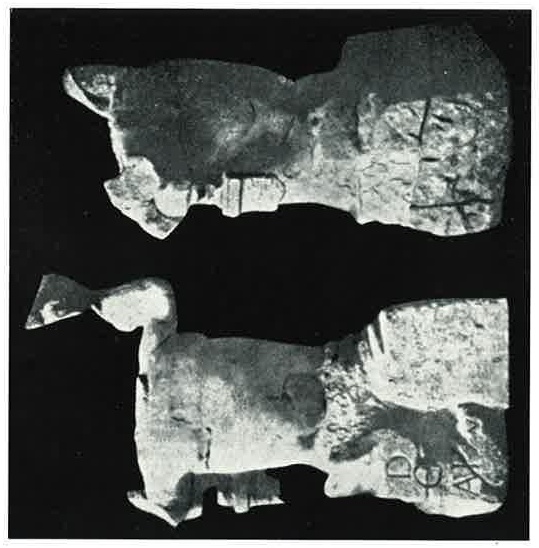
Sandstone statue from the entrance area of the Mithraeum at Königshoffen depicting the youthful naked Mithras emerging from the rock, with the sheath of a dagger still visible at his hip; head, right arm, and left hand are lost.
Sandstone lion from Brumath, ancient Brocomagus, with a votive inscription on its base recording a dedication by Tertius; a common Mithraic cult animal.
Evidence for a Mithraeum at Sentinum (modern Sassoferrato) in ancient Umbria, attested by a marble tauroctony group and three inscriptions, with a related mosaic found on the grounds of the Countess of Leuchtenberg and later given to King Louis of Bavaria…
A marble statue fragment found at Sentinum (modern Sassoferrato) in ancient Umbria, walled in the atrium of the Palazzo Raccamadoro-Ramelli, showing Mithras tauroctone with dog, serpent and scorpion, one foot pointing towards a torchbearer; the bull's head, tail and Mithras'…
A brief dedicatory inscription carved in the lower corner of the tauroctony relief from near Vicus Matrini on the Via Cassia in Etruria, recording L. Avillius Rufinus as dedicant.
A statue found along the Via Cassia about six kilometres from Rome, tentatively identified as an Aion entwined by a serpent but possibly representing Atargatis according to Vermaseren, now in the Museo Nazionale delle Terme.
A marble relief depicting Cautopates as a standing cross-legged torchbearer in Eastern attire with his burning torch pointing downwards, found in Rome near the Via Appia and now in the Museo Nazionale delle Terme, the head and much of the torch lost.
A white marble tauroctony statue found in 1925 at the ancient site of Lorium near the eleventh milestone on the Via Aurelia outside Rome, showing Mithras slaying the bull with dog, serpent and scorpion, accompanied by Cautes and Cautopates; now in the Palazzo Doria…
