Your search Villa of Domitian at the Castel Gandolfo gave 3663 results.

Altar from Mithraeum I at Carnuntum, Pannonia Superior, dedicated to Deo invicto by Iulius Pacatus ex voto, with Marcus Valerius serving as sacerdos for the second time — one of the few attestations of the Mithraic title sacerdos from Pannonia.
Inscription from Carnuntum, Pannonia Superior, recording the restoration of a collapsed Mithraic spelaeum by Caius, identified only by the first three letters of his name; whether dedicated to Deo invicto or Soli invicto is disputed.
Sandstone statue from Mithraeum I at Carnuntum, Pannonia Superior, depicting a lying lion with a bull's head before its forefeet; a large opening at the back of the head communicated with a channel below, suggesting use as a cult water outlet.
Sandstone haut-relief from Mithraeum I at Carnuntum, Pannonia Superior, depicting Cautopates cross-legged; head, feet, and left arm are lost; possibly belonging to the great tauroctony relief.
Marble votive altar from Stix-Neusiedl, Pannonia Superior, recording that Valerius and Valerianus restored a collapsed Mithraic temple at their own expense for the welfare of Emperor Lucius Septimius; red-painted lettering is preserved.
Fourth Mithraic sanctuary discovered at Ptuj, ancient Poetovio, at Zgornji Breg in 1937; the sanctuary (c.14 × 7 m) is oriented west–east with the standard corridor and bench division, an altar before the cult niche, and a water-basin in the pronaos.
Marble relief fragment from Mithraeum III at Ptuj, ancient Poetovio, preserving Cautopates with the torch pointing downward; head and feet are lost.
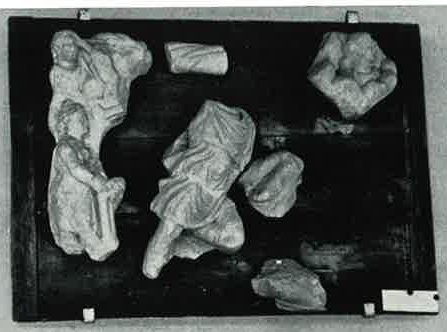
Marble tauroctony relief from Mithraeum III at Ptuj, ancient Poetovio, preserving Mithras killing the bull — head and most of the flying cloak lost — flanked by Cautopates holding the torch downward.
Damaged marble relief from Mithraeum III at Ptuj, ancient Poetovio, preserving Cautopates with torch downward on the right and the outline of a standing Cautes on the other side, with a fragmentary inscription in the lower border.
Corner of a marble altar from Mithraeum III at Ptuj, ancient Poetovio, dedicated to Deo Soli invicto Mithrae for the welfare of persons whose names begin Atti- and Saturni-; the rest, including the dedicant, is lost.
Inscription from Mithraeum III at Ptuj, ancient Poetovio, dedicated to Invicto Augusto sacrum by an imperial slave serving as hereditatum tabularius — an officer for death-duties — one of the rarer administrative titles attested in Mithraic epigraphy.
Three marble cornice fragments from Mithraeum III at Ptuj, ancient Poetovio, bearing an inscription recording that the monument was elevated in the manner of Sol, in honour of Cautes and Cautopates.
Marble relief fragment from Mithraeum II at Ptuj, ancient Poetovio, preserving the body of Cautopates; the upper head and both feet are lost.
Marble relief fragment from Mithraeum II at Ptuj, ancient Poetovio, preserving the upper part of Cautopates supporting his head with his left hand in a pensive attitude.
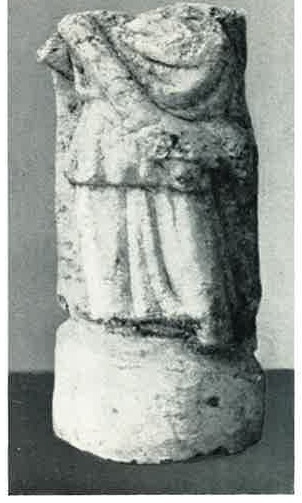
Marble statuette from Mithraeum II at Ptuj, ancient Poetovio, depicting Cautes raising the torch with both hands; head, right hand, and lower legs are lost.
Marble right hand holding a patera from Mithraeum II at Ptuj, ancient Poetovio — a fragment of a cult statue performing a libation.
Terracotta statuette from Mithraeum II at Ptuj, ancient Poetovio, depicting Mithras as bull-slayer with yellow-painted garments; the piece was not recovered during the author's visit and may be lost.
Fragment of a marble relief from Mithraeum II at Ptuj, ancient Poetovio, preserving a woman's head adorned with a wreath; probably a secondary deity from the sanctuary's sculptural programme.
Upper portion of a marble plate from Mithraeum II at Ptuj, ancient Poetovio, decorated with a central stem flanked by leaf motifs and a small twig — a purely decorative element from the sanctuary.
Marble plate fragment from Mithraeum II at Ptuj, ancient Poetovio, recording a dedication to Deo invicto Mithrae for the welfare of the Emperors and the restoration or construction of a templum.
