Your search Villa of Domitian at the Castel Gandolfo gave 3663 results.

The inscription on the decorated altar No. 839 from the Mithraeum at Vindobala (modern Rudchester), recording a gift to the Deity by L. Sentius Castus, a soldier of the Sixth Legion.
A brief inscribed fragment found in the ruins of the Temple of Isis at Aquileia, attesting to the veneration of Sol in proximity to the Isiac sanctuary.
An altar found at Milan (ancient Mediolanum), dedicated to the Invincible Mithras by Varia Severa, daughter of Quintus; because the dedicant is a woman, Cumont suggests it may alternatively be dedicated to the Dis Manibus.
Inscription of unknown provenance, recording a dedication by Aurelius Victor, veteran ex praetoriano(?).
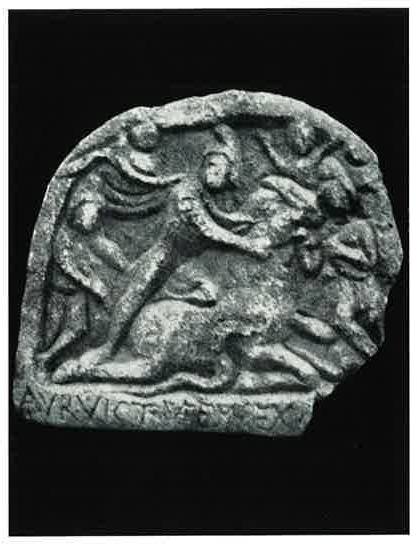
Arched white marble tauroctony relief of unknown provenance, depicting the standard bull-slaying in the usual attitude with dog and serpent.
Two limestone statue fragments from Mithraeum II at Aquincum, Pannonia Inferior, representing Mercury in a shoulder-pinned garment with wings in his hair; probably stood in room A on base y.

The Roman remains of Benifaió, or Benifayó in Spanish, are located on the outskirts of the city. Of particular interest is a rustic villa inhabited between the 1st and 4th centuries according to the numismatic and ceramic remains found.
Elusatium refers to the territory associated with the Elusates in Roman Aquitania.
The site of Slăveni preserves traces of military occupation associated with the frontier system of Dacia.
Ratiaria became one of the principal military and urban centres of the upper Danube frontier.
Praetorium Latobicorum occupied a strategic position along the communications routes of southeastern Pannonia.
Callatis developed as an important Black Sea port on the western coast of the Pontus Euxinus.
The island of Brattia, modern Brač, formed part of the Adriatic maritime landscape of Dalmatia.
Atrans stood near the important Alpine crossing routes linking Italy with the Danubian provinces.
Labici or Labicum or Lavicum was an ancient city of Latium, in what is now central Italy, lying in the territory of the modern Monte Compatri, about 20 km SE from Rome, on the northern slopes of the Alban Hills.
A head in a Phrygian cap, possibly belonging to a torchbearer statue, formerly kept at St. Wendel in Belgica but possibly transported to the Provinzialmuseum in Trier, where it may be identical with CIMRM 993.
Two small stone altars from Apt (ancient Apta Iulia) in Narbonensis, one bearing a carved upraised torch representing Cautes and the other a downturned torch representing Cautopates.
A fragment of a pebble relief showing Mithras as bullkiller, with the collar-wearing dog holding its head near the wound, found in the bed of a stream at Interanum (modern Entrains-sur-Nohain) in Lugdunensis.
