
White marble slab showing Mithras as a bull-killer on a rocky base, found in 1928 by the Comtesse de Robillant in a cellar of the Palazzo del Grillo behind the Forum of Augustus; Mithras' head, both arms, and the bull's head and tail are lost.
Marble relief with the dressed busts of Sol with five rays, a long-bearded man, and Luna with crescent, found in the camp of the equites singulares near the Scala Santa, now in the Museo Nazionale delle Terme.
Two marble fragments of the same stone, with worn lettering, set into the floor of the church above S. Clemente, bearing dedications to Sol Invictus Mithras and to Jupiter Dolichenus.
Well with a drainage pipe and two oblong brick-built tombs in the room to the left of the entrance of the Mithraeum of San Clemente, one tomb filled with refuse and a large number of animal bones, particularly swine.
Marble statuette representing a bearded person as the Good Shepherd, found in the Dominicum Clementis opposite the Mithraeum of San Clemente; it definitively represents S. Peter, not a Mithraic father of the mysteries.
Sculptural fragments of two torchbearers from the Mithraeum of San Clemente, Rome.
Marble cippus of which only two sides are preserved, with a brief dedication to Cautes on the front face, from the Mithraeum of San Clemente, Rome.
Group of Mithraic and other cult remains possibly originating from several neighbouring sanctuaries destroyed or abandoned in Late Antiquity.
Mithraic monuments associated with Ceionius Iulianus Kamenius and linked with the inscriptions discussed in entries 395A–B.
Mithraic material whose correct archaeological attribution belongs to Regio XII of ancient Rome.
Two painted decorative phases from the Santa Prisca Mithraeum whose figures became clearer after later conservation work.
Fragmentary relief from the area of the Porticus of Pompey once interpreted as Mithraic but later identified as a representation of Victoria.
Archaeological remains connected with the Praetorian camp and the presence of Mithraic worship among the imperial guard.
Marble cippus from the Quirinal residence of Ceionius Iulianus Kamenius preserving references to his Mithraic and other priestly functions.
Monumental inscription honouring the senator and Mithraic pater Kamenius together with his numerous priestly offices and initiatory roles.
Marble inscription discovered near the Via Cupa mentioning an offering to the invincible Mithras by Apollonius Tetes Syras of Marcianopolis.
Inscription now preserved in the Palazzo Ducale of Urbino whose wording may point to the existence of a Mithraic community.

A probable Mithraic sanctuary near Santa Maria in Domnica on the Caelian Hill, known from a group of dispersed reliefs formerly owned by Ottaviano Zeno.

In this relief of Mithras as bull slayer, recorded in 1562 in the collection of A. Magarozzi, Cautes and Cautopates have been replaced by trees still bearing the torches.
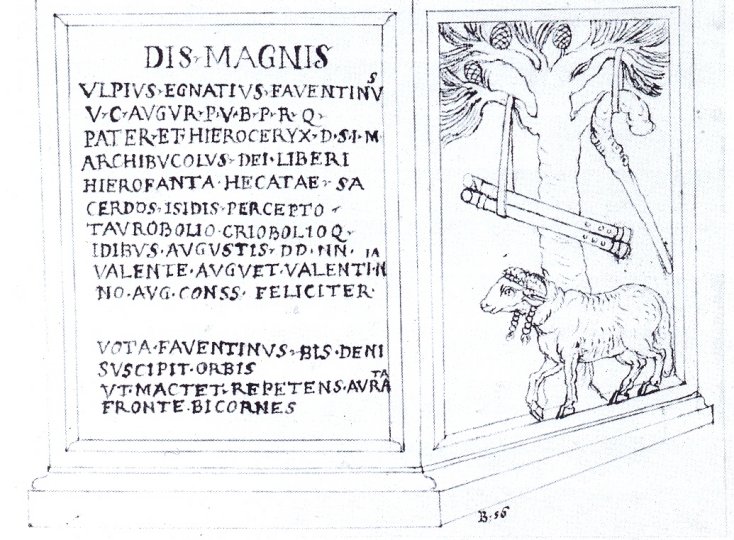
Both of them were discovered in 1609 in the foundations of the façade of the church of San Pietro, Rome.
