Your selection in monuments gave 384 results.
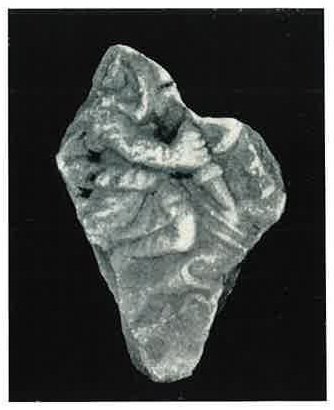
Marble tauroctony relief fragment from Mithraeum II at Ptuj, ancient Poetovio, preserving the central scene with the leaping dog, serpent, and scorpion; the bull's body is encircled by two girdles.
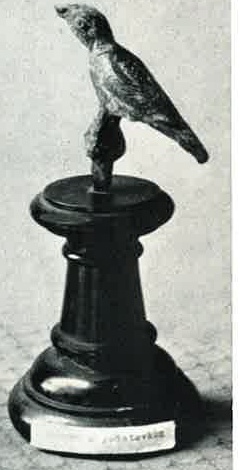
Small bronze raven perched on a dagger from Mithraeum I at Ptuj, ancient Poetovio — a Mithraic grade symbol representing the corax, the lowest of the seven Mithraic initiation grades.

Fragmentary marble altar from Ptuj, ancient Poetovio, dedicated to Deo Soli invicto Mithrae by a dedicant identified with the publicum portorium Illyricum; the name may be Iulius or Iulianus.
White marble base from Ptuj, ancient Poetovio, bearing a weathered inscription and the remnants of a downward-pointing torch, identifying the statue as Cautopates.
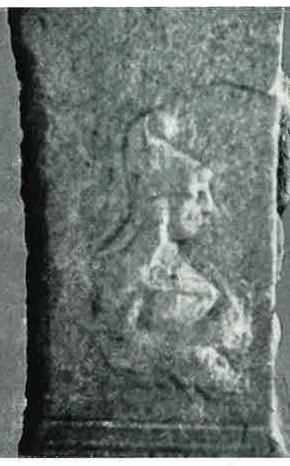
White marble altar from Mithraeum I at Ptuj, ancient Poetovio, decorated below the inscription with the dressed bust of Cautopates, a palm between two ram's heads above, and busts of Mithras on both lateral faces.
Duplicate inscription from Mithraeum I at Ptuj, ancient Poetovio, set up by Primitivos in memory of Hyacinthus; a companion piece to no. 1501, suggesting that the two inscriptions flanked the cult niche.
White marble base from Mithraeum I at Ptuj, ancient Poetovio, with an inscription and the preserved legs, garment, and torch of a Cautopates statue.
Inscription from Mithraeum I at Ptuj, ancient Poetovio, set up by Primitivos, contrascrip of the imperial procurator Caius Antonius Rufus, in memory of Hyacinthus — probably the founder of the sanctuary.
White marble base from Mithraeum I at Ptuj, ancient Poetovio, with an inscription and the preserved foot and lower garment of a Cautes statue.
Inscription from Mithraeum I at Ptuj, ancient Poetovio, dedicated to Cautes sacrum by Venulus, slave of Aponius Ingenuus.
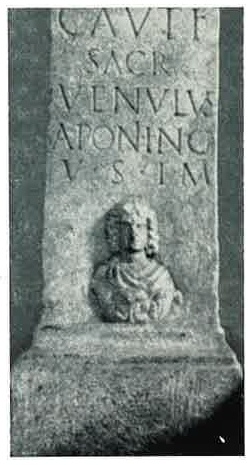
White marble votive altar from Mithraeum I at Ptuj, ancient Poetovio, distinguished by a dressed bust of Cautes emerging from foliage below the inscription — an unusual iconographic feature for an altar.
Altar from Mithraeum I at Ptuj, ancient Poetovio, dedicated to Deo invicto Mithrae by Optimus Vitalis, vicarius of Sabinus Veranus, vilicus of the publicum portorium.
Inscription from Mithraeum I at Ptuj, ancient Poetovio, dedicated to Petrae genetrici ex viso by Felix, vicarius of Prudens, slave of Antonius Rufus, vilicus of the publicum portorium Illyricum — one of several Mithraic dedications by this household.
White marble base from Mithraeum I at Ptuj, ancient Poetovio, bearing a dressed bust of Sol on the left lateral face and an inscription recording a dedication related to the Mithraic transit ritual.
Marble altar with akroteria from Mithraeum I at Ptuj, ancient Poetovio, dedicated to Invicto Mithrae by Festus, vicarius of Primus, vilicus of the publicum portorium.
Inscription from Sisak, ancient Siscia, dedicated to Iovi optimo maximo, Soli invicto, and the Genius loci by Aurelius Antiocianus; the Mithraic character is uncertain.
Inscription from the area of the castellum at Sisak, ancient Siscia, recording that Iucundus, imperial dispensator of Pannonia Superior, built a portico and an aparatorium for Deo invicto Mithrae ex voto.
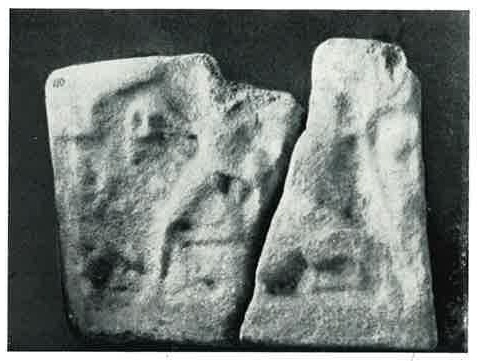
Weathered marble tauroctony relief in two fragments from Ruše, Noricum, depicting the bull-slaying with only the dog visible, flanked by two torchbearers both holding their torches upraised; no Sol or Luna.
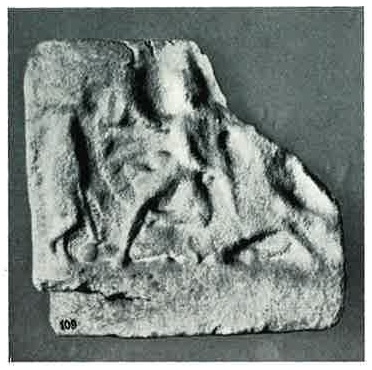
Marble tauroctony relief from Ruše, Noricum, showing a grotto scene in which Cautopates holds the torch downward against the rocky ground and supports his head with his left hand in a pensive attitude; the upper left corner preserves a bust of Sol.

Small marble tauroctony relief from Ruše, Noricum, badly weathered, depicting the bull-slaying in a grotto-like niche with cross-legged torchbearers on bases.
