Your selection in monuments gave 384 results.

Marble altar from Hrastnik near Trojane, ancient Atrans in Pannonia Superior, dedicated to Deo invicto Mithrae by Eutyches, contrascrip of the conductores portorii publici, slave of the Iulii, acting as vicarius of Benignus, vilicus of the statio Atrantiana…
Right portion of a sandstone altar from Topusko, Pannonia Superior, formerly used as a step in a bathing establishment, dedicated to Invicto Mithrae by Maximus with his companions.
Fragmentary inscription from Pregrade, Pannonia Superior, preserving only the end of a dedicant's name (-rentianus) and the closing formula.
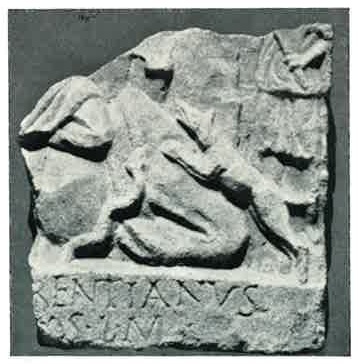
Right portion of a marble tauroctony relief from near Pregrade, Pannonia Superior, preserving Mithras killing the bull with dog, serpent, and scorpion; the greater part of the god and the bull's head are lost.
Inscription from Neviodunum, Pannonia Superior, with a head of Sol at its centre and a dedication to Iovi optimo maximo Soli invicto comiti Augusti; the Mithraic attribution is doubtful.
Inscription from Wieden, ancient Neviodunum in Pannonia Superior, dedicated to Invicto deo by Charito, of the Neviodunenses — possibly a slave or freedman of the community.
Small limestone altar from near Višnja Gora, Pannonia Superior, dedicated to Fonti perenni — the eternal spring — a dedication associated with the Mithraic water cult.
Altar from Trebnje, ancient Praetorium Latobicorum in Pannonia Superior, dedicated to Invicto Mithrae by Publius Aelius Respectus.
Large tauroctony plate with pediment from Vadas, Pannonia Inferior, formerly in the hunting lodge of the Jankovich estate, demolished in 1907; now lost.
Reference to a Cautopates statuette with inscription from Rácálmas near Intercisa, Pannonia Inferior, preserved at Székesfehérvár; the publication cited was inaccessible to the author.
Small altar bearing only the dedication Cautopati, from near Intercisa, Pannonia Inferior, found in the bed of the Danube.
Head in Phrygian cap from the bed of the Danube near the Isle of Szalk, Intercisa area, Pannonia Inferior; the face is lost — possibly a torchbearer or Attis.
Altar from Intercisa, Pannonia Inferior, dedicated to Soli invicto.
Altar fragment from Intercisa, Pannonia Inferior, dedicated to Deo invicto by Comitius.
Plate from Intercisa, Pannonia Inferior, bearing a Mithraic votive inscription; now lost.
Altar from Intercisa, Pannonia Inferior, dedicated to Deo invicto.
Altar from Intercisa, Pannonia Inferior, dedicated to Deo invicto.
Altar from Intercisa, Pannonia Inferior, bearing only the brief dedication Cauti.
Altar from Intercisa, Pannonia Inferior, found in the area of the castra.
Plate from Intercisa, Pannonia Inferior, with traces of red painting and an ivy-leaf in the middle line; bearing an inscription recording a Mithraic dedication.
