
Minor finds from Mithraeum I at Carnuntum, Pannonia Superior, comprising legionary brick stamps, burnt coal and wood, ash with ox, sheep, and goat bones, and fragments of serpent-vases; the coin evidence points to a terminus ante quem in the early third century…
Marble altar rim from Mithraeum I at Carnuntum, Pannonia Superior, preserving only the beginning of the dedicant's name: Caius Fron-.
Altar from Mithraeum I at Carnuntum, Pannonia Superior, dedicated to Deo invicto by Valerius Victorinus, optio of Legio X Gemina.
Altar from Mithraeum I at Carnuntum, Pannonia Superior, dedicated to Deo invicto by Iulius Pacatus ex voto, with Marcus Valerius serving as sacerdos for the second time — one of the few attestations of the Mithraic title sacerdos from Pannonia.
Inscription from Carnuntum, Pannonia Superior, recording the restoration of a collapsed Mithraic spelaeum by Caius, identified only by the first three letters of his name; whether dedicated to Deo invicto or Soli invicto is disputed.
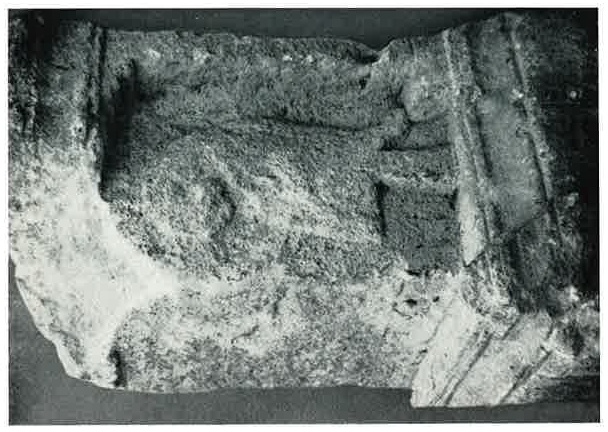
Sandstone altar from Mithraeum I at Carnuntum, Pannonia Superior, decorated on each lateral face with a Phrygian cap upon a dagger — a distinctive Mithraic iconographic pairing — and bearing an inscription on the front.
Large sandstone altar from Mithraeum I at Carnuntum, Pannonia Superior, with Cautopates cross-legged carved on the left side and Cautes walking on the right, both holding their torches with two hands; the front bears an inscription.
Cone-shaped sandstone stone encircled by a serpent from Mithraeum I at Carnuntum, Pannonia Superior, probably forming the base of a rock-birth group.
Sandstone statue from Mithraeum I at Carnuntum, Pannonia Superior, depicting a lying lion with a bull's head before its forefeet; a large opening at the back of the head communicated with a channel below, suggesting use as a cult water outlet.
Sandstone haut-relief from Mithraeum I at Carnuntum, Pannonia Superior, depicting Cautopates cross-legged; head, feet, and left arm are lost; possibly belonging to the great tauroctony relief.
Marble plate from Stix-Neusiedl, Pannonia Superior, dedicated to Deo invicto Mithrae by Vitalis and Silvanus; traces of red colour are preserved in the lettering.
Marble votive altar from Stix-Neusiedl, Pannonia Superior, recording that Valerius and Valerianus restored a collapsed Mithraic temple at their own expense for the welfare of Emperor Lucius Septimius; red-painted lettering is preserved.
Marble altar from Stix-Neusiedl, Pannonia Superior, dedicated to Invicto deo sacrum by Longinus Secundus, with a triangle in the right rim and red-painted lettering.
Fragmentary marble inscription from Stix-Neusiedl, Pannonia Superior, preserving only the end of a dedicant's name (-mus) and the abbreviated closing formula.
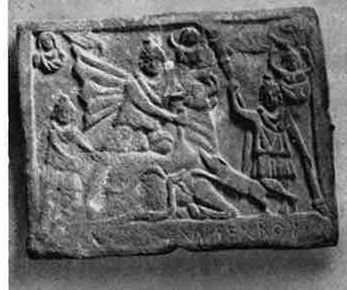
White marble tauroctony relief from Stix-Neusiedl, Pannonia Superior, depicting Mithras killing the bull with the raven perched on the rim of the god's flying cloak — an unusual detail placing the raven on the cloak rather than on the grotto border…
Fragment of a marble altar from Mithraeum IV at Ptuj, ancient Poetovio, preserving only the opening of a dedication to Deo invicto Mithrae.
Marble altar from Mithraeum IV at Ptuj, ancient Poetovio, dedicated to Deo invicto Mithrae by Aurelius Aurelianus.
Marble altar from Mithraeum IV at Ptuj, ancient Poetovio, dedicated to Deo invicto Mithrae by Titus Flavius Aper, decurio of the Colonia Poetovionis.
Fourth Mithraic sanctuary discovered at Ptuj, ancient Poetovio, at Zgornji Breg in 1937; the sanctuary (c.14 × 7 m) is oriented west–east with the standard corridor and bench division, an altar before the cult niche, and a water-basin in the pronaos.
Marble altar fragment from Mithraeum III at Ptuj, ancient Poetovio, dedicated to Deo invicto Mithrae by a dedicant whose name is partially preserved as -us Candidus.
