
Inscription from Virunum, Noricum, dedicated to Deo invicto Mithrae for the welfare of Antonius Severinus by Helvius Acceptinus ex voto.
White marble slab from the Zollfeld at Virunum, Noricum, dedicated to Deo invicto Mithrae by Diadumenus, arcar(ius) of the imperial dispensator Nicolaus for the kingdom of Noricum.
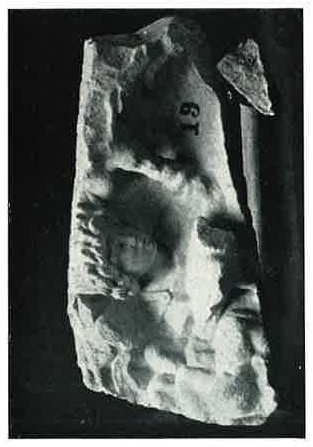
Three Italian marble fragments from the Zollfeld at Virunum, Noricum, forming a tauroctony relief; the iconography is well preserved and the use of imported Italian marble reflects the high status of the dedicants.
Small finds from the Mithraeum at Schachadorf, Noricum, comprising white stucco fragments, an iron dagger, a knife, and faunal remains of chicken, sheep, and pig.
Deposit of twenty-three coins from the Mithraeum at Schachadorf, Noricum, spanning from Claudius II to Valentinianus II and providing a terminus for the sanctuary's use.
Conglomerate statue from a layer of fire debris in the Mithraeum at Schachadorf, Noricum, depicting a naked Mithras without Phrygian cap being born from the rock with upraised hands; a coiling serpent is visible below.
Small rectangular Mithraic sanctuary (spelaeum 8.00 m long) found in 1935–36 in a gravel terrace at Schachadorf near Wartberg an der Krems, Noricum; the building is divided into a pronaos and an inner cult room, and shows traces of fire destruction.
Small bronze bust of Sol with five rays found at Strasbourg, ancient Argentoratum, during construction works in the 1860s–70s; associated with the Mithraic assemblage from the city.
Upper portion of a sandstone statue from Strasbourg, ancient Argentoratum, showing a head surmounted by a serpent's head; the fragment probably belonged to an Aion.
Sandstone relief fragment from the Mithraeum at Gimmeldingen preserving the upper bodies of two standing deities: a bearded male, possibly Vulcanus, and a helmeted Minerva with lance.
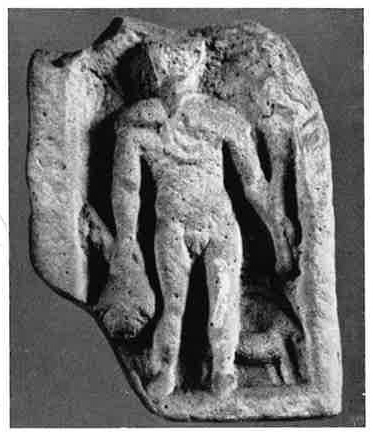
Sandstone relief from the Mithraeum at Gimmeldingen depicting a standing Mercury with caduceus and purse, accompanied by a ram and a cock; the head and upper caduceus are damaged.
Lower portion of a sandstone relief from the Mithraeum at Gimmeldingen, preserving a cross-legged torchbearer in a long cloak, probably Cautes.
Statue of Cautopates from Neuenheim, holding a downward torch with both hands, now in the Kurpfälzisches Museum at Heidelberg
Lance point, key, bronze lamp, and pottery and brick fragments from the Mithraeum at Neuenheim
Sandstone altar fragment from the Mithraeum at Neuenheim dedicated by Sentionius Tertinus
Altar from the Mithraeum at Neuenheim dedicated to Iovi optimo maximo by Candidius Quartus
Rocky base from the Mithraeum at Neuenheim probably originally supporting a representation of Mithras' rock-birth
Red sandstone base from the Mithraeum at Neuenheim with representations of deities on each of its four sides
Small red sandstone statuette of a lying lion from Wiesbaden, ancient Aquae Mattiacae, with snout and hindquarters broken off
Sandstone relief from Wiesbaden, ancient Aquae Mattiacae, found in a subterranean room in 1858, depicting Cautopates in Oriental dress holding a downward torch
