Biography
of Senilius Carantinus
- Senilius Carantinus, a free citizen, is attested as a member of a Mithraic community (syndexios) at the Mithraea of Heddernheim.
- Attested in the 2nd – 3rd century.
- Attested at Nida, Germania superior, Germania (TNMM 388).
TNMP 53
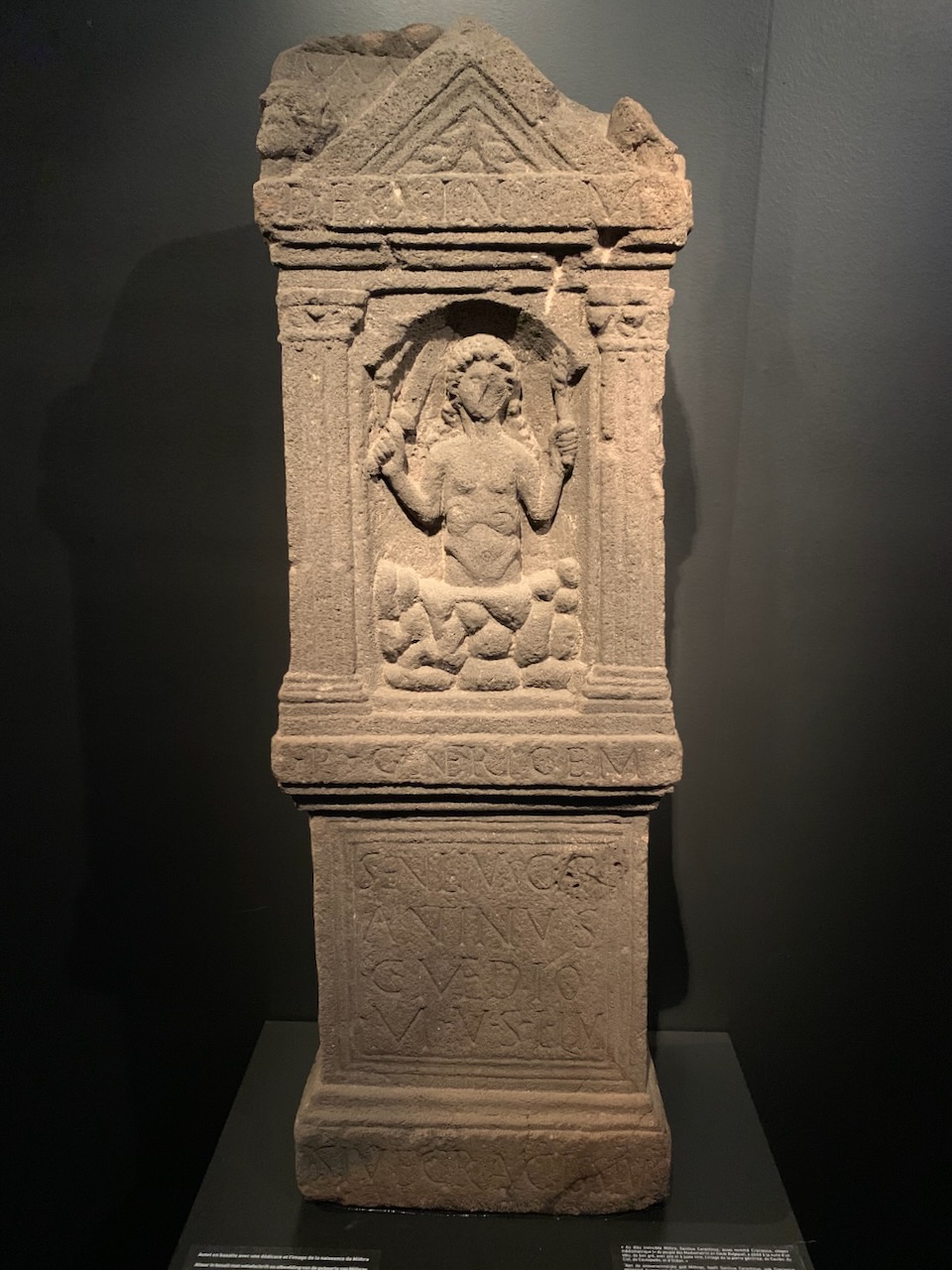
Senilius Carantinus, also named Cracissius, was a citizen (civis) of the Mediomatrici, whose principal town was Divodurum Mediomatricorum, modern Metz in Gallia Belgica. He is attested at Nida, Germania superior, by an elaborate basalt monument dedicated to Mithras (TNMM 388; CIMRM 1127; CIL XIII 7369; ILS 4197). The inscription identifies the dedicator as Senilius Carantinus, c(ivis) Medio(matricus) […] sive Cracissius.
The monument was found in the second Mithraeum at Nida-Heddernheim, a sanctuary established around 100 e. c. and apparently in use until the mid-3rd century. According to Clauss, Carantinus is the only member of this Mithraic community known by name. He describes his dedication as an unusually elaborate votive offering (Clauss 1992).
Both Carantinus and Cracissius are names of Celtic origin. His designation as civis Mediomatricus indicates an origin in, or civic affiliation with, the territory of the Mediomatrici in Gallia Belgica.
Schwertheim suggested that Carantinus may have been a merchant (Schwertheim 1974; Clauss 1992), although neither his occupation nor the reason for his presence at Nida is stated in the inscription. His status as a free citizen, however, is explicitly indicated by civis.
References
- Elmar Schwertheim (1974) Die Denkmäler orientalischer Gottheiten im römischen Deutschland.
- Manfred Clauss (1992) Cultores Mithrae. Die Anhängerschaft des Mithras-Kultes..
Attestations
Altar with Mithras rock-birth of Nida
TNMM 388
The Mithraic stele from Nida depicts the Mithras Petrogenesis and the gods Cautes, Cautopates, Heaven and Ocean.
V[otum] s[olvit] l[ibens] l[aetus] m[erito] / Sive Cracissiu[s]. // P[etram] genetricem.